

Published Aug 22, 2026 | 7:45 PM ⚊ Updated Aug 22, 2026 | 7:45 PM

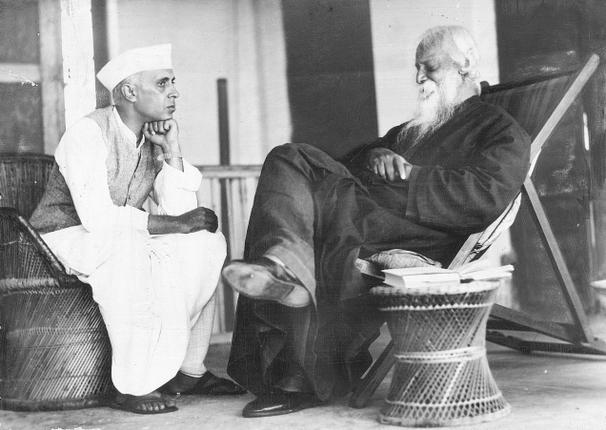
Jawaharlal Nehru with Rabindranath Tagore at Santiniketan in 1940. (Wikimedia Commons)

Synopsis: Did you know that Vande Mataram began life as a two-stanza song? And that the man who got the Congress to restrict the song to two stanzas had also popularised it?
The BJP wants the whole of the nation to sing the six-stanza version of Vande Mataram and has even called the Congress the “new Muslim League” for not obliging. Amit Shah, in fact, termed the decision an “act of treason” and the Congress Working Committee’s resolution in 1937 restricting the song to the first two stanzas the ‘original’ sin that set in motion Partition.
The decision taken by Subhas Chandra Bose, Jawaharlal Nehru and Rabindranath Tagore was not driven by anyone’s whimsy, but stemmed from deep consultations.
Bose was the Congress president then and, interestingly, initially believed that the song deserved to be sung in its entirety. Pandit Nehru too was of the same belief and found the song to be ‘harmless’.
Krishna Kripalani, a freedom fighter, wrote in the October 1937 issue of Visva-Bharati News (page 31) that he ‘openly disagreed’ with Nehru’s opinion and ‘supported the Muslim objections’. It was the outcry in these quarters that drove both Bose and Nehru into reflecting and seeking wiser counsel.
Nehru’s letter from Allahabad on October 20, 1937, shows how it was Bose who asked him to approach Rabindranath Tagore before the Working Committee meeting in Kolkata.
“My dear Subhas, Your letter of the 17th. Certainly, as suggested by you, I shall discuss the Bande Mataram song with Dr Tagore,” Nehru writes. “I do not know that any formal statement is necessary by the Working Committee but we should be clear in our own minds.”
He then goes on to add, “I have managed to get an English translation of Ananda Math and I am reading it at present to get the background of the song. It does seem that this background is likely to irritate the Muslims.”
But then comes the qualification.
“There is no doubt that the present outcry against Bande Mataram is to a large extent a manufactured one by the communalists. At the same time there does seem some substance in it and people who are communalistically inclined have been affected by it. Whatever we do cannot be to pander to communalists’ feelings but to meet real grievances where they exist,” Nehru stated in a letter that ended with the sign-off: Yours affectionately, Jawaharlal Nehru.
Tagore, incidentally, was the one who set Vande Mataram to music and sang it, in 1896, at the opening of the 12th session of the Indian National Congress, held in Kolkata. It was he who popularised the song.
On October 26, 1937, three days before the Congress began its session, Tagore replied to Nehru’s letter, “To me the spirit of tenderness and devotion expressed in its first portion, the emphasis it gave to beautiful and beneficent aspects of our motherland made special appeal so much so that I found no difficulty in dissociating it from the rest of the poem and from those portions of the book of which it is a part, with all sentiments of which, brought up as I was in the monotheistic ideals of my father, I could have no sympathy.”
As historian Sabyasachi Bhattacharya has recorded in Vande Mataram: The Biography of a Song, Tagore also conceded that “the whole of Bankim’s Vande Mataram poem, read together with its context, is liable to be interpreted in ways that might wound Moslem susceptibilities, but a national song, though derived from it, which has spontaneously come to consist only of the first two stanzas of the original poem, need not remind us every time of the whole of it, much less of the story with which it was accidentally associated.”
Tagore wrote separately to Bose, telling him that Muslim objections to the song were natural and understandable.
“The core of Vande Mataram is a hymn to goddess Durga: this is so plain that there can be no debate about it. Of course Bankim Chandra (Chatterjee) does show Durga to be inseparably united with Bengal in the end, but no Mussulman can be expected patriotically to worship the ten-handed deity. The novel Ananda Math is a work of literature, and so the song is appropriate in it. But Parliament is a place of union for all religious groups, and there the song cannot be appropriate,” Tagore wrote, as captured on page 487 of Selected Letters of Rabindranath Tagore compiled by Krishna Dutta and Andrew Robinson.
It was after Tagore shared these reservations that Nehru drafted a resolution to restrict the song to the first two stanzas.
Gandhiji’s reservations were not as categorical. But he did not want the song to trigger any disquiet.
“It had never occurred to me that it was a Hindu song or meant only for Hindus,” he wrote in the Harijan weekly in 1939 while stressing that he saw the song as an anti-imperialist cry. But the father of our nation conceded that “I would not risk a single quarrel over the singing of Vande Mataram at a mixed gathering.”
Interestingly, the song originally had only the first two stanzas.
Sabyasachi Bhattacharya notes in his book that the two-stanza song, written somewhere between 1872 and 1875, was forgotten till a young editorial assistant working with Bankim Chandra’s own literary journal Bangadarshan, suggested using it as a filler while an issue was heading to the press. Bankim held the assistant back with words a nephew recorded: “You cannot possibly guess now if this is good or bad. Time will tell – I shall be dead by then.”
The poem’s six-stanza version came into being later when Anand Math was published serially between 1881 and 1882. According to many experts, the four stanzas have a different tone and tenor, as they were written for the novel that reinterpreted the Sanyasi-Fakir rebellions against the British East India Company and painted the Muslims as villains, instead of comrades-in-arms.
The novelist’s great-grandson Sajal Chattopadhyay, despite joining the BJP, had, towards the end of last year, expressed the desire that the politicisation of Vande Mataram must end.
“Bankim Chandra is being used politically. We want no politicisation. Keep Bankim Chandra and his iconic Vande Mataram out of politics,” he was quoted as saying.
But 2026 has seen the enactment of the Prevention of Insults to National Honour (Amendment) Act that has made stopping the rendition of the full Vande Mataram a punishable offence. And now we are having the BJP-Congress row over how much of the song must be sung. If the “Chronology (of the song) samajhiye aap” advice is followed in earnest, this can be avoided.
Also Read:
Vande Mataram-150: Mother of Bharat or Mother of Hindu Rashtra?
(Edited by R Rajesh Kumar.)



