

Published Nov 06, 2026 | 2:18 PM ⚊ Updated Nov 06, 2026 | 2:26 PM

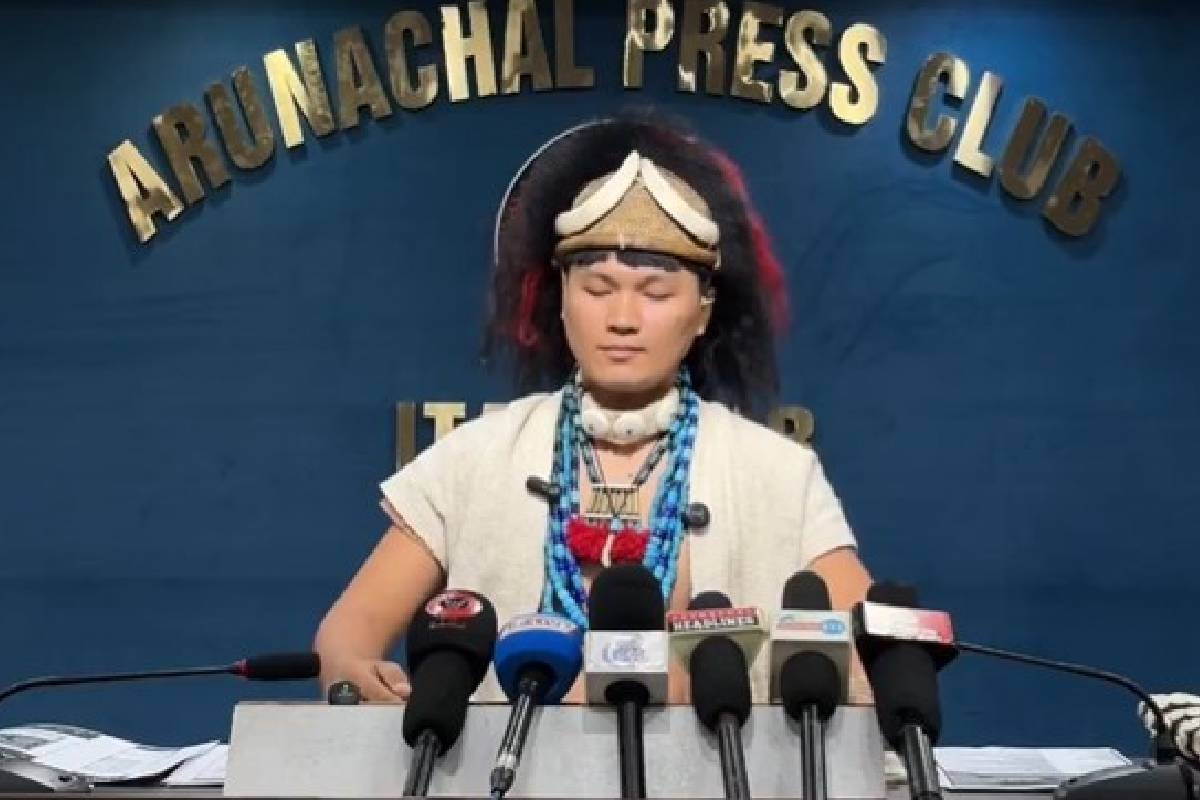
Katon Moyong

Donning the traditional attire of the Adi community, tribal activist and engineer Katon Moyong addressed the media on November 5 and issued a strong warning to the BJP-led governments at the Centre and state, over alleged attempts to stifle the ongoing protests in Arunachal Pradesh against the proposed Siang Upper Multipurpose Project (SUMP).
Moyong, also known as Abor Man, has emerged as the face of Arunachal’s youth-led movement against the proposed dam project over the Siang river, which allegedly threatens the lives and livelihoods of several tribal groups, including the Adi community, which considers the river sacred.
Addressing the presser on Thursday, Moyong said, “We have no issue if you build dams on small rivers, but not on the Siang. Either you exterminate the entire Adi community to build the Siang dam, or else there will be no Siang dam.”
He also stated that the time for discussions on the project has ended, expressing rage over repeated attempts by the government to convince the people to agree to the proposed dam.
Addressing Arunachal Chief Minister Pema Khandu, Moyong said, “Pema Khandu, it’s been 47 years that the Adi people have been opposing and rejecting the Siang dam. Aren’t these three words – ‘No Siang Dam’ – getting into your ears?”
Moyong was among several people who were detained by the Delhi Police during a protest in front of the Arunachal Bhavan earlier this week. He is a member of the youth wing of the Siang Indigenous Farmers Forum (SIFF), one of the organisations leading the protest in Arunachal Pradesh.
On October 23, a 12-hour bandh called by the SIFF and other organisations, including Adi Baane Kebang United and the Adi Galo Welfare Society, resulted in arson and violence, prompting police action against over 26 protesters. A police station was set on fire, and the houses of two local MLAs and the BJP State president were vandalised by angry mobs. The office of the National Hydroelectric Power Corporation (NHPC) was also torched. Several protesters were detained by the police under the draconian Arunachal Pradesh Unlawful Activities (Prevention) Act, 2014 (APUAPA).
However, the protesters have accused the police of instigating the violence after the bandh was over. According to a Frontline report, a young protester alleged that the police threw something at a group of 40-50 people, including him, which burst loudly, triggering chaos and violence.
Also Read: Carrying the library within: Kolkata’s bold stand against book vandalism
The Siang Upper Multipurpose Project (SUMPS) is a proposed massive hydropower dam on the Siang river in the Upper Siang and Siang districts. It is slated to be India’s largest hydropower project with an estimated capacity of 11,200 megawatts (MW). The capacity of India’s current largest hydropower project, Tehri Dam in Uttarakhand, is 2,400 MW.
The dam was proposed by the United Progressive Alliance government in 2008-09 as a venture for power generation and flood control. After 2010, the project gained momentum and developed into the proposed massive hydropower dam.
In the initial years of the first BJP-led government under Prime Minister Narendra Modi, the project entered the technical preparation phase, and pre-feasibility reports were prepared by the National Hydroelectric Power Corporation Limited (NHPC). Dissent was brewing against the project, which, by the end of 2017, developed into peaceful protests by the indigenous communities, ultimately forcing the project to be halted.
In 2020, the BJP government decided to revive the project, claiming “national security” reasons after reports emerged regarding China’s plan to construct a mega dam over the upper reaches of the Siang river (Yarlung Tsangpo), which originates in Tibet. The Chinese dam’s estimated capacity is 60,000 MW. The government argued that if China releases water from its massive dam, it could act like a “water bomb” and claimed that the SUMPS could minimise its impact. However, environmentalists warn that the proposed dam wouldn’t be able to contain the impact of such an attack, as its estimated capacity is much lower than that of the Chinese dam.
The Siang river enters Arunachal Pradesh through four districts and goes on to form the Brahmaputra in Assam. For the tribal communities in Arunachal, including the Adi, Galo, Nyishi, Apatani, and Idu Mishmi, Siang is a sacred lifeline and has remained intertwined with their identity, culture, religion and livelihood for centuries.
The Adi community describes the river as “Ane Siang,” which means Mother Siang.
“Our whole lives revolve around this river. And also, our cultural heritage. I can trace my forefathers’ names back 37 generations, and I know where each of them lived. Our migration through generations was dictated by the Siang river,” Katon Moyong was quoted as saying by The Print.
According to a Frontline report citing independent fact-finding reports, the proposed dam over the river will not only erase the cultural identity of the tribes but also submerge almost 20 villages in Upper Siang district and seven villages in Siang district, while another 52 villages will be affected indirectly. An estimated 1.5 lakh people will be displaced due to the project, with the Adi community being the most affected as they are concentrated in the Siang Valley.
“Our farming lands, our terrace fields, even our religious sites, will go under water. This is the disintegration of our entire culture, traditional knowledge system, and relation with the land,” an Adi community member was quoted as saying in the report.
In his address to the media, Moyong, who is reportedly the first environmental engineer from the Adi community, stressed that his people were not against development and would allow the construction of smaller dams but not one that would threaten their existence.
He also slammed repeated attempts spanning decades and different governments to build a dam over the Siang River.
“The narratives on the Siang dam have changed over 47 years. In 1979, it was called ‘flood mitigation’; in 2008, under the Manmohan Singh government, it was called ‘national interest’; in 2017, the NITI Aayog put a new narrative tag of ‘national project’; and the Pema Khandu government has come up with the trick of a new narrative called ‘national security’,” Moyong said.
“Since all the options are gone and the government has failed to convince the Adi people to build a dam on the Siang, the Pema Khandu government has come up with a false narrative called national security and water bomb,” he said.
Stressing that the protests would continue, Moyong called for unity among the tribal communities in opposing the project and urged them not to fall for the government’s “divide-and-rule trap.”
(Compiled by Fayisa CA)



