

Published Aug 06, 2026 | 7:52 PM ⚊ Updated Aug 06, 2026 | 7:52 PM

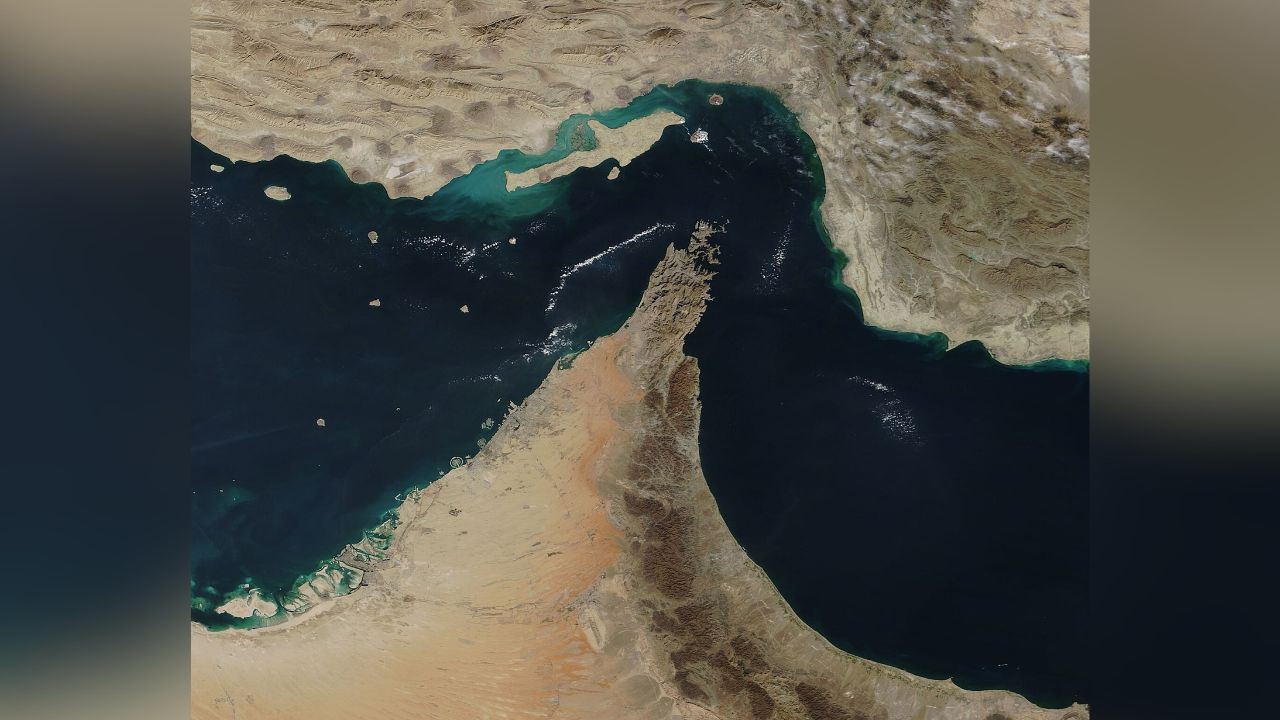
A satellite image of Strait of Hormuz.

Synopsis: The Union Government has informed the Parliament that as many as 10 seafarers and six other Indians were killed during the Iran war. The Minister of External Affairs, while responding to questions raised by CPI(M) MP John Brittas, also acknowledged that out of the total 16, only five families have been granted compensation while maintaining silence on what diplomatic action has been taken against the attacks.
The BJP-led Centre recently informed the Parliament that as many as 16 Indians, including 10 seafarers, have been killed during the ongoing US-Israel war on Iran, in attacks near the Strait of Hormuz. The government also acknowledged that out of the 16 people, the families of only 5 persons have so far received compensation for their tragic deaths.
The remarks were made by Minister of State for External Affairs Kirti Vardhan Singh in response to a query from CPI(M) MP John Brittas in the Rajya Sabha.
Among the questions Brittas posed to the ministry were: the number of Indians killed in the conflict and those stranded or evacuated from affected regions, details regarding compensation granted to the kin of the deceased and the diplomatic steps taken by the government in the aftermath of the events.
Also Read: Government to shift Parliament to ‘work from home’ on Insta
In its reply to the Rajya Sabha, the government said, “since the outbreak of the conflict in the Middle East in 2026, 16 Indian nationals including 10 seafarers have lost their lives in the Middle East (one in Saudi Arabia; two in Kuwait; eight in Oman; one in Iraq; and four in UAE), and 75 Indians have been injured (32 in UAE; 24 in Oman; four in Qatar; 13 in Kuwait; one in Saudi Arabia; and one in Israel)” adding that another 12 people have lost their lives in a separate gas leak incident in Qatar, which was not connected to the conflict.
The government also highlighted the assistance provided to the families of the deceased, including coordinating with the host governments for the early repatriation of the mortal remains to India.
“The injured Indian nationals received medical treatment in local hospitals. Indian embassies and consulates coordinated with the local authorities and the hospitals for regular updates on the health condition and extended all required assistance, viz, establishing contact with the family members, guidance on available travel options and their safe return to India, etc,” the MEA said in its reply.
Elaborating on the compensations issued to the kin of the deceased, the minister said, “In all cases involving war-zone incidents, under the DGMA Welfare Scheme (Seafarers’ Welfare Fund Society – SWFS), an ex-gratia compensation of ₹10 lakh is provided. Following due diligence and verification, the amount is disbursed by the government expeditiously to the next of kin of the affected seafarers.”
“Seafarers covered under the Collective Bargaining Agreements signed with their respective unions are also eligible for additional war-zone compensation, by the Maritime Union of India – for officers ( ₹12 lakh), or National Union of Seafarers of India – for crew ( ₹10 lakh),” he added.
The minister also stated that out of the total 16 people killed in the conflict, only 5 families have received the compensation so far.
However, the government response did not mention any concrete diplomatic efforts taken in the aftermath of the violence, further reinforcing suspicions raised by the Opposition.
Also Read: GenZ has obvious contempt for BJP and PM Modi; borrowing their lingo alone won’t change it
Sharing the MEA minister’s response in a post on X, CPI(M)’s John Brittas pointed out that the government failed to address the question regarding diplomatic action or demands for accountability regarding the attacks that killed the Indians, especially the US strikes on vessels carrying Indian seafarers.
The government’s “reply to Parliament is silent on the most fundamental question: What diplomatic action did India take to uphold the dignity of its citizens? No mention of a demarche. No demand for accountability. The dignity of Indian citizens demands that every such death or injury be matched by visible diplomatic resolve. The Government’s reply tells Parliament nothing about whether such action was taken,” Brittas said.
The MP was echoing a criticism that has been raised against the central government repeatedly by various opposition parties and even led to protests within the Parliament.
On June 17, 2026, Prime Minister Narendra Modi held a much-anticipated talk with US President Donald Trump on the sidelines of the G7 summit in France. The talks were held days after the US military’s continuous attacks on vessels carrying Indian seafarers had killed three people, triggering massive criticism from the Opposition along with intense pressure to take the matter up with the US leadership.
However, Modi refused to raise the issue during his talks with Trump, while making a passive mention of the matter during his address at the G7 summit, in the presence of Trump.
Without making any direct reference to US attacks, Modi said, “Several Indian civilians have also lost their lives. The safety of seafarers, who connect nations through global maritime trade, is our responsibility. We must ensure that sea routes remain secure and that seafarers can carry out their work without fear.”
A more direct and clear statement was made by External Affairs Minister S Jaishankar, days before the Modi-Trump meet.
On June 12, Jaishankar spoke to US Secretary of State Marco Rubio and registered a strong protest against the attacks on Indian seafarers.
“Spoke to US Secretary of State Marco Rubio this evening. I reiterated India’s strong protest at the attacks by the US Navy in the Gulf that killed three Indian mariners. Such lethal actions against commercial shipping are not justified,” he wrote in a post on X.
However, the reaction from the US could be read as embarrassing for a powerful country like India.
Acknowledging the conversation with Jaishankar, Rubio issued a statement in which he explicitly stated that US forces “will continue to take all necessary measures to enforce maritime security and counter hostile threats in the region,” while also stressing that “American interests and the safety of international shipping demand decisive action against those who endanger stability,” an indication of similar attacks in the future.
Equally embarrassing were the MEA’s attempts to repeatedly highlight that the vessels which were attacked and resulted in the deaths of Indians were foreign-flagged, a suggestion that the government had limited control and thus accountability.
The only concrete diplomatic action that has happened is the repeated summoning of the U.S. chargé d’affaires by MEA officials to register protests regarding the attacks.
(Compiled by Fayisa CA)



