

Published Apr 23, 2026 | 7:00 AM ⚊ Updated Apr 23, 2026 | 7:00 AM

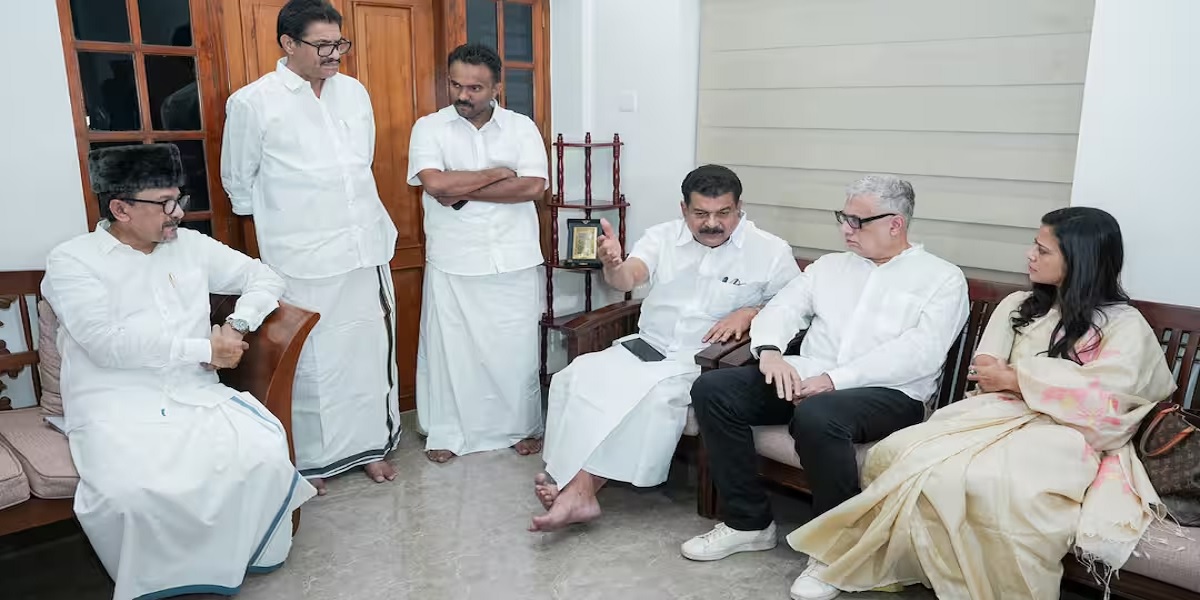
TMC MPs Mahua Moitra and Derek O'Brien, accompanied by P.V Anvar, met Sadiq Ali Shihab Thangal in Malappuram. (File photo)

Former Kerala MLA PV Anvar’s exit from the All India Trinamool Congress (TMC) was less a rupture and more a delayed formality. For both the state unit in Kerala and the party’s national leadership, the writing had been on the wall for months.
By the time Anvar announced his exit — in his unique style, through the media rather than party channels — the TMC had already moved on, quietly but decisively. The party leadership underscored this by pointing to Anvar’s shifting political trajectory and his decision to float a new outfit.
If anything, the “exit” only formalised what had long been an uneasy, transactional relationship.
Also Read: TMC’s ‘Mission Impossible’ in Kerala with PV Anvar as its lead
At the heart of the fallout lies a rather unflattering “report card” on Anvar, prepared not by the Kerala unit but by the party’s own research wing and placed before its Chairperson, Mamata Banerjee. Contrary to popular political optics, Anvar had never even met Mamata — though she reportedly knew enough.
The assessment, far from encouraging, flagged his shifting loyalties, tendency to make public statements without consulting the party and an overall unpredictability that does not sit well with a centrally calibrated outfit like the TMC.
In short, not quite the team player.
Yet, Anvar’s entry into the party was not without backing. TMC General Secretary Abhishek Banerjee is said to have had his own calculations — Kerala, after all, remains a tempting but tricky frontier. For the state leadership, Anvar was useful — a loud voice, a visible face and someone who could momentarily expand the party’s reach beyond its traditional vacuum in Kerala.
This wasn’t the first such experiment.
In the 2016 Assembly elections, the TMC fielded five candidates, each reportedly backed with ₹25 lakh from the national leadership. Victory was never the immediate goal; visibility was. Votes were indeed chipped away in pockets, even if seats remained elusive.
But by the next election cycle, Anvar found himself without funds, without a symbol and perhaps without patience. The party maintains he failed to follow procedures; TMC insiders say the enthusiasm had worn thin on both sides.
Also Read: Non-veg Vishu ads spark cultural fault lines in Kerala
Anvar’s political instincts, however, remain sharp or at least bold. His early groundwork in the Beypore constituency, a traditional Left stronghold, signals calculated risk-taking.
Internal assessments within the TMC reportedly suggested a dip in the winnability of Minister PA Mohammed Riyas due to anti-incumbency, making Beypore an attractive battleground.
Anvar, true to form, invested heavily out of pocket.
Ironically, he credits Congress and Muslim League workers — not TMC cadres for campaign support. The state leadership, meanwhile, rejects any claim of neglect from the national leadership, pointing to high-profile visits by leaders like Mahua Moitra and Derek O’Brien, as well as pre-entry studies conducted by I-PAC.
Still, beneath the surface, friction was constant.
Ego clashes between Anvar and local TMC leaders were less an exception and more a routine feature. In fact, some senior leaders privately admit they had anticipated his exit within a year and chose silence over confrontation when he was inducted.
His final act followed the same script: A unilateral announcement, bypassing party mechanisms. But even his critics concede one point: Anvar brought visibility to the TMC in Kerala, something the party has long struggled to achieve.
There is also a more pragmatic layer to his exit.
Within the TMC, ministerial prospects in Kerala are virtually non-existent, given its lack of alliance with the Congress-led UDF. Outside, if he wins Beypore, Anvar gains bargaining power. In that sense, the exit appears less impulsive and more strategic.
For all his inconsistencies, Anvar remains a political disruptor.
As one of the earliest voices to openly challenge Chief Minister Pinarayi Vijayan — coining terms like “Pinarayism” — he has managed to stay relevant in public discourse. His willingness to take risks perhaps stems from his background as a businessman with gold mining interests in Africa, where uncertainty is part of the terrain.
However, politics is less forgiving than business.
If his Beypore gamble fails, the same volatility that keeps him in headlines could just as quickly push him out of Kerala’s political landscape.
(Edited by Muhammed Fazil.)



