

Published Nov 16, 2026 | 1:14 PM ⚊ Updated Nov 16, 2026 | 1:16 PM

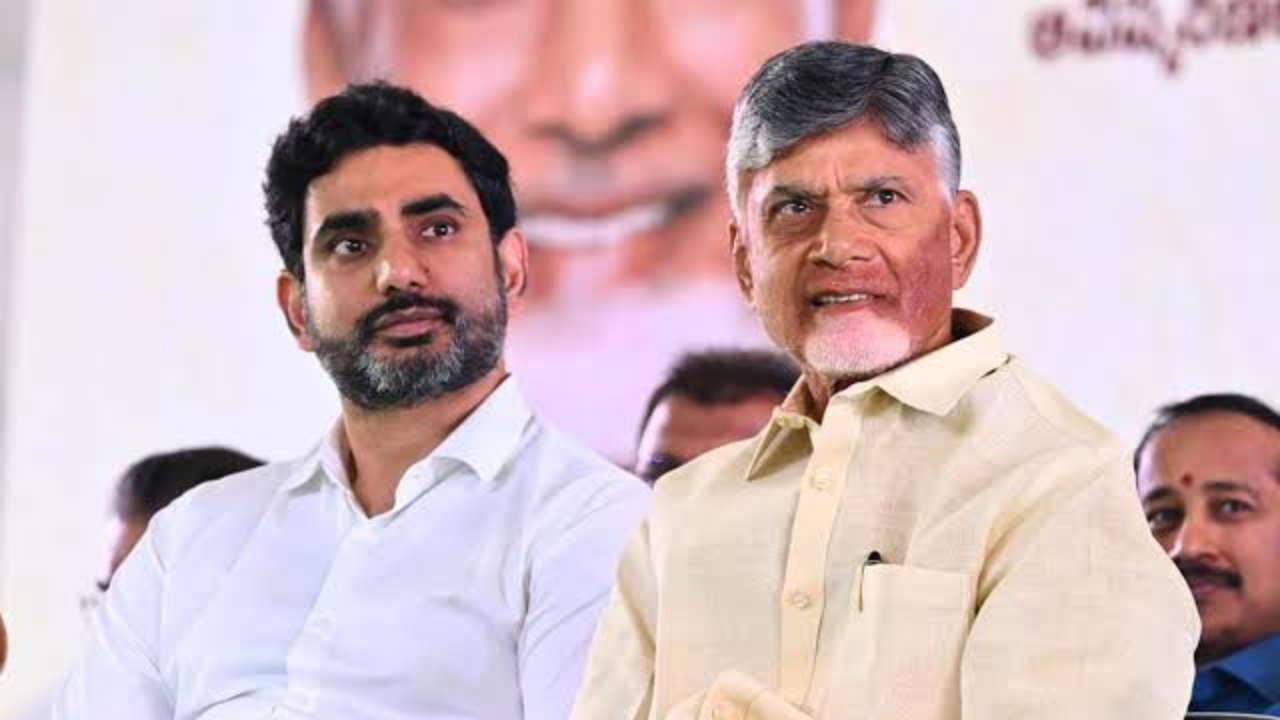
Chief Minister N Chandrababu Naidu with son and IT Minister Nara Lokesh. Credit: x.com/naralokesh

Hyperloop… Bullet train… Quantum computer… Wireless electricity… Sunlight at night… Hosting the Olympic Games… A world-class capital… Investments worth lakhs of crores…
Whenever Andhra Pradesh Chief Minister and TDP chief Chandrababu Naidu has come to power, there has been no dearth of big, beautiful ideas.
But while some projects have materialised, others remain in the approval and study stages, and several others are still mere proposals.
The Chandrababu government’s 2017 Hyperloop proposal sparked nationwide interest at the time.
The AP Economic Development Board signed a Memorandum of Understanding (MoU) with US-based Hyperloop Transportation Technologies (HTT). The system was proposed to cover the approximately 35-kilometre distance from Vijayawada to Amaravati in just five minutes.
The plan was to build it under the PPP model using private investments. However, by 2020, reports emerged that the project was no longer among the government’s priorities.
Globally, too, no commercial Hyperloop system had become operational by then. In 2020, the Andhra Pradesh Transport Department announced that no Hyperloop proposal was under the state government’s consideration.
During his visit to China in 2016, Chandrababu travelled on a bullet train and mooted the idea of connecting Amaravati, his new capital, with major cities in the country via high-speed rail. In 2025, he again announced that he had ordered a survey for a bullet train route connecting Hyderabad, Amaravati, Chennai and Bengaluru.
It was estimated that this would enable travel from Hyderabad to Amaravati in 70 minutes and from Amaravati to Chennai in 112 minutes. The project is currently at the survey stage and is awaiting approval from the central government.
Since 2025, Naidu has also announced plans to introduce drone taxis and drone ambulances over the next two years to reduce urban traffic congestion and provide emergency medical services, alongside a dedicated drone traffic controller system.
The contrast is striking: even as bullet trains and drone taxis are being proposed, metro rail projects for major AP cities such as Vijayawada and Visakhapatnam remain in limbo and have not moved beyond the proposal stage.
In 2015, the construction of an approximately 180-kilometre Outer Ring Road (ORR) around Amaravati was proposed at an estimated cost of ₹20,000 crore.
After returning to power in 2024, the government renewed its focus on the proposal.
In 2025, the Centre issued a gazette notification for the land acquisition process for an approximately 189.9-kilometre, six-lane greenfield road. The project is currently in the tendering and bidding stage, overseen by the National Highways Authority of India (NHAI).
Quantum computer and a technological revolution in Amaravati
Developing Amaravati into a world-class quantum technology hub is another goal announced by the Chandrababu government.
Partnerships were initiated with institutions and companies such as IBM, IIT Madras and TCS.
In April 2026, a quantum computing testing facility was inaugurated in Amaravati, along with a Quantum Reference Facility at SRM University.
This marks a step forward in establishing infrastructure in the quantum computing sector. However, enabling international-level research and commercial applications requires further investment and technical experts. Following the April 2026 launch of the testing facility in Amaravati and the reference facility at SRM University, the government aims to provide full-scale services by January 2027.
Chandrababu Naidu’s remarks at the CII Partnership Summit held in Visakhapatnam in November 2026 became a major talking point.
The Chief Minister suggested exploring technology that provides sunlight from space to specific areas on Earth even during the night.
US-based firm Reflect Orbital is developing experimental technology to redirect sunlight onto Earth by fitting large mirrors on satellites. It also announced a partnership with Indian firm Skyroot Aerospace for satellite launches.
However, this remains in the experimental stage.
On the same occasion, discussions were also held on the viability of space-based solar power technology, which collects solar energy in space and transmits it to Earth via microwave or laser beams. The idea of transmitting electricity without wires is also part of this concept. However, a commercial system to supply electricity directly from space to every household is currently unavailable.
During the foundation stone-laying ceremony for an international sports complex in Amaravati in 2018, Chandrababu brought up the topic of hosting the Olympics.
He called upon the central government to bid for hosting the Olympics in India and suggested exploring the possibility of hosting the event in Amaravati in the future.
Following the bifurcation of united Andhra Pradesh in 2014, Chandrababu took up the construction of the new capital in Amaravati as a prestige project.
He signed agreements with the Singapore government to prepare master plans, aiming to develop Amaravati with world-class infrastructure and smart city facilities. However, after the change of government in 2019, priorities for the capital project shifted, and the startup area development agreement with the Singapore consortium was cancelled.
After returning to power in 2024, construction of Amaravati resumed.
Chandrababu Naidu’s tenure has seen the announcements of investments worth lakhs of crores of rupees and promises of lakhs of new jobs.
Between 2016 and 2018, investment proposals worth ₹12.32 lakh crore and employment opportunities for 22.81 lakh people across 1,182 projects were announced.
In December 2019, the then Industries Minister informed the Assembly that only 309 of the previously announced projects had commenced production, bringing in actual investments of ₹1.39 lakh crore and creating 1.54 lakh jobs.
According to a white paper released by the then government on 327 MoUs signed between 2016 and 2018, 45 projects had commenced operations, while 92 were under implementation. Another 190 projects were noted as stalled or delayed.
After 2024, a fresh wave of massive investment announcements began.
The foundation stone for Asia’s largest Google AI Data Centre cluster, with a capacity of 1 gigawatt (GW), was laid near Visakhapatnam in April 2026, while Reliance Industries also came forward to set up a 1 GW data centre.
At the 2026 CII Summit, agreements worth ₹29,500 crore were signed with ReNew for two projects, alongside a proposal for a ₹4,000-crore Indo-Korean battery manufacturing unit in Naidupeta.
However, doubts persist regarding the actual extent of employment generation and the ground-level development these investments will bring about.
The comprehensive development plan announced in 2014 included goals to develop 14 major and minor seaports, three international airports, 14 domestic airports, three mega cities and 11 smart cities across the state.
A proposal to develop a national waterway from Kakinada to Puducherry also surfaced.
Currently, the state operates six commercial seaports, while four more greenfield ports are under construction. The state also has three international airports, with Bhogapuram’s Alluri Sitarama Raju International Airport inaugurated this year.
As part of river interlinking, the government put forward a proposal to divert Godavari waters from Polavaram to Banakacherla.
Designed at an estimated cost of ₹81,900 crore, the project aims to provide irrigation water to drought-prone regions.
However, it faces multiple challenges, including scrutiny by the Central Water Commission (CWC), objections from other states, water availability, environmental clearances and the mobilisation of massive financial resources.
Meanwhile, the construction of the Polavaram project itself faces technical hurdles. Due to issues related to rehabilitation and compensation, water storage at full capacity has not been achieved, and the project height has been restricted to 41.15 metres from the original 45.72 metres.
Not all proposals announced by Chandrababu Naidu can be viewed through the same critical lens.
Projects such as the Hyperloop lack commercial validation worldwide. The bullet train depends on decisions by the central government. Even as metro rail projects for Vijayawada and Visakhapatnam — promised under the Bifurcation Act — have failed to move forward, bullet train proposals have been brought to the forefront.
Quantum computing is an active field of research, and steps have been taken to build infrastructure for it in Amaravati. Concepts such as sunlight from space and wireless power transmission remain experimental research areas. Projects such as the Amaravati Outer Ring Road and capital construction are progressing through administrative and construction stages.
A Chief Minister’s ideas may have no boundaries, but projects undertaken with public money are bound by financial, technical and timeline constraints. Questions such as where the funds will come from, whether agreements have been finalised, whether clearances have been obtained, whether work has begun and when the public will benefit must be answered.
And these answers will be demanded amid the high-pitched publicity, dazzling statistics and development campaigns.
The true measure of an action-oriented government will be how many agreements move beyond paper, how many projects reach completion and whether their benefits reach the people.
Also Read:
Beyond the Rs 10 lakh crore headline: the PR playbook behind Vizag Partnership Summit
If YSRCP didn’t get ya, TDP will: Andhra Pradesh’s brand image under siege from both sides
(Edited by R Rajesh Kumar.)



