

Published Aug 14, 2026 | 3:47 PM ⚊ Updated Aug 14, 2026 | 3:47 PM

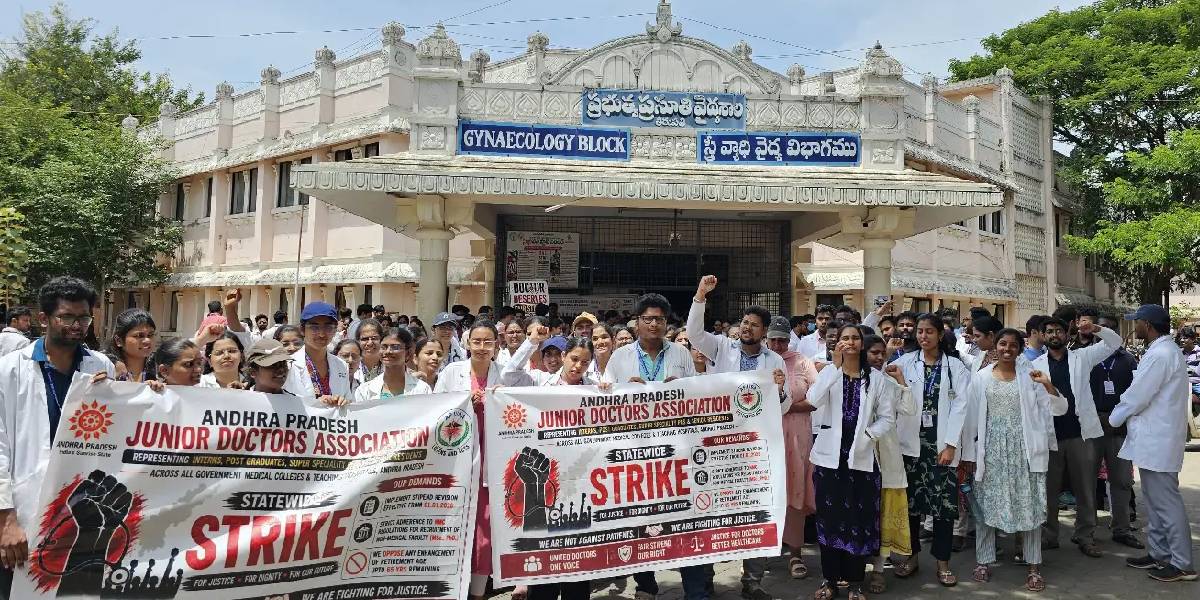
Doctors protesting at the Sri Venkateswara Medical College, Tirupati

Synopsis: Junior doctors at government medical colleges and hospitals across Andhra Pradesh have suspended non-emergency services for a third day over their demand for a 30 percent stipend hike, while the State government has yet to respond to the agitation. The strike follows weeks of unsuccessful efforts to secure a revision of stipends, with talks breaking down after the government reportedly offered a 3 percent hike.
Junior doctors at government medical colleges and hospitals across Andhra Pradesh continued their withdrawal from non-emergency services on Wednesday, 14 August, taking their strike over stipend enhancement into its fifth day. The state government is yet to respond to the agitation.
The current agitation is Phase II of the strike, which originally began on 10 August. A fresh round of talks with state officials collapsed on the night of 11 August, leading to a full-day suspension of non-emergency duties from the following day, 12 August.
The Andhra Pradesh Junior Doctors’ Association (AP JUDA) said interns, junior residents, senior residents, super-speciality postgraduates, and postgraduates posted under the District Residency Programme and in peripheral postings would withdraw completely from non-emergency services.
Emergency departments, ICUs, labour rooms, emergency surgeries, and blood banks continue to function uninterrupted, the association said. Striking doctors have also been carrying out voluntary relay hunger strikes every day since 12 August.
The Federation of All India Medical Association (FAIMA) and Andhra Pradesh Government Doctors Association (APGDA) extended solidarity to AP JUDA and endorsed its demands.
Also Read: HRF condemns Vizag police preventing peaceful protest against data centres
The stir has been building since 21 July, when AP JUDA first issued a strike notice to the Director of Medical Education, the Principal Secretary of the Health, Medical & Family Welfare Department, and the state Health Minister, seeking a long-pending revision of stipends.
On 30 July, the association said it gave the government until 4 August to respond in writing, either through a signed order or a commitment to issue one.
In the absence of action from the authorities, AP JUDA issued a strike call for 4 August. It was, however, deferred by a week at the request of the Director of Medical Education, who sought additional time to negotiate with higher authorities.
Members said the decision was a gesture of goodwill rather than a softening of their demands. With the matter still unresolved, the association wrote to the government setting out a phased strike plan.
The strike began with a four-hour stoppage of emergency services on 10 and 11 August. Talks held on the night of 11 August broke down after the government reportedly offered a 3 percent stipend hike against AP JUDA’s demand for 30 percent. This pushed the agitation into Phase II, with the withdrawal of non-emergency services from 9 am to 4 pm, effective 12 August.
Also Read: SIT finds that AP Group 1 selection was not vitiated
One of the three core demands of the striking doctors is a 30 percent hike in the stipend paid to interns, postgraduates, super-speciality postgraduates, and senior residents. They are seeking a revision of the existing rate, which provides for a 15 percent increment every two years under a 2009 government order. They have also called for the revised stipend to be paid retrospectively from 1 January 2026.
However, the Health Department agreed to only a 3 percent hike, which AP JUDA deemed unacceptable.
The association has also urged the government to strictly adhere to National Medical Commission (NMC) regulations on the appointment of non-medical faculty to clinical teaching and examiner posts.
Dr Ranjith, representing AP JUDA, told South First that the Andhra Pradesh government had breached the NMC cap of 15 percent for non-medical faculty postings.
“They are hiring Biochemistry and Microbiology MSc/PhD graduates as faculty. Despite the 15% limit, the AP government has breached it and has filled over 30% of the posts with such candidates,” said Ranjith.
The association is also seeking a review of the policy itself.
“We already have medical postgraduates in these subjects. Non-medical faculty teaching and examining for medical students is causing a lot of issues as they do not have clinical experience,” added Ranjith.
Another demand is that the government halt proposals to raise the faculty retirement age beyond 65. Health Minister Satya Kumar Yadav announced in July that the government was considering raising the retirement age of medical professors at government colleges from 63 to 70.
Ranjith said AP JUDA opposes any such proposal.
“Such changes will make it difficult for MDs seeking positions at government hospitals. Even a 2- to 3-year change can severely affect their careers. We want more hiring of new faculty,” he said.
Apart from these core demands, the doctors are also calling for improvements to basic facilities at government medical colleges and hospitals. They said that even basic amenities such as drinking water and resting spaces are missing in several of these institutions.
The association has given the government a deadline of 15 August to provide a written response addressing their demands. Further escalation will begin from 17 August in case of inaction, AP JUDA said.
(Edited by Dese Gowda)



