

Published Apr 22, 2026 | 2:19 PM ⚊ Updated Apr 22, 2026 | 2:19 PM

Kerosene prices in India have shown fluctuations but an overall upward trend. Credit: Sreelakshmi Soman/South First

Synopsis: Kerala’s fishermen face mounting losses as subsidised kerosene prices spike from ₹103 to ₹155.37/litre, driven by global tensions and GST hikes. Limited fuel allocations force reliance on costly black-market supplies, while rising gear costs and debts deepen the crisis. Despite higher retail fish prices, profits bypass fishermen, leaving livelihoods fragile and survival at sea increasingly uncertain.
The hues of yellow and red before sunset deepen the heaviness hanging over the fishermen of the Cherupushpam boat.
”Every time the kerosene price rises, it feels like the sea itself is slipping away from us” says Jackson Xavier, staring at the restless waters with his crew.
On the shore, they gather in prayer before the Lord Mary, seeking hope for better catches and higher fish prices—even as they know it can do little to offset the mounting losses they are already bearing.
A sudden spike in subsidised kerosene—from ₹103 to ₹155.37 per litre, driven by global tensions in West Asia has tightened an already fragile lifeline.
The limited subsidised fuel, barely enough for a day or two of fishing in a month is no longer sufficient, forcing many to depend on expensive black-market fuel just to keep their boats moving. For crews like Jackson’s, each trip has become a costly gamble, with daily operational expenses reaching around ₹40,000 even as the catch remains uncertain.
As fishing grounds push farther into deeper waters during the dry season, fuel consumption rises further, stretching survival on the sea to its limits. The strain is now visible onshore too—medium-sized mackerel prices in urban markets have nearly doubled from ₹180 to ₹260 per kg. Sardines have also become costlier, though the rise has brought no relief to the fishermen who harvest them.
Across the coastal villages of Chellanam, Kumbalangi and Vypin, South First met several fishermen like Jackson who said they did not know how to cope with the rising kerosene prices.
Also Read: Between belief and branding: Non-veg Vishu ads spark cultural fault lines in Kerala
Speaking to South First, Wilson of the Kerala Swathantra Matsya Thozhilali Federation (KSMTF) said that most fishing boats in Kerala continue to depend on Yamaha engines that are traditionally designed to run on kerosene.
He explained that in Kerala and Tamil Nadu, fishermen largely use inboard boats, where the engine is fixed inside the vessel. These boats are more stable, powerful and fuel-efficient, making them suitable for deep-sea fishing.
In Kochi, each inboard boat typically provides employment to around 55–60 workers.
In contrast, outboard boats have engines mounted externally at the rear. They are easier to maintain, operate well in shallow waters and offer better handling, but are smaller in size and usually support only 20–25 workers per boat.
Across Kerala, about 14,342 government-approved engines receive subsidised kerosene through pumps operated by Matsyafed, with each engine allotted 140–190 litres/month.
Compared to other states, Kerala has a higher number of kerosene-dependent inboard boats, which also makes it one of the leading consumers of kerosene in the sector.

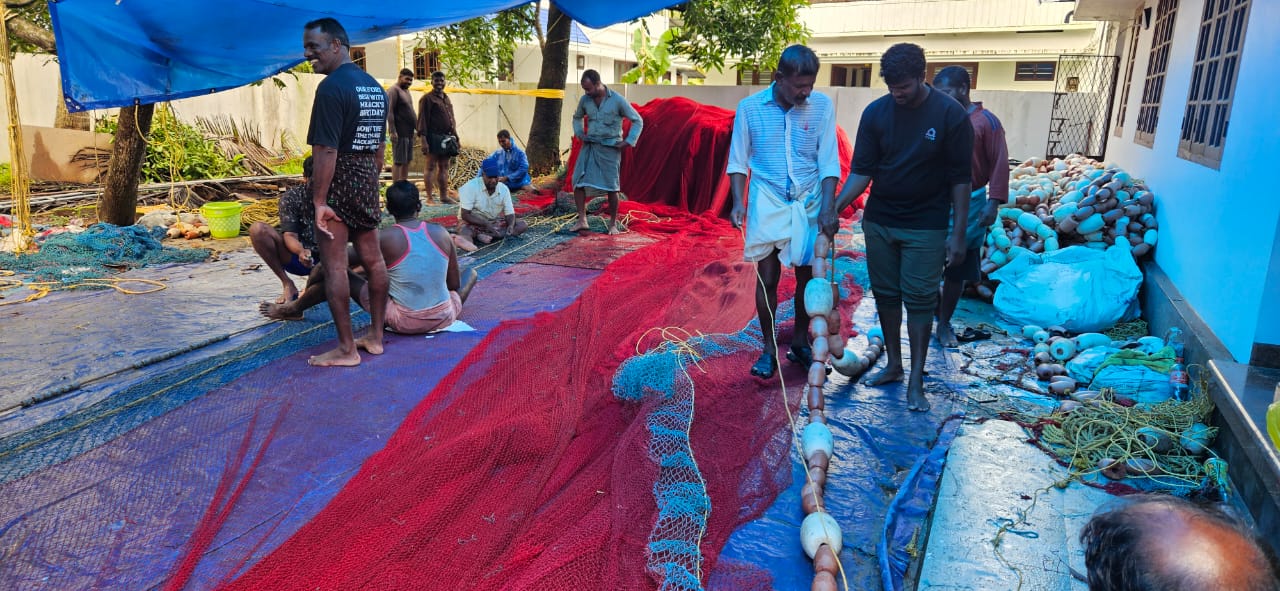
Fisherfolk in Chellanam carrying nets for repair.
Fishermen’s organisations in Kochi say the recent rise in kerosene prices is linked to an increase in the base price, along with an additional 9% GST imposed by both the Centre and the State. They argue that reducing GST could offer significant relief to workers already struggling with rising costs.
Meanwhile, to eases the burden on fishermen, the state government recently increased the subsidy for kerosene used in boats from ₹25 to ₹50.
Over the past three years, kerosene prices in India have shown fluctuations but an overall upward trend.
In 2023, retail prices were generally between ₹70 and ₹85 per litre, while subsidised kerosene in Kerala remained much lower at around ₹15 per litre for eligible users such as fishermen.
In 2024, prices stabilised somewhat, with retail rates mostly ranging between ₹60 and ₹70 per litre due to relatively steady global crude oil conditions. However, this relief was short-lived.
By 2025, kerosene prices rose sharply to around ₹120–₹135 per litre in many regions, driven by higher crude oil costs, supply pressures and a decline in the effective reach of subsidies, further intensifying the financial strain on fishermen.
Also Read: Ration crisis surfaces in Kerala’s only tribal panchayat, probe intensifies
Speaking to South First Gomez Sebastian, a fisherman who owns an outboard boat, said that earlier there was little difference between diesel, petrol and kerosene prices but kerosene rates have now shot up like a rocket.
Questioning the reasons behind the spike, he alleged that the crisis has disproportionately affected kerosene and termed it man-made.
”Black market lobbies are creating the crisis. We receive subsidies based on engine horsepower, not on the number of workers employed. For a 25 HP engine, we get only 129 litres of kerosene per month at a subsidised rate, which lasts barely one or two days for inboard boats. For a 9.9 HP engine, the allocation is just 90 litres.” he said.
He further claimed that while the government cites global tensions and tax hikes, kerosene remains readily available in the black market.
However, a kerosene dealer in Kochi denied allegations of black marketing, stating that the fuel is sourced legally through licensed channels and that the crisis is genuine, not fabricated by traders.
Meanwhile, Siju Pothen (name changed), a fishing boat owner from Vypin, said obtaining a kerosene permit in Kerala is a herculean task. He pointed out that subsidies for kerosene purchased through Matsyafed are credited only after six months, whereas the Civil supplies department provides spot subsidies.
”Permits are renewed only for engines purchased within the last 10 years. Boat owners often sell their vessels after five or six years but retain the kerosene permits. This forces new owners to depend on previous owners for subsidised fuel,” he said.
He added that the complex procedures discourage many from applying for permits, pushing them towards the black market in the hope of offsetting costs when fish prices rise.

Fisherfolk in Chellanam mending their fishing nets.
Speaking to South First, Matsyafed chairman T. Manoharan said the agency can continue distributing kerosene at subsidised rates only until existing stocks last, stressing that it has no control over pricing. He attributed the crisis to rising tensions in West Asia.
At the same time, fishermen are also struggling with the escalating cost of essential gear—nets, ropes and hooks driven by shortages linked to the global trade crisis. A kilogram of net used in inboard boats now costs nearly ₹900, and a single boat requires around 1,500–3,000 kg pushing expenses into several lakhs.
Adding to their burden, nets and ropes demand constant repairs often damaged by dolphins biting through them, as fishermen recount.
”As this is the summer season, we are forced to travel farther into the sea, while fish move deeper- below 50 to 60 metres due to the rising temperature. That means higher fuel use and mounting maintenance costs. But what do we get in return? While sardines sell for over ₹200 per kg in retail markets, we are paid barely ₹30. The real profits go to middlemen and retailers.” said Wilson.
In Kochi, many fishermen are already sinking under heavy debts, borrowing just to keep their boats running and their hopes afloat. Each journey into the sea now feels less like a livelihood and more like a gamble against forces far beyond their control. They wait- for a fair price and for a good catch that never seems to come.
Until then, their lives rise and fall like the waves they sail on- restless, uncertain and quietly breaking beneath the weight of a future that offers no guarantees.



