

Published May 07, 2026 | 5:33 PM ⚊ Updated May 12, 2026 | 11:44 AM

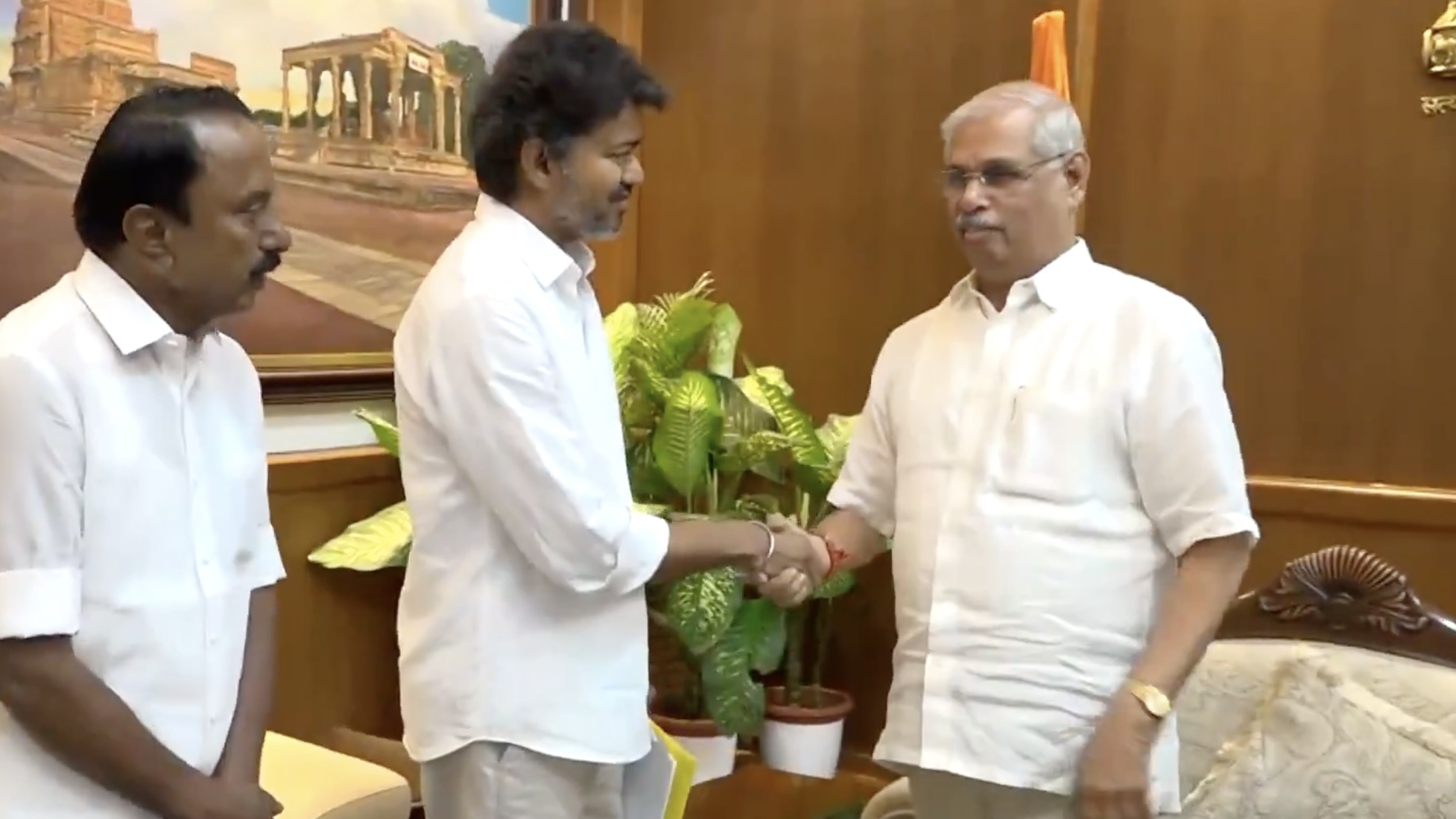
Vijay has already staked claim to form the government and met with the Governor on Wednesday.

Synopsis: Tamil Nadu Acting Governor Rajendra Vishwanath Arlekar’s refusal to allow TVK chief Vijay to take oath as Chief Minister, saying the party had not shown enough support to prove a majority in the Assembly, has invited criticism from across the political aisle. The Governor has demanded that Vijay produce signatures of support from 118 MLA-elects. In the past, Governors appointed during BJP-led governments at the Centre have invited parties that fell short of a majority.
Tamilaga Vettri Kazhagam (TVK) chief Vijay’s attempt to form the government in Tamil Nadu has run into hurdles after Acting Governor Rajendra Vishwanath Arlekar said he was unconvinced the party had demonstrated the numbers needed to prove a majority.
TVK emerged as the single largest party in the recent Assembly election with 108 seats in the 234-member House, 11 short of the majority mark.
The Congress on Wednesday, 6 May announced support from its five MLAs, taking the formation’s tally to 113. But Vijay still needs the support of at least six more MLA-elects to cross the halfway mark.
Vijay met the Governor on Wednesday and staked claim to form the government. He met him again on Thursday.
He is understood to have sought two weeks to prove his majority on the floor of the Assembly while continuing talks with parties including the Viduthalai Chiruthaigal Katchi (VCK) and the Left parties.
But in a statement issued after the meeting, the Lok Bhavan said the Governor had informed Vijay that the “requisite majority support” required for government formation had not been established.
The decision has drawn criticism from across the political aisle, with members of the TVK, the Congress and others accusing the Governor of acting at the behest of the BJP. They also pointed out that Vijay only needed to prove his majority on the floor of the Assembly, not before the Governor.
The Governor’s demand that Vijay produce signatures of support from 118 MLA-elects, while unconventional, is also being seen as a political tactic. In the past, Governors appointed during BJP-led governments at the Centre have invited parties that fell short of a majority—and, in some cases, were not even the single largest party—to form governments and prove their strength later on the floor of the House. What is common in all these instances is that the party seeking to form the government was the BJP or its allies.
Also Read: Congress dumps DMK for Vijay: What happens to INDIA bloc now in Tamil Nadu?
The 2019 Maharashtra Assembly election saw the BJP-Shiv Sena alliance secure a combined majority in the 288-member House.
The BJP won 105 seats and the Shiv Sena 56, taking the NDA tally to 161, above the majority mark of 145. The NCP secured 54 seats and the Congress 44.
But the BJP-Shiv Sena alliance collapsed after the BJP refused to honour a purported pre-poll power-sharing arrangement under which the Shiv Sena would hold the Chief Minister’s post for two-and-a-half years under a “50-50” formula, prompting the Shiv Sena to withdraw from the alliance.
On 8 November, Governor Bhagat Singh Koshyari invited the BJP, as the single largest party, to form the government.
But without the numbers required for a majority on its own, the party declined to form the government.
The Governor then invited the Shiv Sena, which sought additional time to secure the support of the NCP and the Congress. The Governor did not grant the extension. The NCP was invited next. With no party able to demonstrate majority support within the deadline, President’s Rule was imposed in the State on 12 November.
On 23 November, President’s Rule was unexpectedly revoked and BJP leader Devendra Fadnavis was sworn in as Chief Minister in a hurried early morning ceremony, with support from a section of the NCP led by Ajit Pawar, who took oath as Deputy Chief Minister, despite not having a majority.
The government collapsed within three days. On 26 November, ahead of a floor test directed by the Supreme Court, Fadnavis resigned after the BJP failed to secure the numbers required to prove its majority.
The Shiv Sena, the NCP and the Congress later formed the Maha Vikas Aghadi coalition. Shiv Sena chief Uddhav Thackeray was sworn in as Chief Minister on 28 November.
Also Read: Rumours of DMK-AIADMK joining hands to counter Vijay-Congress: Why and how it started
The 2018 Karnataka Assembly election produced a hung verdict. The BJP emerged as the single largest party with 104 seats in the 224-member Assembly, followed by the Congress with 78 and the JD(S) with 37. An Independent candidate and the BSP won one seat each.
Soon after the results were declared on 15 May, the Congress extended unconditional support to the JD(S) and backed HD Kumaraswamy for the Chief Minister’s post.
Together, the Congress and the JD(S) claimed the support of 115 MLAs—above the halfway mark of 112—and submitted letters of support to Governor Vajubhai Vala.
At the same time, the BJP also staked claim to form the government, saying it was the single largest party in the Assembly.
On 16 May, the Governor invited BJP leader BS Yeddyurappa to form the government and asked him to prove his majority on the floor of the House within 15 days despite the numbers.
The decision was immediately challenged by the Congress-JD(S) alliance in the Supreme Court, arguing it had already demonstrated majority support and should have been invited first.
In an overnight hearing, the Supreme Court refused to stay Yeddyurappa’s swearing-in but directed an expedited floor test.
Yeddyurappa took oath as Chief Minister on 17 May. Two days later, ahead of the trust vote, he resigned after addressing the Assembly, saying the BJP did not have the numbers required to secure a majority.
The resignation cleared the way for the Congress-JD(S) coalition to form the government. HD Kumaraswamy was sworn in as Chief Minister on 23 May with Congress support.
The 2017 Goa Assembly election saw no party secure a majority in the 40-member House.
The Congress emerged as the single largest party with 17 seats, while the BJP won 13. The Maharashtrawadi Gomantak Party and the Goa Forward Party won three seats each, Independents secured three seats and the NCP won one.
Soon after the results were declared, the BJP began putting together support from smaller parties and Independents.
Manohar Parrikar, then Union Defence Minister, returned to the State to lead the effort. With the backing of the MGP, the GFP, two Independents and the lone NCP MLA, the formation reached a strength of 21.
On 12 March, Parrikar met Governor Mridula Sinha and staked claim to form the government. The Congress, despite being the single largest party, was unable to secure enough support to form a majority coalition in time.
Governor Sinha invited Parrikar to form the government. He was sworn in as Chief Minister on 14 March.
The Congress challenged the decision in the Supreme Court, saying that as the single largest party, it should have been invited first to explore the possibility of forming the government.
The court declined to stay the swearing-in and directed that a floor test be conducted. The BJP-led coalition later proved its majority in the Assembly.
Also Read: TVK functionary sexually assaults 10-year-old girl in Chennai on polling day, arrested
The Congress emerged as the single largest party in the 2017 Manipur Assembly election, winning 28 seats in the 60-member House.
The BJP secured 21 seats, short of the majority mark of 31. The National People’s Party and the Naga People’s Front won four seats each, while the Lok Janshakti Party, the All India Trinamool Congress and an Independent candidate won one seat each.
In the days following the results, the BJP secured the backing of the NPP, the NPF, the LJP, the AITC legislator and the Independent MLA, taking its strength to 32.
The Congress, despite being the single largest party, was unable to gather enough support to form the government. BJP leader N Biren Singh then staked claim to form the government.
After three days of consultations with various parties, Governor Najma Heptulla invited Biren Singh to form the government, citing the “stability factor”.
He was sworn in as Chief Minister on 15 March.
The Congress unsuccessfully challenged the Governor’s decision, saying that as the single largest party, it should have been given the first opportunity to form the government.
The BJP-led coalition later proved its majority on the floor of the House.
Also Read: 57 DMK, 25 AIADMK, 10 INC, 4 BJP: Who TVK defeated in Tamil Nadu polls
The Constitution does not lay down a fixed procedure for a Governor to follow when no party secures a majority in an Assembly election.
In such situations, the Governor is allowed to exercise discretion in inviting a party or coalition to form the government and prove its majority on the floor of the House.
But over the years, two commissions on Centre-State relations and Supreme Court judgments have laid down conventions to guide that discretion.
There’s little surprise that Governor Rajendra Arlekar’s delay in inviting Vijay, as the leader of the single largest party, to form the government is facing criticism. However, such criticism shouldn’t be facile. Let us examine the logic behind his position. A long thread. 1/n
— K Venkataramanan (@kv_ramanan) May 7, 2026
The Sarkaria Commission on Centre-State relations, which examined the issue in the 1980s, laid down an order of preference for the appointment of a Chief Minister in the event of a hung Assembly. It recommended that the Governor first invite:
These recommendations were later referred to and affirmed by a Constitution Bench of the Supreme Court in Rameshwar Prasad vs Union of India (2005).
The Justice MM Punchhi Commission on Centre-State relations, which submitted its report in 2010, said that where no party or pre-poll coalition secures a clear majority, the Governor should invite either “a pre-poll alliance commanding the largest number” or the “largest single party” to form the government.
(Edited by Dese Gowda)



