

Published Jun 15, 2026 | 6:49 PM ⚊ Updated Jun 15, 2026 | 7:13 PM

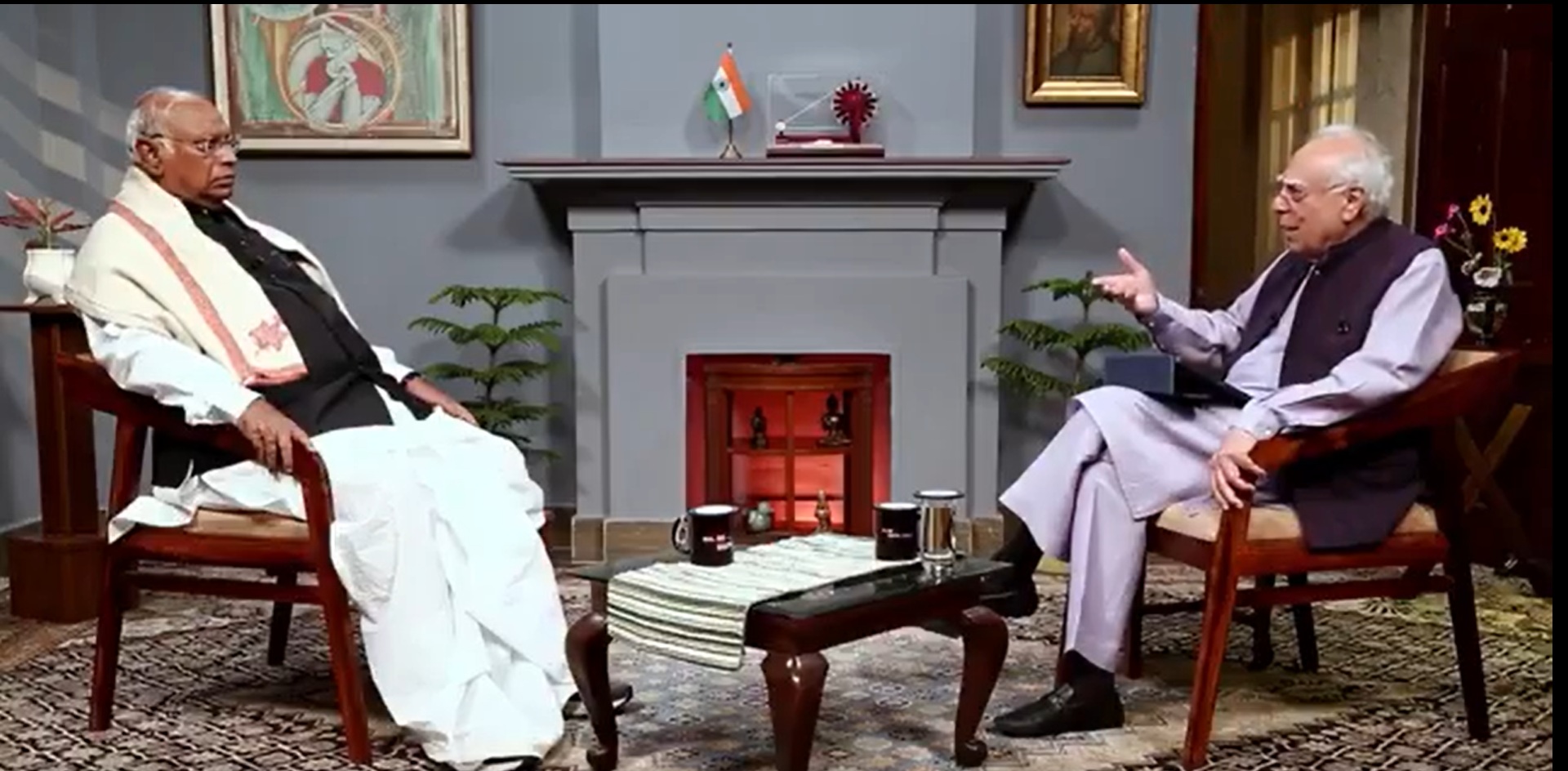
In conversation with Kapil Sibal, AICC president Mallikarjun Kharge recalled his many battles, including how he lost his dear ones much early in life.

Synopsis: Mallikarjun Kharge harks back to an older era of politics and politicians. His rise to his current position of national importance came after a beginning that saw him suffer the gravest of tragedies.
Mallikarjun Kharge might be the President of the Indian National Congress and the Leader of the Opposition in the Rajya Sabha today. But the resilience of the 83-year-old—the first non-Gandhi party chief in over two decades—was forged as far back as 1948.
On the show Dil Se with Kapil Sibal, Kharge recounted the many battles in his life, tracing his journey back to a dark afternoon 78 years ago when his near and dear ones were burnt to death.
Kharge recalled how Varvatti, the village where he was born into a Dalit family in Karnataka’s Bidar district, was under the Hyderabad Nizam’s rule when India gained independence in 1947.
Believed to be the world’s richest man at the time, the Nizam had stubbornly resisted joining the new nation. His Razakars (volunteer) force went from village to village demanding written declarations from residents that they wanted to remain independent.
They sacked the countryside and spread fear to ensure they were obeyed. A six-year-old Kharge bore witness to their horrors in 1948.
Urged by Sibal, the Congress President revisited the painful afternoon when the Razakars set his family’s tin-shed house on fire. His father, Mapanna, was away.
“The modus operandi of the Razakars was to arrive on 20 to 25 horses, enter a village, and beat and kill people,” Kharge remembered. “A massive tragedy happened in a village right next to ours, where at least 780 people were killed. That village was hardly six kilometres away.”
“Naturally, these Razakars headed towards our side too. Every house they saw along the way, they would burn it down… They attacked our house as well because it was near the road. My mother was killed when they set fire to my house. My brother died, my sister died and my uncle passed away too. My father was working in the fields—the small plot of land we had, about seven or eight acres… He got very disturbed hearing the shouting around him. Then someone told him, “Anna, your house is on fire! We don’t know if anyone survived, but your child is playing with other kids under a tree, so at least go and save him,” an emotional Kharge told Sibal.
With the Razakars on the rampage, terrified neighbours and relatives refused to give the two survivors refuge, believing they had done some wrong. Mapanna had no option but to flee with his son to the nearby Sendhi (toddy palm) groves, where they found shelter for an entire month.
“My father thought, ‘Let me make him sleep in the jungle,'” the Congress president shared. “In a dense jungle area where a little water was flowing, he spread his blanket that night and made me sleep… Today, I walk on carpets, but at that time, he used to make me even sleep on leaves, weaving them together.”
When night fell, his father would head out to beg for food from relatives and acquaintances, returning before sunrise to be back with his son.
Also Read | Dear Mr Modi: What Nehru would have told his successor as India’s longest-serving PM
After a month, the father and son went hunting all the way for Mallikarjun’s uncle to a military depot in Khadki, Pune. But there they learnt that he had left.
The duo eventually got on a train and headed to Gulbarga (now Kalaburagi), where Mapanna, thanks to a good samaritan named Sadashiv Master, found employment as a badli (substitute) labourer at the Mahboob Shahi Kalaburgi (MSK) Mill. Yet, the hardships endured, and fresh discrimination awaited Kharge at the mill-run school.
“Poor children were taught by untrained teachers, while the children of supervisors and high-ranking officials were given good teachers,” he recalled.
Determined to give his son a good future, Mapanna enrolled Mallikarjun in a private school run by followers of freedom fighter Swami Ramanand Teerth, where more than half the teachers were from the RSS. He persuaded the management to let him pay the fees by the 10th of every month, which was when he got his wages from the mill.
Though Kharge confessed he was initially keener on sports—playing kabaddi, hockey, and cricket—his father’s relentless push ensured he graduated in law in 1967. He cleared the Bar Council exam the following year.
Another obstacle sprang up. Kharge found that no senior lawyer in Gulbarga was willing to take the son of a mill worker as an apprentice.
Redemption came in the form of Shivraj Patil, a young lawyer whom he became friends with and who suggested a workaround.
“Even he (Shivaraj) hadn’t completed 15 years of practice (needed to be a senior lawyer) at that time. But he was good at heart,” Kharge remembered. “He came up with a trick. Shivraj said, ‘You sit and work with me. I will find a senior under whom I had worked a bit earlier.’ So, going to that senior’s office was solely for the purpose of getting signatures on the diary, while I actually sat and worked with Shivraj Patil.”
Kharge was soon juggling legal work with activism.
He had joined a student union in 1967 and formed a labour union the next year. His father worried about his son’s lack of attention to law, noting that “from early morning, he goes to join strikes and protests.” But soon, politics would turn Mallikarjun’s main calling.
The big turning point came in 1970 when then-PM Indira Gandhi visited Karnataka to rebuild the party after the old guard (the Syndicate leaders) deserted her during the 1969 Congress split. When she came to Kalaburagi, Devaraj Urs, the Congress convener, introduced the then-young Kharge to her.
Indira Gandhi was quick to spot the spark in him and told Urs: “Make him the city president.”
“There was a shortage of people.. I was already a labour leader also,” Kharge recalled. “They preferred me because I had 8000 to 10000 people ready at any moment to take out a procession or do ground work, plus the student union support. Because of this, I had an advantage.”
There was to be no looking back. A glorious run followed. From 1972, Kharge never lost an election till 2019 when he was swept away in the BJP wave in the Lok Sabha elections from Kalaburagi.
He had become an MLA on nine occasions and was elected as an MP twice. As Kapil Sibal concluded, Kharge continues to remain at the very top as Congress President, a position he has held since 2022, and the main Congress voice in the Rajya Sabha.
Also Read | ‘Resistance works’: What Rahul Gandhi needs to do to keep his tryst with destiny
(Edited by R Rajesh Kumar.)



