

Published Jun 13, 2026 | 6:30 PM ⚊ Updated Jun 13, 2026 | 6:30 PM

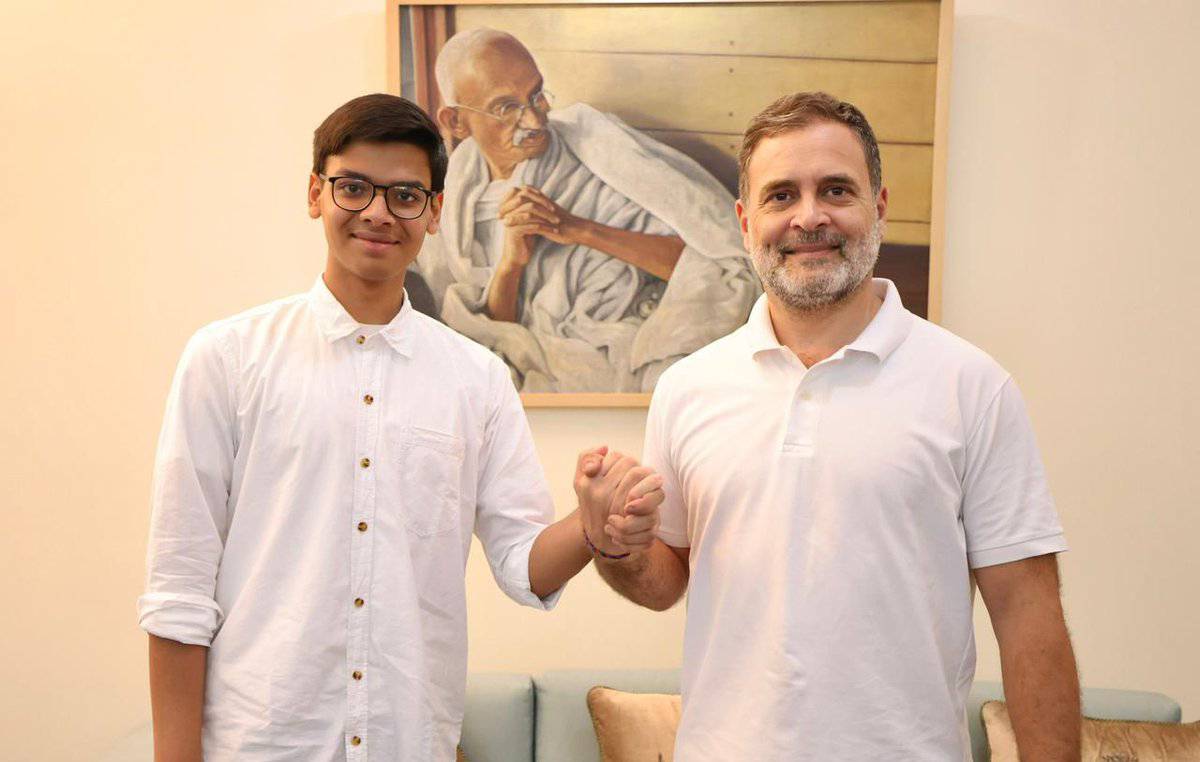
Rahul Gandhi seen here with Sarthak Siddhant, one of the four who exposed the CBSE OSM flaws. Courtesy: X/@@RahulGandhi

Synopsis: There are many reasons why Rahul Gandhi has the potential to be the central point of the “resistance movement”. A vital transformation, however, remains in converting the resistance to victory.
Rahul Gandhi is the best example of the theory that even the most powerful, dictatorial and crooked power structure cannot do anything to a person who has nothing to fear.
Looking at it from this prism, the speech by the Leader of Opposition in the Lok Sabha at a meeting of the INDIA alliance leaders in New Delhi on June 8 is profound in many ways.
It is early to liken his call to the Jayaprakash Narayan movement post the Emergency in 1970s, but the signs of a resistance struggle going forward are unmistakable. And, Rahul is, perhaps for the first time, showing signs of emerging as the rallying point for anti-BJP voters and parties alike. More than the parties, for the voters.
The strongest part of Rahul’s June 8 speech was his insistence that resistance matters.
“If political parties cannot function, what functions? Resistance functions. Resistance works. Wherever we resist, it works. It is a spirit. It is a way of thinking—and whether we like it or not, that is where we have to go. The mindset must now be we will not fight each other. We will not give the press a chance to attack us. We will resist,” he proclaimed.
Yet this formulation is also where the limits of his argument become visible.
The BJP’s success was not built merely on ideological conviction or electoral messaging. It was built through organisation. Decades before it became electorally dominant, the Sangh Parivar invested in creating networks of cadres, student organisations, labour fronts, religious institutions, neighbourhood committees and cultural associations.
This is where Rahul’s challenge begins. If resistance is to become more than a moral posture, it must be translated into organisation and mobilisation.
Who are the foot soldiers of this resistance? Where are the platforms where students, workers, farmers and ordinary citizens can participate? Which are the institutions that can sustain it between elections?
These are the questions that reveal the chasm between the Congress Party and its leader. The civil society that helped Congress come to power in Karnataka and Telangana is now left disappointed for many reasons, primary among them being the failure of his party governments to follow Rahul’s idea of India.
Many opposition-ruled states, including the Congress ones, increasingly operate within a remarkably similar economic framework to the BJP. Development is organised around attracting large private investment, facilitating corporate expansion, expanding surveillance and policing capacities, and managing social distress through welfare transfers and subsidies.
The result is a model that combines market-led growth for big business with survival-level support for the poor. Remove hardline Hindutva support from the equation and the differences become minuscule.
Yet, was historian Ramachandra Guha right in declaring Rahul a failure? The truth lies somewhere else.
From being lampooned as a “Pappu” by BJP’s social media to becoming a victim of the misuse of state agencies and judiciary at various levels and even being thrown out of his house, Rahul has indeed come a long way.
A senior BJP leader, in a private conversation, described Rahul as a “pro-poor socialist” in a philosophical and ideological sense, and a man with compassion. That the Congress leader is honest is not doubted even by rivals.
Among all Opposition politicians, Rahul alone has displayed, on all occasions, the willingness to take the BJP head-on. Most others have, at various instances, compromised or capitulated.
Is it enough if Rahul succeeds in bringing all anti-BJP forces under one umbrella? Maybe not. There remain issues that the Congress needs to address and it has begun to focus on some.
Rahul increasingly speaks on unemployment, education, caste census, crony capitalism and institutional capture—and has given the Congress a clearer ideological direction than it possessed a decade ago.
He is making the right moves by planning to meet students in different cities, picking on the nascent and ongoing protests about the education system in the country. The crisis in the education and health sectors is bound to emerge as one of the major electoral issues soon.
Education is today the driving force for even lower-middle-class and poor families across the country. Children of today are keen on getting educated and so are the parents. Unwittingly or otherwise, Dharmendra Pradhan provided a massive cause for the Gen Z to hit the streets.
Congress needs to go beyond by coming up with credible policy measures that will make education cost-neutral to those who cannot afford it. Access is another problem. Improving public infrastructure in education and subsidising private education for such families is the need of the hour.
The huge constituency of students who would turn into voters is an element that the Congress and like-minded parties can ill afford to ignore. They could well turn out to be the foot soldiers for organisationally weak parties like the Congress.
The same holds true for health, where both access and cost are major problems for most. Most Indian middle-class households are just one hospitalisation away from turning poor. There is also the need to find jobs for the increasing millions in need of them.
It is not difficult to beat the BJP, Rahul told his allies. That too requires tweaking.
When Babar invaded India, he did not come with big numbers. He came with superior strategy and technology for those times.
The same is true of the BJP. It is superior in terms of strategy and organisational network, besides, of course, its ability to use the levers of the state efficiently to suppress political opponents and annex them. The Congress too was guilty of this when in power, but then this was a limited-purpose vehicle used occasionally. What has changed is the wholesale capture of democracy which renders inside-activism virtually moot.
The BJP’s greatest “achievement” has been making religious identity the primary lens through which the Indian polity is mobilised—even as the average standard of living plummets across the country.
The challenge before Rahul is therefore to make other political identities matter again. When the farmers’ movement launched a powerful mobilisation in 2021, the BJP confronted a political challenge that could not easily be resolved through polarisation.
Likewise, mobilisation has to happen around other issues—unemployed youth over jobs, students around NEET, women around inflation and workers around wages. That is the only way to neutralise the Hindu majoritarian agenda.
The Congress today remains largely an electoral machine. It contests elections, runs governments and distributes patronage. What it lacks is the kind of social infrastructure that once made it a mass movement and which today underpins the BJP’s dominance.
That is why the central question is no longer whether Rahul is committed. He has amply demonstrated it and ticks most boxes needed for a claim to being a political alternative to the BJP. The question is whether the Congress can transform itself from a party seeking office into a political organisation capable of building power in the society.
Without that transformation, resistance risks remaining a slogan rather than becoming a movement. If Rahul does manage this transformation, he will have his tryst with destiny.
Also Read:
Delhi calling: Pawan Kalyan aiming to emerge as the NDA’s southern face
The minister who sat on a stove and turned up the flame



