

Published Jun 10, 2026 | 6:37 PM ⚊ Updated Jun 10, 2026 | 6:52 PM

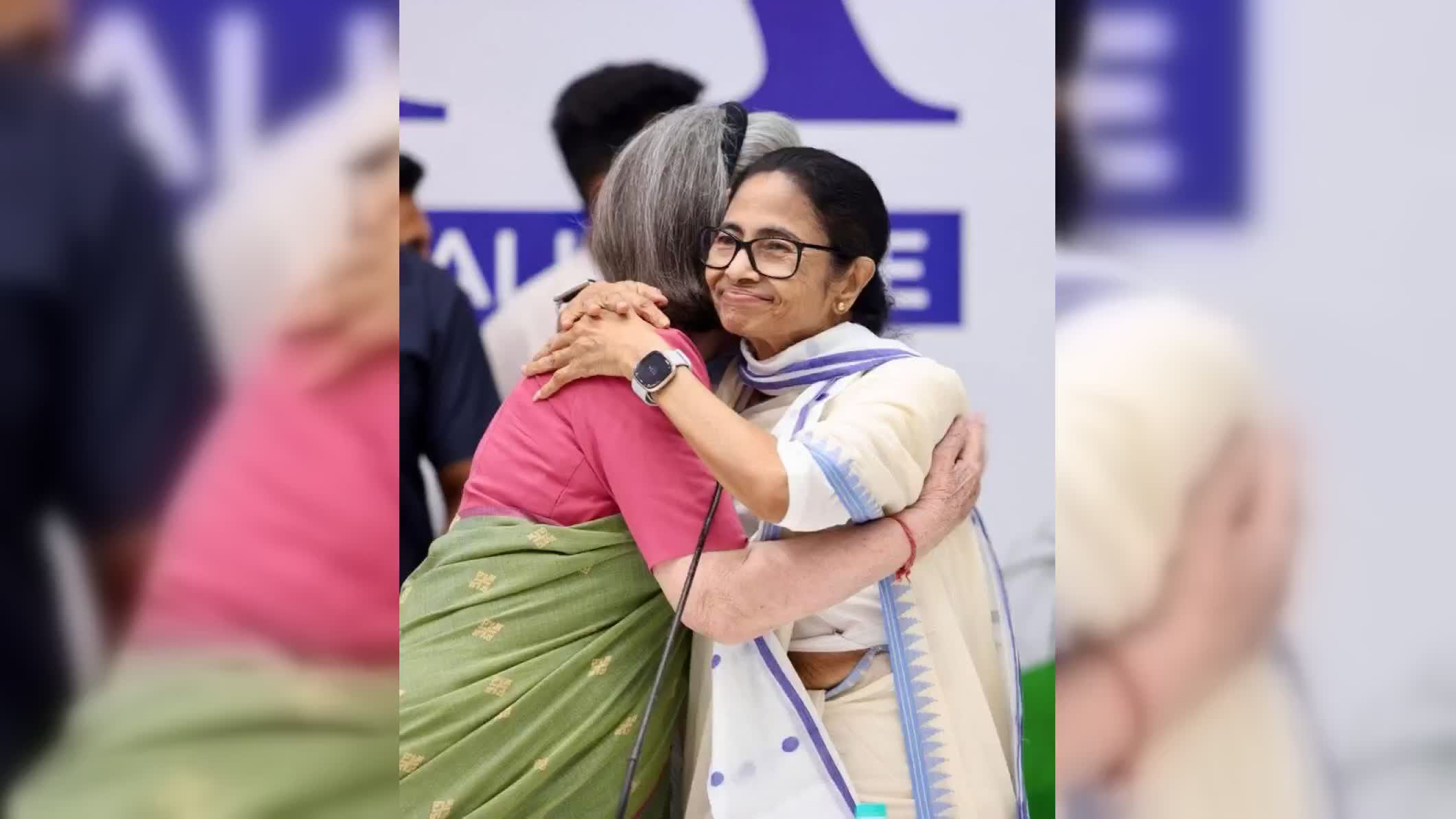
The hug that started it all. (x.com/TMC)

Synopsis: First, Mamata met Sonia. Then, Abhishek met Rahul. South First has learnt that big strides are being taken towards a coming together of the two parties.
Is the Mamata Banerjee-led Trinamool Congress planning to return to the Congress fold?
The buzz gained momentum after the 9 June meeting between Mamata and Congress Parliamentary Party chairperson Sonia Gandhi at the latter’s residence at 10 Janpath, which came a day after their warm hug in public on the sidelines of the India bloc meeting.
On 10 June, Trinamool national general secretary Abhishek Banerjee followed up his aunt Mamata’s meeting with a 90-minute tete-a-tete with Rahul Gandhi.
A top source told South First that Sonia had indicated to Mamata that she wanted the latter in the position of the party’s national vice president to fight the might of the BJP—not just in West Bengal, but across India.
There was also talk that Mamata could even be made the chairperson of the INDIA bloc, a post many have been suggesting for her.
While a definite confirmation on the merger proved hard to come by, there are enough indications to suggest that the coming together of the parties is in the works.
Indications are also that the AICC General Secretary (Organisation) KC Venugopal’s call for an “urgent meeting of AICC General Secretaries, in-charges and PCC Presidents” on 11 June at Indira Bhavan, New Delhi, is in light of these developments.
Congress President Mallikarjun Kharge is set to chair the meeting where the contours of the possible merger are set to dominate the agenda.
The likely development has also triggered the bigger question of whether other smaller parties, including Sharad Pawar’s NCP faction, will return to the Congress fold in the near future.
Recently, Mamata had faced an unprecedented revolt after the drubbing her party suffered in the 2026 West Bengal Assembly elections.
Despite trailing by only 30 lakh votes, the TMC ended with 80 seats in comparison to the victorious BJP’s 207 seats.
More recently, even bigger heartbreak came for the feisty ex-chief minister, who had led her state for the past 15 years.
Fifty-eight of her MLAs and 20 of her 28 MPs broke away, citing unhappiness with the importance Mamata’s nephew Abhishek Banerjee had gained in the party.
Also Read: How Meenakshi Natarajan fiasco betrays Congress High Command’s loss of grip over state units
Mamata had quit the Indian National Congress in 1998.
In her first elections, the same year, Mamata’s party won seven Lok Sabha seats from West Bengal.
But her real rise began after villagers in Nandigram were given eviction notices to make way for the Tata Nano plant.
Mamata joined and led the protests that caught fire on 14 March 2007 after 14 protesting villagers were killed. The Tata Nano project turned out to be a non-starter.
In the 2009 Lok Sabha elections, Mamata’s party showed that they had arrived by winning 19 seats.
Two years later in 2011 came the even bigger win in the state elections where the TMC with 184 seats unseated the CPI(M), which had ruled West Bengal for 34 years.
From then on Didi remained unstoppable till the recent setbacks.
Now, with a relentless BJP snapping at her heels, the once-indefatigable 71-year-old leader seems to have decided that she will be best served if she puts up a united front with the Congress.
Political convention in India for years has suggested that the BJP could easily defeat Congress in a straight contest, but regional parties like TMC, DMK, Shiv Sena, NCP proved to be a bigger challenge for the electoral juggernaut that is the saffron party.
However, recent instances of forced defections, midnight mergers, rebel factions splitting regional parties—whether in Maharashtra or West Bengal—with the BJP emerging the beneficiary in most cases, have forced regional parties to adopt radical measures.
Also Read | Open Letter: To defeat the BJP, the Congress doesn’t have to lead everything



