

Published May 15, 2026 | 9:32 AM ⚊ Updated May 15, 2026 | 1:57 PM

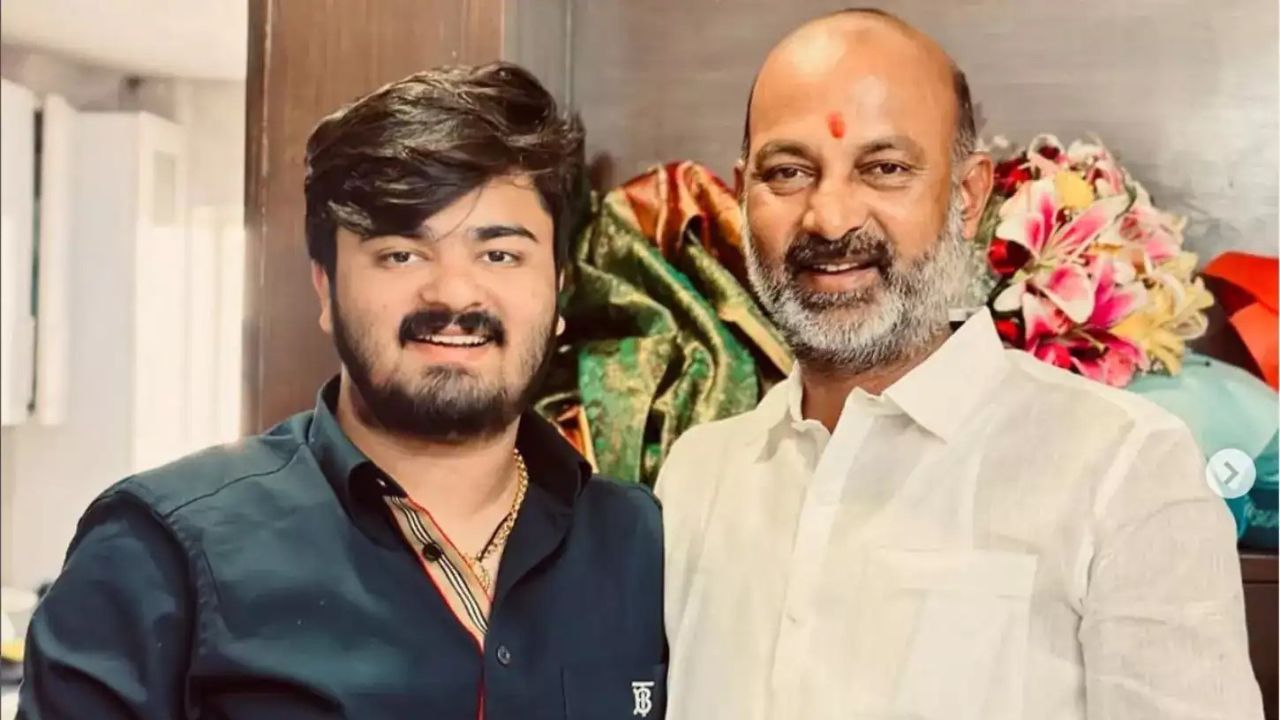
Bageerath with his father, MoS Bandi Sanjay.

Synopsis: The Telangana Police’s handling of the POCSO case against the son of Union Minister of State Bandi Sanjay Kumar raises more questions than providing answers. They are not able to find the accused even a week after registering the case. Adding to that, the state government’s handling of the accused’s bail petition in the high court is also questionable.
The Telangana Police are not covering themselves in glory over the manner in which they have been handling the POCSO (Protection of Children from Sexual Offences) case against Union Minister of State for Home Bandi Sanjay’s son, as their approach raises more questions than providing answers.
First, they served a notice on Bandi Sai Bageerath, the accused, to appear before the police through his uncle, who lives in Karimnagar, when the residence of the Union Minister of State in the posh Banjara Hills colony in Hyderabad is not an unknown location, least of all to the police.
For more than a week since the case was booked on 8 May, the police have been unable to trace the whereabouts of the accused. In any other case involving a normal citizen, the action would have been swift.
Also Read: POCSO failures to ‘political alignment’ signals — Telangana, where are you headed?
The absolute lack of preparation on the part of the public prosecutor when the matter came up before the Telangana High Court on Thursday, 14 May, also reflected the casual manner in which the police went about their job.
Having filed a case under POSCO after examining all records, the prosecution could not even immediately produce universally accepted documents such as a Tenth Standard certificate or passport as proof of age, even though the counsel for the accused raised doubts about the age of the survivor.
Aadhaar, even according to the Supreme Court, is no proof of identity. The police would have surely examined all relevant records before registering the case under POSCO.
More fundamental questions now.
Legal experts to whom South First spoke said any bail application (even in cases other than POSCO) is considered based on three tests:
The answers to the first two tests have been provided by the accused himself. He has been absconding for a week, and his father, who has already pronounced his son innocent, is very much in a position to influence the investigation.
Experts pointed out that, in any case, the age of the survivor cannot be an issue for consideration before the high court. The high court is not expected to give any finding on this, as it could potentially influence the subsequent trial in the appropriate lower court. At best, the high court could make some observations if, at all, it finds any discrepancies.
In both Telugu states, there has been a trend of state governments hiring senior counsel from the Supreme Court with expertise in criminal law in all important cases, without leaving such matters in the hands of public prosecutors alone.
In this case, however, the government did not even seek the services of the Advocate General and instead relied just on the Public Prosecutor, despite the uproar in the larger society.
A case in point was what this very Telangana government did in the case involving a Bharat Rashtra Samithi (BRS) activist who was arrested some months ago for “retweeting” a post on X.
When the high court granted him bail while passing strictures against the government for such an extreme action, the government hired senior Supreme Court lawyer Siddharth Luthra to argue the appeal in the apex court.
The Supreme Court too riled at the government. The sums the government needs to pay such senior counsel are not difficult to guess.
Also Read: POCSO charges, age row dominate Bandi Sai Bageerath’s bail hearing
Even as the survivor has been facing massive “shaming” on social media where her identity has been exposed by way of photos and videos, the minor’s mother has now come forward with a statement to the media on the morning of Friday, 15 May.
In the five-page statement, a reading of which will put any sensible citizen to shame over the state of affairs, the mother said: My daughter deserves protection, dignity and a future free from public humiliation.” The statement is expected to be placed before the high court when the hearing resumes on Friday.
“Never in our worst nightmares did we imagine that one day we would have to stand before society begging institutions to protect the child and hear our cries for justice. This statement is not issued out of revenge or publicity. It is issued because silence has become more painful than speaking,” the mother said.
Detailing all that happened from the time her daughter came in contact with Bageerath in 2025, she said the family had requested the police to preserve CCTV footage, General Diary entries, FIR metadata, station records and other electronic evidence so that the exact chronology would emerge before the law without any distortion.
Welcoming the police altering the FIR against Bageerath under stricter provisions of POSCO, the mother said the family continues to face fear, emotional trauma, social targeting and uncertainty as the accused remains free. “As parents, this reality breaks us every day.”
Despite multiple social media posts targeting the girl in gross violation, there has been no evidence of any action by the police. Not even a statement warning that such acts amount to a violation of the law and invite punishment.
Referring to discrepancies regarding the age of her daughter, the mother said lawful correction procedures and harmonisation procedures regarding the records had been initiated much before the current episode.
“We firmly believe that procedural discrepancies in documents cannot erase the lived suffering of a child nor defeat the statutory protections guaranteed under POSCO when the cumulative material and chronology clearly indicate minority during the relevant period,” she added.
(Edited by Muhammed Fazil.)



