

Published May 15, 2026 | 9:00 AM ⚊ Updated May 15, 2026 | 9:00 AM

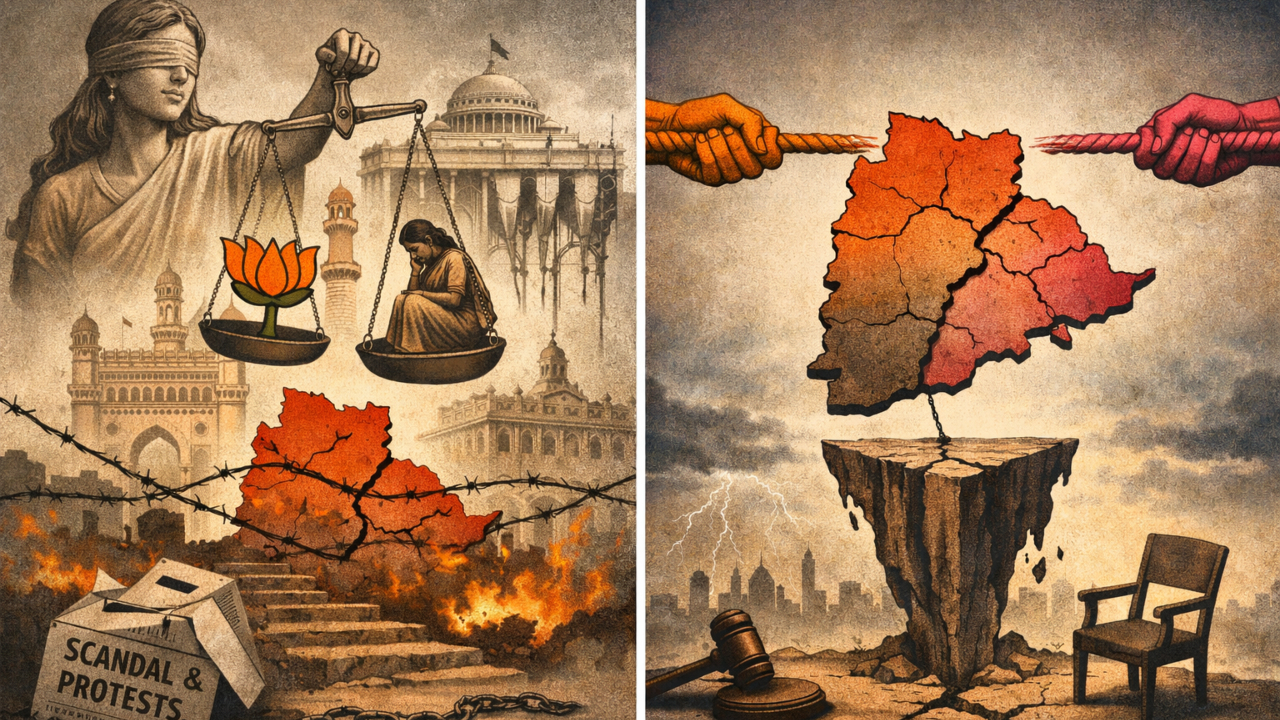
POCSO Act leaves no ambiguity about the gravity of offences against minors, irrespective of claims of consent.

Synopsis: Two major developments in Telangana raise troubling questions: allegations of sexual assault against Bandi Sai Bageerath, highlighting failures in law enforcement and institutional accountability, and Prime Minister Modi’s speeches suggesting conditional developmental support tied to political alignment. Together, they expose deeper issues of power, federalism, and governance, shaping the state’s democratic trajectory and future direction.
This week has seen two significant developments that bear directly on the direction and future of Telangana. These are not isolated incidents that can be dismissed as momentary disturbances; they are rooted in deeper processes and carry serious implications.
While other developments may also be unfolding, a closer examination of these two alone is enough to raise disturbing questions about the trajectory of the state.
The first concerns the allegations that emerged on Saturday against Bandi Sai Bageerath, son of Telangana BJP leader and Union Minister of State for Home Affairs Bandi Sanjay, involving the sexual assault of a minor girl, and the chain of events that followed over the next five days. The second relates to the speeches delivered by Prime Minister Narendra Modi on Sunday, first at Hitec City and later at the Parade Grounds.
Bandi Sanjay’s abrasive political style is well known. That his son, too, has displayed a pattern of aggression was evident three years ago, when, as a student at Mahindra University, he assaulted a fellow student, recorded the act, and circulated the video as a display of bravado.
No meaningful inquiry or disciplinary action followed that incident. In the meantime, the father rose to ministerial office at the Centre. The absence of accountability has only emboldened the son.
According to the complaint filed by the victim’s mother at the Pet Basheerabad police station, the accused befriended a minor girl, promised marriage, took her along with him, forced her to consume alcohol, sexually exploited her, and later refused to marry her.
The victim is said to have attempted suicide twice. On the same day, the accused filed a counter-complaint in Karimnagar, alleging that he had been honey-trapped and extorted.
More troubling is the conduct of institutions. The victim’s family reportedly tried for three months to file a complaint. The police delayed registering an FIR, while political pressure was allegedly exerted on the victim to withdraw her complaint, including the filing of a counter-case against her.
Only after the family threatened to take an extreme step at the Prime Minister’s public meeting did the police agree to register an FIR. Even then, the victims were made to wait for hours, while a counter-complaint by the accused in a different police station was processed first.
Also Read: POCSO case against MoS Bandi Sanjay’s son: Silence of Congress
This sequence stands in stark contrast to the provisions of the Protection of Children from Sexual Offences (POCSO) Act, 2012. The law mandates immediate registration of an FIR, prompt medical examination, time-bound recording of statements before a special court, protection of the victim’s identity, and swift arrest of the accused. It is designed precisely to prevent delay, intimidation, and institutional indifference.
Yet, in this case, the procedures appear to have been turned on their head. The FIR was delayed, the accused was not immediately apprehended, and the investigative process appeared hesitant. Even as the accused remained “untraceable,” as stated by the police themselves, there was no visible urgency in securing his custody.
Meanwhile, attempts to publicly identify him—such as the circulation of “missing” posters—were swiftly removed by municipal authorities.
Equally significant has been the role of sections of the media, where the accused’s narrative found prominence while the victim’s account struggled for space. Only after the issue gained traction on social media and among sections of civil society did the state announce a Special Investigation Team. Even here, the initial responses raised questions about priorities and procedure.
This is not merely a failure at the level of one police station or one investigation. It points to a deeper problem: a lack of recognition of how power operates, how law is selectively enforced, and how social hierarchies shape institutional responses. The POCSO Act leaves no ambiguity about the gravity of offences against minors, irrespective of claims of consent.
Yet, the persistence of patriarchal assumptions and power asymmetries continues to shift the burden onto the victim. The result is a climate in which truth struggles to assert itself against influence, and accountability becomes contingent rather than assured.
It is against this backdrop that the Prime Minister’s visit assumes significance. At a meeting in HICC, the Chief Minister reportedly remarked that just as Gujarat had benefited from central support during Narendra Modi’s tenure as Chief Minister, Telangana too could progress rapidly with similar cooperation.
The “Gujarat model,” however, has long been debated, with several studies indicating that its benefits were uneven and often concentrated among select corporate interests.
In response, the Prime Minister suggested that Telangana could not achieve its goals merely by seeking parity with past allocations, and added that to reach its aspirations, it should “join” him.
Presented as a non-political remark, the statement was, in fact, deeply political. It implied that developmental support is contingent upon political alignment.
Also Read: Bandi Bageerath seeks two days to appear before SIT in POCSO case
Such a formulation raises important questions about federalism and democratic norms. When an opposition Chief Minister is publicly invited to “join” the ruling dispensation at the Centre, it signals not cooperation, but conditionality. The optics of the moment were equally telling: the sharing of public platforms, the absence of direct rebuttal, and the rhetorical framing of political choices as developmental necessities.
These are not isolated signals. They form part of a broader pattern that merits close attention. When questions of law enforcement, political power, and institutional response intersect in this manner, they shape not just immediate outcomes, but the future character of governance.
What, then, do these developments indicate? Do they suggest an emerging political realignment? Or do they point to a deeper erosion of institutional autonomy? More importantly, what do they mean for Telangana—a state shaped by a long history of popular struggles and democratic aspirations?
These are not questions that can be deferred. They go to the heart of what Telangana is, and what it is becoming.



