


Published Dec 20, 2025 | 6:25 PM ⚊ Updated Dec 20, 2025 | 6:25 PM

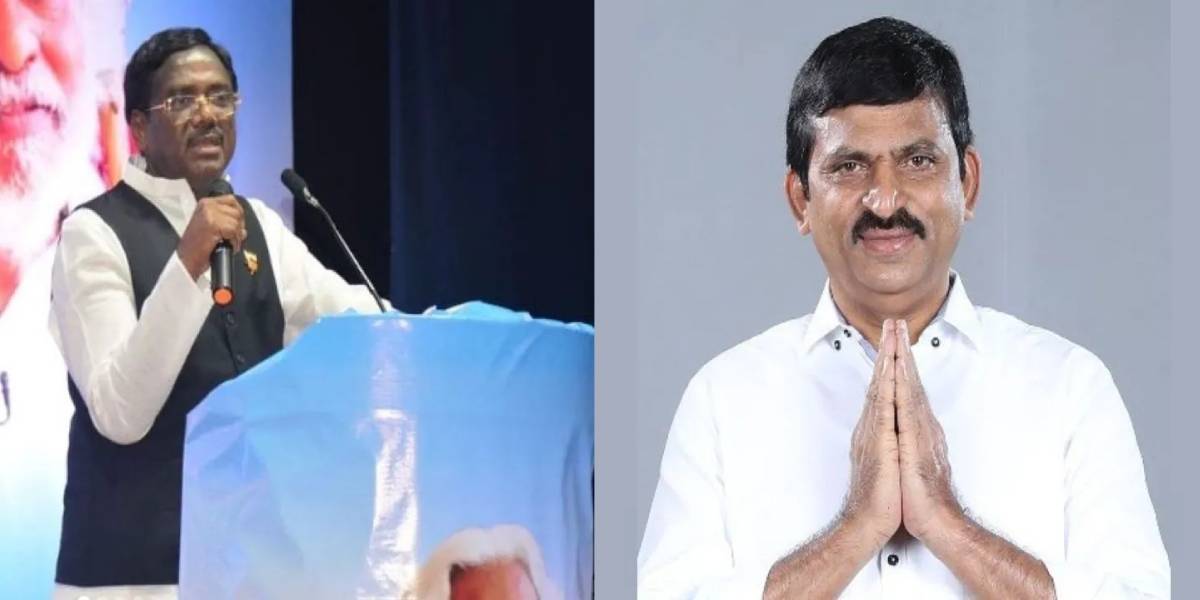
'Velugu', a Telugu newspaper owned by Labour Minister G Vivek Venkataswamy (Left), alleged that corruption is rampant in the Revenue Department under Minister Ponguleti Srinivasa Reddy.
Synopsis: The news report alleged that additional collectors—entrusted with resolving complex land disputes—turned their offices into extortion centres, demanding hefty bribes for inclusions, deletions, and corrections in land records. Farmers, who approached officials seeking relief and clarity, were reportedly made to pay to regularise even their own legally-held lands.
A front-page report in Velugu, a Telugu newspaper on Saturday, 20 December, alleging rampant irregularities and large-scale corruption in land registrations under the Bhu Bharati Act in Telangana has exposed not just administrative rot but also what many see as a widening crack within the state Cabinet.
The timing and prominence of the report have added a sharp political edge to the controversy. The Bhu Bharati Act falls under the watch of Revenue Minister Ponguleti Srinivasa Reddy, while Labour Minister G Vivek Venkataswamy owns Velugu.
The report fuelled intense speculation about a simmering rivalry, now spilling into the public domain.
The news report alleged that additional collectors—entrusted with resolving complex land disputes—turned their offices into extortion centres, demanding hefty bribes for inclusions, deletions, and corrections in land records. Farmers, who approached officials seeking relief and clarity, were reportedly made to pay to regularise even their own legally-held lands.
Files of those unwilling or unable to “play along” were allegedly left to gather dust indefinitely, stalled on one pretext or another, the report said. In stark contrast, applications backed by bribes—often routed through trusted middlemen—were expeditiously cleared, raising serious questions about the integrity of the process.
Additional collectors, the report alleged, exploited the vast powers vested in them under the Act, including removal of lands from the prohibited list (22A), correction of survey numbers wrongly recorded as government land, data rectification modules, and resolution of discrepancies in land extent.
What was intended as a farmer-friendly reform, critics said, has been twisted into a money-spinning machine, with innocent landowners footing the bill.
The Chief Minister’s Office (CMO) has reportedly been inundated with complaints from districts such as Sangareddy, Rangareddy, Medchal–Malkajgiri, Vikarabad, and Yadadri Bhongir. Similar allegations have also emerged from Warangal, Hanamkonda, and Siddipet.
Given the high market value of land in these districts, officials have been accused of demanding exorbitant sums, particularly for the regularisation of industrial lands in Sangareddy and residential lands in Rangareddy.
Even minor corrections, farmers complained, required endless rounds of offices.
Sources said the Chief Minister was visibly angry after reviewing the complaints and asked the senior officials to “set the house in order” by taking stern action against erring officials.
The report further alleged that corruption in land registrations remained deeply entrenched across Telangana, despite repeated government assurances and the introduction of digitisation.
Farmers approaching offices under government schemes or welfare-linked services were reportedly not spared either, with officials accused of exploiting their vulnerability—especially those forced to sell land due to financial distress.
While allegations of corruption in land and registration departments were not new, what set the latest episode apart was its political undertone. By placing the issue prominently on its front page, Velugu has amplified public anger and sharpened the spotlight on governance failures, given the ownership of the newspaper.
Congress circles saw the exposé less as a routine investigative report and more as a pointed message in an ongoing internal tussle. Party insiders admitted that the leadership, uncomfortable with the episode, has been closely monitoring the situation.
With farmers and small landowners bearing the brunt of the alleged irregularities, the issue might snowball into a larger political headache.
(Edited by Majnu Babu).


