

Published Oct 24, 2026 | 7:00 AM ⚊ Updated Oct 24, 2026 | 7:00 AM

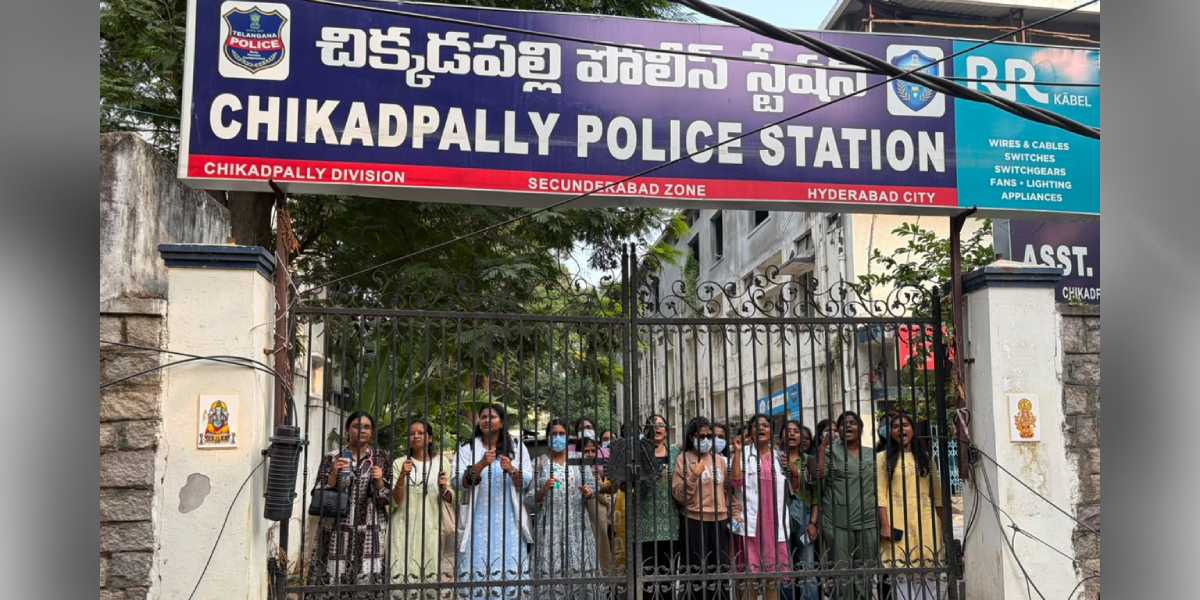
FMG interns were taken to Chikkadpally Police Station after being detained from the DMHS campus in Sultan Bazaar, Hyderabad. (Supplied)

Synopsis: Medical graduates from foreign universities interning at government hospitals in Telangana say they are struggling to survive without regular stipends and are forced to rely on their parents. Demanding parity with Indian medical graduates, they have sought monthly payments of ₹29,792, payment of pending dues, and protection from punitive action after protests over years of unresolved representations.
India has long debated and interpreted equal pay for equal work in multiple ways. Yet the concept has not taken root, despite efforts to curb brain drain. Young Indians who graduated from foreign universities and are doing internships in Telangana know how hard it is to keep training and start practising as registered medical practitioners in the country.
Take the case of 24-year-old Mohammad Sameer Sohail. He works as a doctor-in-training at a government hospital in Nagarkurnool and depends entirely on his family for survival.
“They (his parents) have been paying all my bills, paying all my rent,” Sohail told South First. “I feel ashamed that, at 24 years old, I still can’t foot my bills.”
Other foreign-educated interns in Telangana’s government hospitals also hide the same embarrassment behind the forced smiles they flash at patients. The Telangana Medical Council (TGMC), meanwhile, washed its hands of it, saying it has no role in helping foreign-educated medical graduates to undertake their internships with dignity.
Sohail has cleared India’s Foreign Medical Graduate Examination (FMGE) after completing his medical education in Georgia. He is now doing the mandatory one-year internship to practise medicine in India.
He began studying medicine in Ukraine in 2018. After Russia’s invasion of the East European country disrupted his education, he moved to Georgia, graduated, and returned to India. He cleared the FMGE in January 2025 and began his internship in Telangana in June 2026.
The internship is meant to qualify him to practise medicine in India. Instead, it has left him working long hours while remaining financially dependent on his family. People like Sohail receive a meagre stipend, less than their India-educated counterparts.
“We are facing this stipend issue all over Telangana,” he said. “Not just (at) my hospital, but collectively, at every government general hospital. Every FMG intern is facing this right now.”
Sohail is among the foreign medical graduate (FMG) interns demanding that Telangana pay eligible interns the same monthly stipend as Indian medical graduates working as house surgeons. The state’s revised rate is ₹29,792. Some FMGs said they received ₹5,000 only occasionally; others received no stipend for months.
At ₹5,000 a month, the payment amounts to roughly ₹166 a day. Interns said it does not even cover their basic expenses, especially when they are posted away from home.
According to Telangana’s Labour Department website, the daily minimum wage for a brick kiln worker is ₹260.79.
“We are not asking for a stipend hike or any extra amount,” Hari Venkatesh, an intern at a government hospital in Rajanna Sircilla, said. “We are asking for the same stipend that Indian medical graduates receive because we perform the same duties.”
For Sohail, Venkatesh, and many others like them, the issue is not just how much money gets credited to their bank accounts. It is also about their long wait for a solution, the work they perform, and the embarrassment of still having to depend on their parents.
Their frustration spilt onto the streets of Hyderabad on Thursday, 22 October, when foreign-educated interns protested at the Telangana State Medical Council and marched to the Directorate of Medical Education (DME) office. They said approximately 150 to 200 interns were detained and taken to various police stations. They accused the police of using force.
The interns claimed they have submitted several representations over the years. They demanded stipend parity at the applicable rate of ₹29,792 for eligible FMGs, payment of eligible dues from January 2026, and a written assurance that participation in peaceful protests will not lead to punitive action or unfair extensions of their internships.
Also Read: India’s resident doctors are working long shifts that lead to fatal mistakes
For Sohail, the wait for parity has become difficult, something hard to explain to his family.
“We are not facing this situation for the first time. We have been giving representations repeatedly for the past four years,” he said. “Despite giving repeated representations, we have not been considered.”
He said interns have sometimes been told to look for opportunities in other states that provided stipends. But, as a Telangana domicile holder posted in a government hospital in the state, he questioned why he should have to leave to receive the justifiable payment.
“Why do I need to go somewhere? I am a domicile of Telangana. So, I have every right to work here,” he said.
Sohail said the interns submitted a representation on 23 September and waited for a response. Even the 22 October protest failed to get a concrete assurance.
“Today also, we got detained brutally,” he said after the protest. “They were really brutal on us. We were protesting peacefully.”
Station House Officer G Naresh of Sultan Bazaar said the police detained 93 foreign medical graduate interns after they allegedly refused to leave the Directorate of Medical and Health Services (DMHS) campus following a meeting with the Academic Director of Medical Education (DME).
“They were not allowed inside the DMHS campus. However, even after meeting the Academic DME, they did not leave the premises. They did not cooperate with the police and raised slogans inside the campus. Despite repeated warnings, they did not listen, so we decided to shift them to another police station,” the SHO told South First.
The officer added they were released after a few hours.
Also Read: Specialist doctor as daily wager?
The interns said they have yet to receive a response to their request for an appointment with the health minister. Sai Shashank, among those protesting, said FMG representatives met Academic DME Dr M Ramadevi on 22 October. Shashank said the DME asked for a month to consider the issue.
“We have already given a lot of time. This issue has been continuing for the past three to four years,” he said. “But till now there is no resolution.”
Shashank said the interns had submitted an official representation on 23 September, a month before the 22 October meeting with the DME.
“They are still asking for one more month,” he said.
The interns said they had not received written assurance or an official order resolving their demands. Their press note said they wanted the authorities to clarify the applicable stipend, clear eligible arrears and ensure that interns were not penalised for taking part in the protest.
South First tried to contact Telangana Director of Medical Education Dr N Vani over the phone to seek her response. She did not respond to the calls.
Also Read: 9 out of 10 Indian doctors do not want their children to pursue their career
Bhuvaneswari, an intern posted at District Hospital Tandur, began medical school in Ukraine in 2018. After the war disrupted her education in 2022, she returned to India and later continued her studies in Uzbekistan. She completed her course in January 2025, passed the FMGE in June that year and started her internship in January 2026.
The young woman said she had not received a stipend during her internship.
“My monthly expense goes up to ₹25,000 per month,” she said. “It is difficult for my mom and my dad to support me, but I am still dependent on them. It is embarrassing at this age, but yeah…,” her words trailed off.
Her estimate included the costs involved in completing her posting away from home. Expenses vary between interns, but rent, food and travel are unavoidable for those staying away from their families.
Bhuvaneswari said the demand for parity should not be seen as an attempt to diminish Indian medical graduates’ work.
“We know that Indian medical graduates work hard, and we are not trying to diminish their work,” she said. “We are asking for equal treatment because we are also working in these hospitals and serving patients.”
She also mentioned the difficulty in striking a work-life balance. Obtaining leave or time off from work could be difficult for interns. Experiences varied across departments: some senior doctors were supportive and guided interns; others were not.
Bhuvaneswari said the internship required FMGs to meet India’s requirements before they could move toward registration. She accepted that they must complete the prescribed training, but questioned the unequal stipend for eligible interns performing hospital duties.
The financial pressure on Bhuvaneswari and her family has continued long after the Russia-Ukraine war disrupted their plans. She returned to India to complete her medical education and qualify to practise. Still, her parents were meeting her expenses.
For FMGs like Bhuvaneswari, the war is still raging in Telangana, their home state.
Also Read: Why do doctors die young?
Venkatesh graduated from Kazan Federal University in Russia in 2025 and passed the FMGE on his first attempt in January 2026. He is now posted at a government hospital in Rajanna Sircilla, while his family lives in Hyderabad.
According to his estimates, around 650 FMG interns have been posted across approximately 27 government general hospitals in Telangana. Other interns gave broadly similar estimates, though the figure has not been independently verified.
Venkatesh said the ₹5,000 payment is not a reliable monthly income. Some interns received it after several months, while others did not receive that amount at all.
“They are giving ₹5,000 but not monthly,” he said. “They are giving the amount together once in six-seven months.” He said some government hospitals have not paid the stipends.
Venkatesh has been staying in a rented accommodation in Rajanna Sircilla. The demands of hospital work leave little time to find other means to support himself. He described duties that lasted 24 hours and continued into the following day.
“They (Indian graduates) are also working 24 hours; we are also working 24 hours,” he said.
At peripheral hospitals, he said, FMG interns can make up a substantial share of the workforce. He estimated that around 15 or 16 FMGs from different batches worked at his hospital, which he said handles about 1,000 to 1,200 outpatients a day.
He questioned the stepmotherly treatment meted out to FMGs: why the stipend should differ when interns share similar responsibilities.
“We are not asking for a stipend hike or any extra amount,” he said. “We are asking for the same stipend that Indian medical graduates receive because we perform the same duties in the hospitals.”
Venkatesh said his monthly expenses came to around ₹10,000 to ₹12,000. He added that not all interns have family support. “They don’t have that much money,” he said.
Also Read: Psychiatrist calls for focus on mental health in medical colleges
Shashank has been doing his internship at a government hospital in Nagarkurnool since June 2026 and has not received any payment. He graduated from Caucasus International University in Tbilisi, Georgia.
For Shashank, passing the screening examination is only one part of a long process. He said the examination required considerable preparation.
Shashank said the screening examination was necessary because the two countries have different medical education systems. He questioned whether the extra exam requirement should translate into unequal treatment during the internship.
He also questioned why Telangana residents should seek internships elsewhere for better financial support.
Also Read: NMC should find out why PG doctors are stressed, depressed
Telangana Medical Council (TGMC) member Dr G Srinivas said the council’s role is limited to conducting counselling and allotting internship postings based on merit, available government vacancies, and National Medical Commission (NMC) guidelines.
“We have no role in policy decisions regarding stipends. The government takes those decisions. Our responsibility is to publish the vacancies received from the government and the Directorate of Medical Education (DME) and conduct counselling based on the merit list,” he told South First.
He explained that counselling takes place twice a year, corresponding to the June and December sessions. The council prepares the merit list and allocates postings based on candidates’ rankings and available vacancies.
“Foreign medical graduates have to complete one year of internship, after which their registration is processed according to NMC guidelines,” Dr Srinivas said.
Also Read: Why are junior doctors stressed and dying by suicide?
The interns’ demand is backed by regulatory guidance, a Telangana government order revising house-surgeon stipends and a Supreme Court order involving foreign medical graduates. The documents support the principle of stipend parity, but do not establish that every FMG automatically qualifies for ₹29,792, irrespective of training history or eligibility.
A National Medical Commission (NMC) circular dated 4 March 2022, on the registration of foreign medical graduates, stated that eligible FMGs should receive stipends and other facilities equivalent to those provided to Indian medical graduates at government medical colleges. The relevant authority must fix the applicable rates. The circular also prohibited medical colleges from charging FMGs fees for offering them internships.
An NMC public notice, dated 22 November 2023, further clarified the requirements for specified categories of FMGs, including some affected by the COVID-19 pandemic and the war in Ukraine. It distinguished between candidates who completed their medical courses offline and those whose education was interrupted or completed online, with different training requirements for different categories. For eligible FMGs covered by the notice, stipend parity applies at the same institution.
Telangana’s G.O.Ms.No.90, issued on 28 July 2025, approved a 15% increase in stipends with effect from 1 January 2025, for house surgeons, postgraduate medical and dental students, super-speciality students and senior residents. It raised the monthly stipend for medical and dental house surgeons from ₹25,906 to ₹29,792.
However, the order’s table did not specifically name FMG interns. Their demand rested on applying the NMC’s parity guidance alongside the state’s revised rate and the rules applicable to their individual circumstances.
The Supreme Court also addressed stipend claims in an order dated 4 February 2026, in Shashank Shekher Pandey and Others v. State of Jharkhand and Others. The petitioners were foreign medical graduates who had completed internships between June 2023 and June 2024. They sought the same stipend as younger FMGs who had received payments under an earlier court order.
The court held that the petitioners stood on the same footing as earlier interns and could not be discriminated against by paying them less. It directed the respondents to pay the stipend difference within three weeks. The order also addressed concerns about adverse action by the University Grants Commission against colleges that paid stipends pursuant to court directions.
The ruling supported the principle that similarly placed FMGs should not be denied stipend payments. It did not, by itself, order every institution in Telangana to pay ₹29,792 to every FMG. The precise entitlement depended on the applicable rules, the intern’s circumstances and the relevant authority’s obligations.
The Telangana interns wanted the state to clarify how those provisions apply to them, issue a written decision and pay eligible pending dues.
Also Read: 7 in 10 Kerala doctors want to leave
The interns began their latest protest on 8 October. They submitted representations and sought an appointment with the health minister before gathering at the Telangana State Medical Council on 22 October and proceeding towards the DME office.
Shashank said the police stopped the protesters before they could enter the DME office premises. He said representatives eventually met Academic DME Dr Ramadevi, who asked for more time.
The interns also raised concerns about possible retaliation, including unfair extensions of their mandatory internship or punitive action for taking part in protests. They want written assurance that participation in peaceful demonstrations would not affect their training or registrations.
For now, no written order has resolved their demands. Venkatesh said they kept visiting officials for updates but have not received a clear timeline.
“No, we keep going there for follow-ups,” he said. “Today, they end up saying, one of the higher authorities, that there is no progress.”
He added: “So, we are waiting for the progress. We will wait for the progress. I hope someday we will get our progress.”
Also Read: 36-hour shifts for doctors, 8-hour limit for pilots
Dr G Vikram, president of the Telangana Junior Doctors Association (T-JUDA), which represents Indian medical graduates (IMG) in Telangana, expressed solidarity with foreign medical graduate (FMG) interns and urged the authorities to address their demands.
“FMG interns are an integral part of our medical fraternity and contribute significantly to patient care across government medical colleges, particularly in peripheral institutions. Their contribution to the healthcare system must be recognised, and their genuine concerns must be addressed with dignity and fairness,” he said.
“FMGs and IMGs are one medical fraternity. Differences in medical education pathways must never become a reason for discrimination, neglect, or unequal treatment. Their fight for justice deserves to be heard, not suppressed. Their concerns deserve solutions, not intimidation,” Dr Vikram said.
“T-JUDA stands firmly in solidarity with FMG interns and their legitimate demands. We urge the authorities concerned to initiate constructive dialogue, resolve their grievances at the earliest, and ensure that no intern faces victimisation for peacefully raising their voice,” he added.
(Edited by Majnu Babu).



