

Published May 23, 2026 | 7:00 AM ⚊ Updated May 23, 2026 | 7:00 AM


Doctor. (Representative image)

Synopsis: Kerala’s globally admired healthcare system is facing a growing doctor exodus demand, with nearly 70 percent of doctors wanting to leave the state or country, according to an IMA survey. Low salaries, poor working conditions, compulsory bond service, and shrinking opportunities amid rising corporate hospital dominance are making the young doctors away look outward.
Kerala built a healthcare system the rest of India studied and admired. Its doctor-to-population ratio, its network of clinics and hospitals, its public health outcomes, all held up as models worth replicating.
Now the doctors who run that system want out.
A survey conducted by the Kerala chapter of the Indian Medical Association (IMA) across 4,000 doctors found that 58.7 percent want to leave for another country, and another 7.6 percent want to move to another Indian state. Only 31.8 percent want to stay in Kerala.
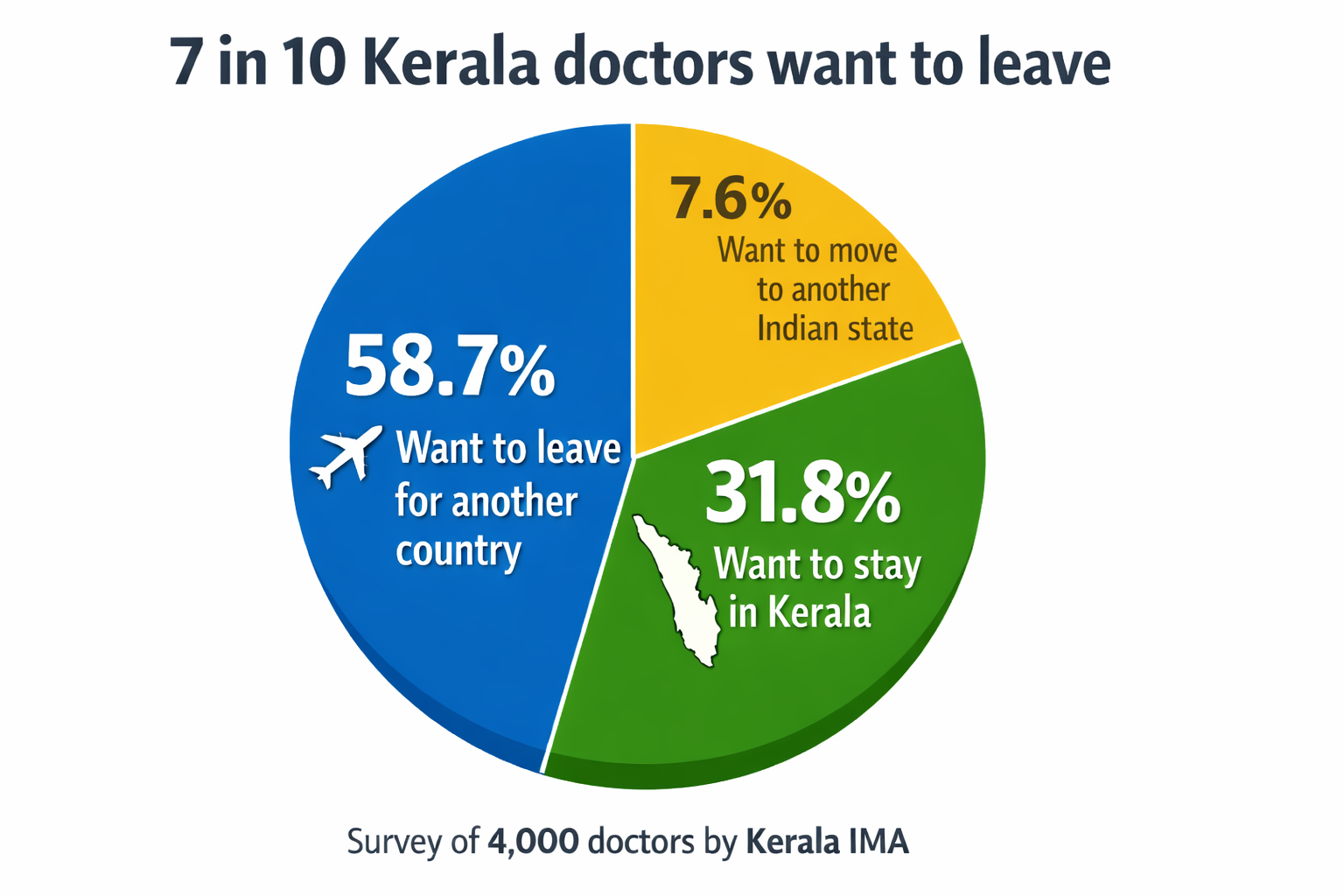
7 in 10 Kerala doctors want to leave
That means roughly 7 in 10 doctors are planning to leave.
“In an alarming trend we identified over the past three months, nearly 70 percent of doctors wish to move out, either abroad or to other states,” said Dr Sulphi Noohu, chairman of the IMA committee that conducted the survey. “Providing better wages and ensuring a safe work environment can help young doctors stay in Kerala.”
Also Read: Kerala’s healthcare paradox: The state that is most ill, most hospitalised, and pays the most
The survey, the first of its kind in Kerala, points to pay as the central driver.
Nearly 45 percent of the 4,000 doctors who participated earn below ₹50,000 a month. Around 6.7 percent earn below ₹30,000. The average salary, Dr Noohu said, sits between ₹35,000 and ₹40,000.
“Almost 60 to 70 percent of doctors are underpaid. We conducted the survey across all specialities and found that many doctors are earning less than ₹30,000 a month. The average salary is only around ₹35,000 to ₹40,000 in Kerala despite the tough working conditions and long duty hours,” Dr Noohu said.
82 percent of respondents said they do not receive fair pay. Only 10.3 percent reported satisfaction with their salaries. 37.8 percent said they are dissatisfied, and 28.8 percent said they are very dissatisfied.
The situation worsens for those still in training. Among the 4,000 surveyed, 30.5 percent of resident doctors receive no stipend at all. Another 20.3 percent receive below ₹10,000 a month.
The survey also found that approximately 81 percent of junior doctors work under compulsory bond service obligations, which means, they cannot leave even when conditions push them to.
“There is no work safety. Doctors are underpaid even for the kind of duty hours they put in,” Dr Noohu said.
IMA state president Dr M N Menon put it directly in a press conference: “An MBBS doctor who works 48 hours a week deserves a minimum monthly salary of ₹80,000.”
The IMA committee has formally recommended ₹80,000 per month as the minimum salary for MBBS doctors, applicable for a 48-hour work week, with mandatory overtime pay beyond that, annual increments, written appointment terms, and salary disbursement before the third working day of every month.
The exodus does not point only to foreign shores. It points to something that has changed inside Kerala’s own healthcare economy.
South First has previously reported that 1,306 outpatient clinics and 444 small hospitals shut across Kerala in the last five years alone, a sharp rise from the 148 clinics and 262 small hospitals that closed in the preceding five years. Corporate hospitals backed by American private equity firms have moved into the vacuum, with more than $700 million invested since October 2023.
Dr Noohu connects both realities directly.
“When small hospitals shut down, young doctors lost many employment opportunities and that created a job crunch. As the number of doctors increases and opportunities shrink, corporate hospitals begin treating doctors like replaceable applicants,” he said.
“Treatment expenditure has increased, but doctors and hospital staff are still not being adequately paid. In many corporate hospitals, managements pay doctors less while taking huge profits themselves. Their focus is on profits and nothing else.”
For generations, Kerala’s doctors relied on migration as the pressure valve. The UK, US, and the Middle East absorbed thousands.
That route is narrowing.
“Earlier, doctors from Kerala and other southern states used to migrate to the UK, US, Middle East and many other countries. But now even those opportunities are shrinking. I have heard that nearly 15,000 people are waiting in the UK system after clearing their qualifying examinations, but they are still waiting for jobs,” Dr Noohu said.
“The UK is no longer easy, the US has become tougher, and while countries like Australia, New Zealand and Germany have opportunities, they are not enough to absorb everyone.”
Also Read: Collapse of trust: Beneath rubble lies Kerala’s healthcare illusion
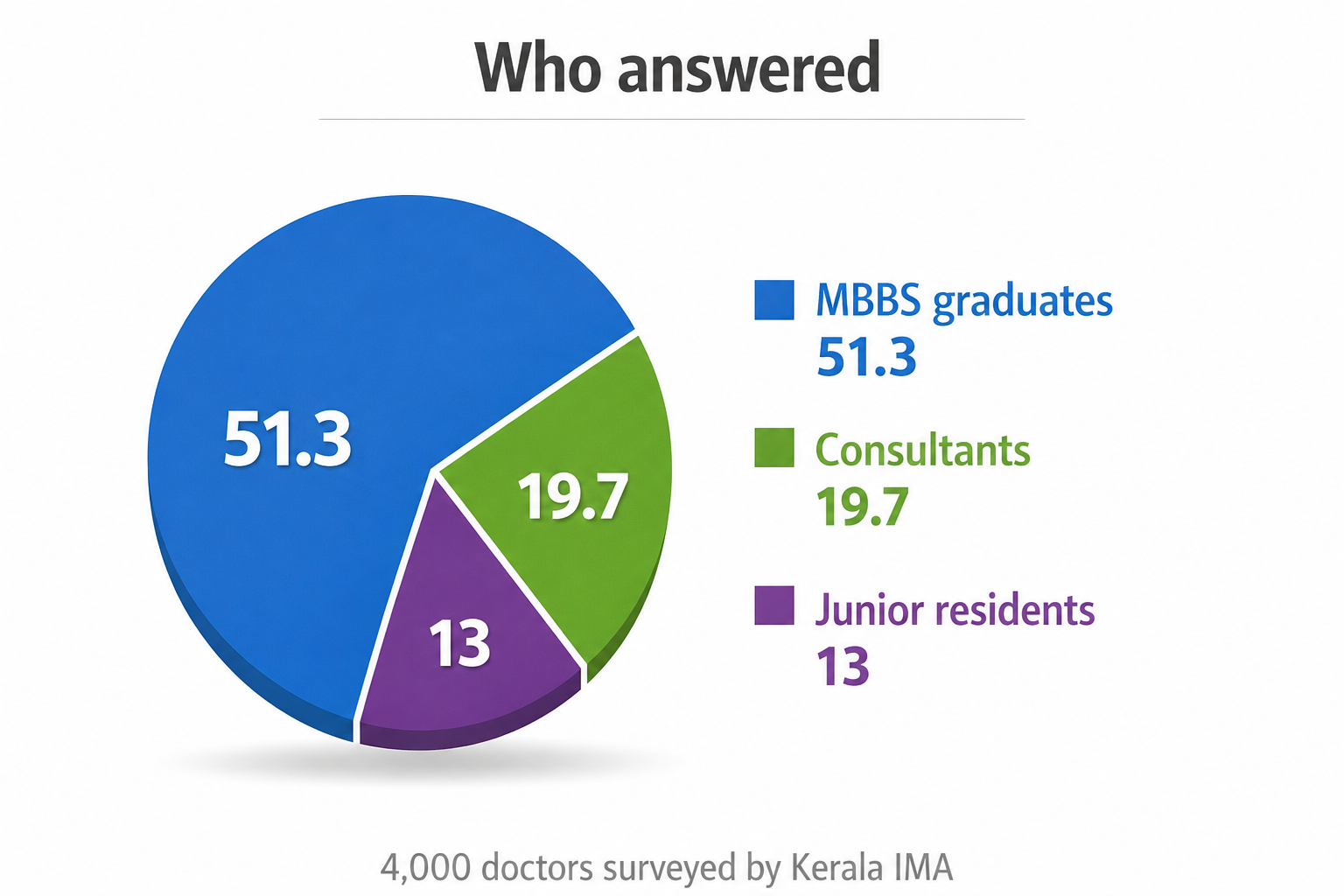
Who answered (South First)
The survey drew participation from across specialities and career stages. 51.3 percent of respondents were MBBS graduates. Consultants made up 19.7 percent. Junior residents accounted for 13 percent.
Crucially, 51.1 percent of respondents were between 25 and 30 years old. These are doctors at the beginning of their careers, not the end.
They trained through years of medical school, cleared licensing examinations, and entered a workforce that pays them an average of ₹40,000 a month, bonds them into service they cannot exit, and offers no clear path upward.
“Unless someone is willing to work in remote areas of states like Uttar Pradesh, opportunities are becoming limited. We need a complete rethinking of medical workforce planning,” Dr Noohu said.
The IMA has called for government intervention to implement a basic salary structure and revise staffing patterns. It also flagged the need for uniform stipends, an end to bonded labour, protection from workplace harassment, and more postgraduate seats aligned with actual healthcare demand.
“Providing better wages and ensuring a safe work environment can help young doctors stay in Kerala,” Dr Noohu said.
Kerala’s health system did not build itself. Doctors built it. The survey suggests the next generation of those doctors has already decided it is not worth staying to maintain.
Also Read: Kerala household’s hospital bill runs Rs 10,341 out-of-pocket compared to Rs 5,290 across India
(Edited by Sumavarsha)



