

Published Jul 03, 2026 | 9:28 AM ⚊ Updated Jul 03, 2026 | 9:28 AM

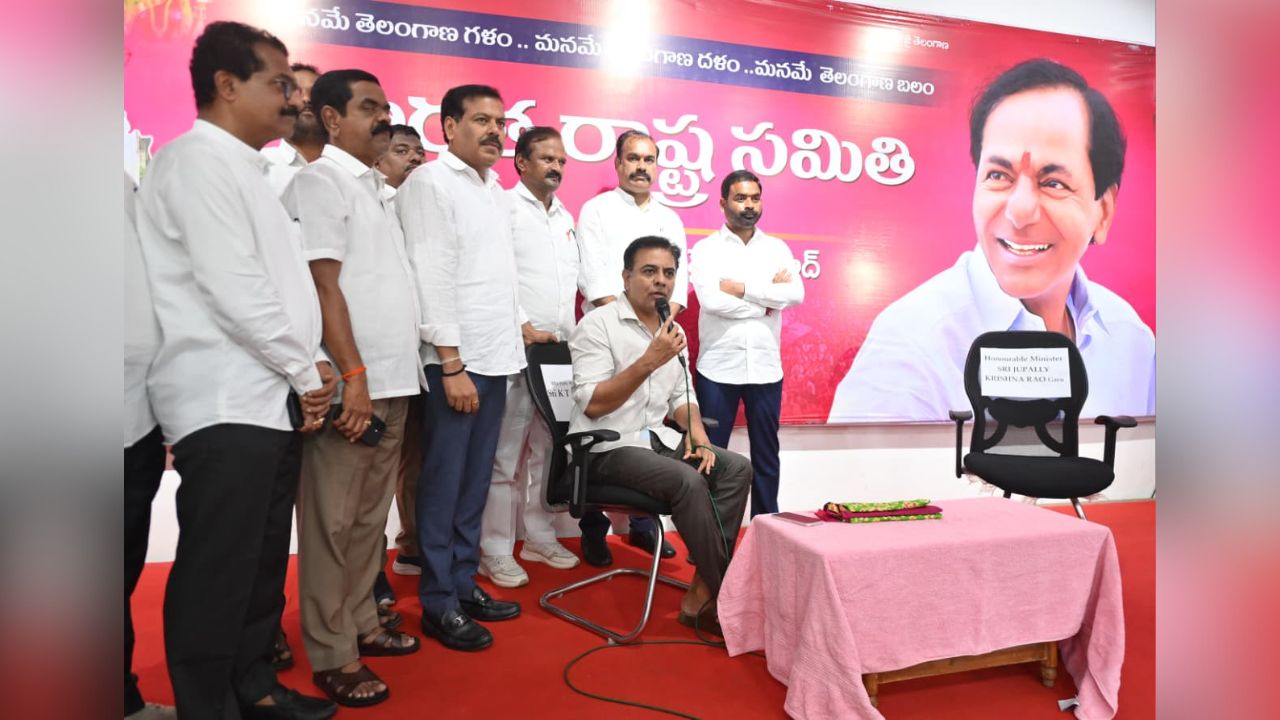
BRS Working President KT Rama Rao challenged Minister Juapplly Krishna Rao for a debate.

Synopsis: The BRS in Telangana appears to have gained political mileage following the alleged irregularities in the procurement of supplies for social welfare educational institutions. The core issue centred on BRS accusations of large-scale corruption in the procurement of the supplies and the pushback by the ruling Congress.
The Opposition BRS in Telangana appears to have gained political mileage from a series of developments linked to alleged irregularities in the procurement of inventory for social welfare educational institutions. It followed repeated unnecessary challenges by Congress ministers, which drew strong criticism from Chief Minister A Revanth Reddy.
Hyderabad witnessed a sharp and tense political confrontation on Thursday, 2 July, as the ruling Congress and the Opposition BRS clashed publicly over these allegations.
The episode, marked by debate challenges, counter-challenges, police intervention, and arrests, underscored the deepening rivalry between the two parties while amplifying BRS’s visibility across media platforms.
Also Read: Telangana government launches Breakfast and Milk Scheme at state-run schools
The core issue centred on BRS accusations of large-scale corruption in the procurement of uniforms, shoes, and school bags for students in Telangana’s residential educational institutions, known as Gurukuls.
Opposition leaders, including BRS general secretary and former IPS officer RS Praveen Kumar, alleged significant financial irregularities, framing them as failures in a vital welfare initiative serving marginalised students.
Congress ministers pushed back assertively. SC Development Minister Adluri Lakshman Kumar dismissed the claims and challenged BRS to furnish evidence. He was joined by Backward Classes Welfare Minister Ponnam Prabhakar and Minorities Welfare Minister Mohammad Azharuddin, among others.
Accepting the gauntlet, the ministers assembled at the Congress Legislature Party office and proceeded to Gun Park (Telangana Martyrs’ Memorial) near the Assembly, where they awaited BRS counterparts for an open debate.
In a parallel development, Excise Minister Jupally Krishna Rao positioned himself to attend a debate on state debt at Telangana Bhavan with BRS Working President KT Rama Rao (KTR).
Even as KTR waited at Telangana Bhavan, Krishna Rao never turned up. This exchange reflected ongoing mutual accusations — the Congress highlighting the fiscal legacy of the previous BRS regime, and the Opposition scrutinising the current government’s handling of finances and new contracts.
Tensions peaked when senior BRS leaders attempted to move from Telangana Bhavan toward Gun Park. Former ministers T Harish Rao and V Srinivas Goud, along with Praveen Kumar and other workers, were detained by police outside Telangana Bhavan amid heavy security deployment aimed at preventing potential clashes.
The arrests, which drew strong criticism from the BRS as suppression of democratic expression, added dramatic intensity to the day’s events. The leaders were later released in the evening.
Chief Minister A Revanth Reddy expressed displeasure over the unnecessary challenges issued by some ministers.
“Why should you throw a challenge when you can’t keep it up?” the chief minister reportedly remarked at the Cabinet meeting in an indirect reference to Krishna Rao.
He viewed such aggressive posturing as detracting from substantive governance discourse. Building on his earlier comments following the Rythu Bandhu fund release, Reddy reiterated the government’s readiness for broad debates comparing the Congress’s recent tenure, the BRS’s decade in power, and central performance records.
His administration framed the ministers’ public stance as a mark of transparency, while accusing the BRS of prioritising disruption over dialogue.
With BRS leaders unable to reach Gun Park due to the detentions, Congress ministers addressed the media at the site. They claimed that the Opposition had avoided the debate out of apprehension.
BRS figures, including KTR and Harish Rao, countered by labelling the government evasive and vowed intensified protests alongside demands for a special Assembly session to discuss accountability.
Also Read: Systemic lapses in Telangana schools
This confrontation captured the inherent dynamics of incumbent-Opposition politics in Telangana. For Congress, protecting the credibility of Gurukul welfare programs remains essential, given their importance to backward classes, SCs, STs, and minority communities.
The ministers’ willingness to debate publicly, even amid the chief minister’s reservations about the approach, sought to shift the narrative toward evidence and delivery.
Conversely, BRS capitalised on the controversy to spotlight perceived governance shortfalls in a sector it previously championed. The involvement of high-profile leaders like Harish Rao, Srinivas Goud, and Praveen Kumar, followed by their brief detention, helped sustain momentum and media focus, turning a policy dispute into a broader spectacle of confrontation.
Ultimately, neither side achieved a clear breakthrough. No detailed evidence was presented publicly, resulting in a stalemate punctuated by arrests and rhetorical exchanges.
While such episodes mobilise political bases and generate publicity, particularly beneficial for the Opposition, they risk diverting attention from the core objective of Gurukul institutions: Providing quality education and support to vulnerable students. Prolonged uncertainty over procurement, even alongside ongoing inquiries, could undermine public trust if not resolved transparently.
In a state with strong welfare expectations, these clashes test the ruling party’s implementation narrative against the Opposition’s legacy critiques. The chief minister’s intervention regarding the ministers’ approach and the police action further intensified the political temperature.
These events in Hyderabad exemplify the competitive, often theatrical nature of Telangana politics. Challenges and ensuing drama produce immediate headlines, but long-term credibility hinges on verifiable accountability, data-backed responses, and visible improvements on the ground.
As both parties gear up for future battles, such confrontations are poised to define the state’s political discourse in the coming months.



