

Published Jun 15, 2026 | 12:46 PM ⚊ Updated Jun 15, 2026 | 12:46 PM

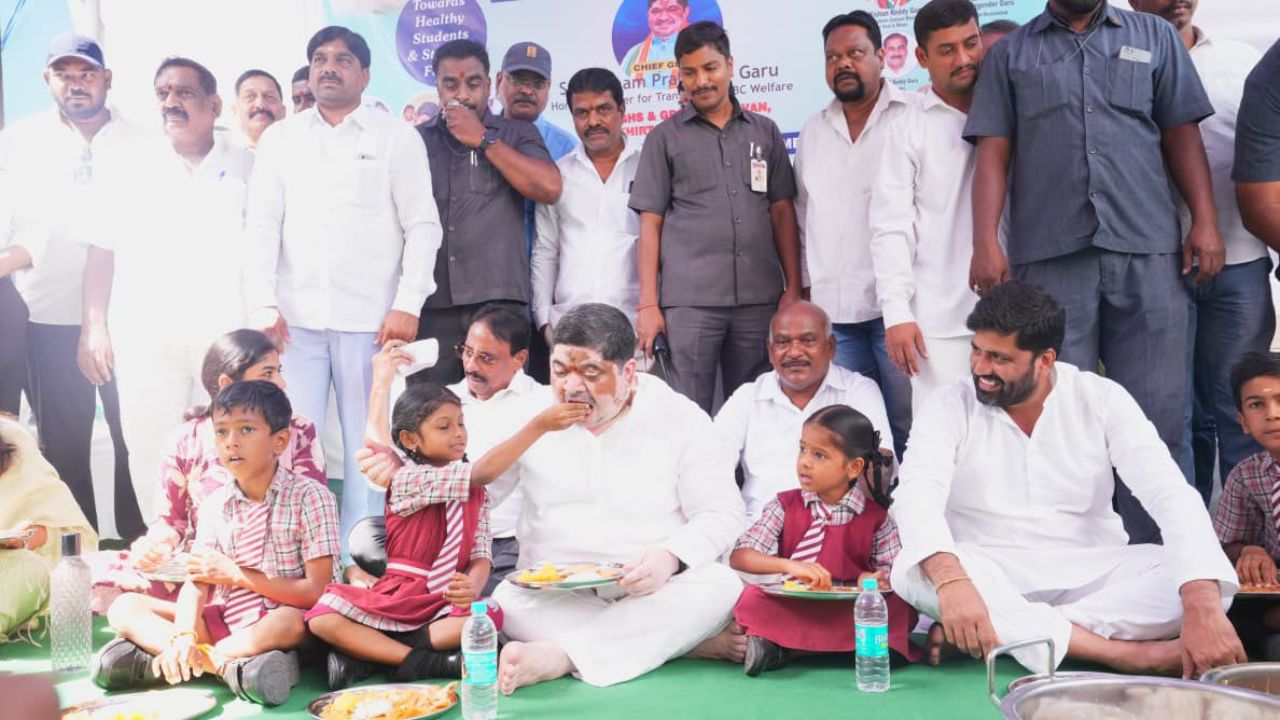
Telangana Minister Ponnam Prabhakar during the launch of Breakfast and Milk scheme.

Synopsis: Telangana Minister Ponnam Prabhakar launched the state government’s flagship Breakfast and Milk Scheme. The minister also distributed textbooks and notebooks to students as part of the inauguration ceremony. Earlier, the government made arrangements to distribute school uniforms, shoes, socks, neck ties, belts and bed material to all students studying in government schools and residential schools.
Marking the reopening of schools after the summer vacation, Telangana Minister Ponnam Prabhakar on Monday, 15 June, launched the state government’s flagship Breakfast and Milk Scheme at Raj Bhavan Government High School in Khairatabad. The minister also distributed textbooks and notebooks to students as part of the inauguration ceremony.
Speaking at the event, Ponnam Prabhakar said the scheme would benefit around 29 lakh students studying from pre-primary to Class XII in government schools across Telangana. The initiative has been launched alongside the state-wide “Badi Bata” enrolment drive, which aims to increase admissions in government schools, bring back dropouts and encourage parents to choose public education institutions.
Earlier, with an aim to strengthen the education sector, the government made arrangements to distribute school uniforms, shoes, socks, neck ties, belts and bed material to all students studying in government schools and residential schools, including Kasturba Gandhi, BC, SC, ST, and Minority residential schools.
According to officials, Chief Minister A Revanth Reddy has asked officials to ensure the quality of fabric.
Also Read: Telangana records nearly 20 kidney disease deaths per lakh, highest in India
Prabhakar said the government would spend about ₹720 crore annually on the programme, including ₹540 crore towards providing breakfast and ₹180 crore for milk supply. Nutritious breakfasts will be served six days a week, while students will receive milk on Mondays, Wednesdays and Fridays and ragi malt on Tuesdays, Thursdays and Saturdays.
“The scheme has been introduced to ensure that no child attends school on an empty stomach. It will help prevent hunger and malnutrition, improve physical and mental health, enhance concentration and contribute to better academic performance,” Prabhakar said.
He urged students to focus on their studies and make their families proud through academic achievement. He also called upon teachers to work towards increasing enrolment in government schools.
“People often aspire to government jobs but overlook government schools and hospitals. The government is making every effort to strengthen public education and improve facilities for students,” he said.
Under the breakfast menu, students will be served items such as dosa with chutney, chapati with curry, millet idli with sambar, poori with aloo kurma, millet upma, pongal and bonda on different days of the week.
In Hyderabad district, 45 government schools have been selected in the first phase of implementation, benefiting 12,437 students. The programme is being implemented with the support of the Manna Trust.
According to officials, the scheme is intended to improve the nutritional status of students, increase attendance, reduce dropout rates and support healthy growth and learning outcomes.
Hyderabad district has 672 government schools with a total enrolment of 93,501 students. Of the schools selected in the first phase, 23 are primary schools with 5,258 students, two are upper primary schools with 175 students, and 20 are high schools with 7,004 students.
Officials said the breakfast scheme forms part of the Telangana government’s broader efforts to improve the quality of education by combining enhanced learning opportunities with better nutrition and health support for students.
MLAs Danam Nagender and Yashaswini Reddy, Hyderabad Collector Priyanka Ala, District Education Officer Yadaiah, Manna Trust CEO Leena Joseph and other officials attended the programme.
Also Read: Paper leaks, broken futures—What Hyderabad ‘cockroaches’ said at CJP protest
To avoid inconsistencies and occasional errors, and to ensure uniformity in procurement and distribution of uniform fabric and other items, the state government has introduced a centralised procurement system this year.
The state government has issued orders to procure 2.97 crore meters of fabric to provide two sets of uniforms to a total of 27 lakh students.
Chief Minister’s Office (CMO) said the government will be spending ₹687.78 crore to distribute uniforms and other essential materials to all students.
According to officials, women’s groups have been entrusted with the responsibility of stitching uniforms, which is expected to generate an income of over ₹40 crore for women’s groups.
The government is also providing kits containing high-quality materials to students studying in government schools. These kits include uniforms, as well as white shoes and white socks. Although shoes were provided only to students in BC residential schools, from this year, the state government is providing shoes to students across all types of school management.
Additionally, the government will provide comprehensive kits to students in BC, SC, ST, and minority residential schools, Kasturba Gandhi Balika Vidyalayas, and urban residential schools. Essential items will also be given to approximately 200,000 students in junior colleges.



