

Published Jun 27, 2023 | 11:05 PM ⚊ Updated Jun 27, 2023 | 11:07 PM

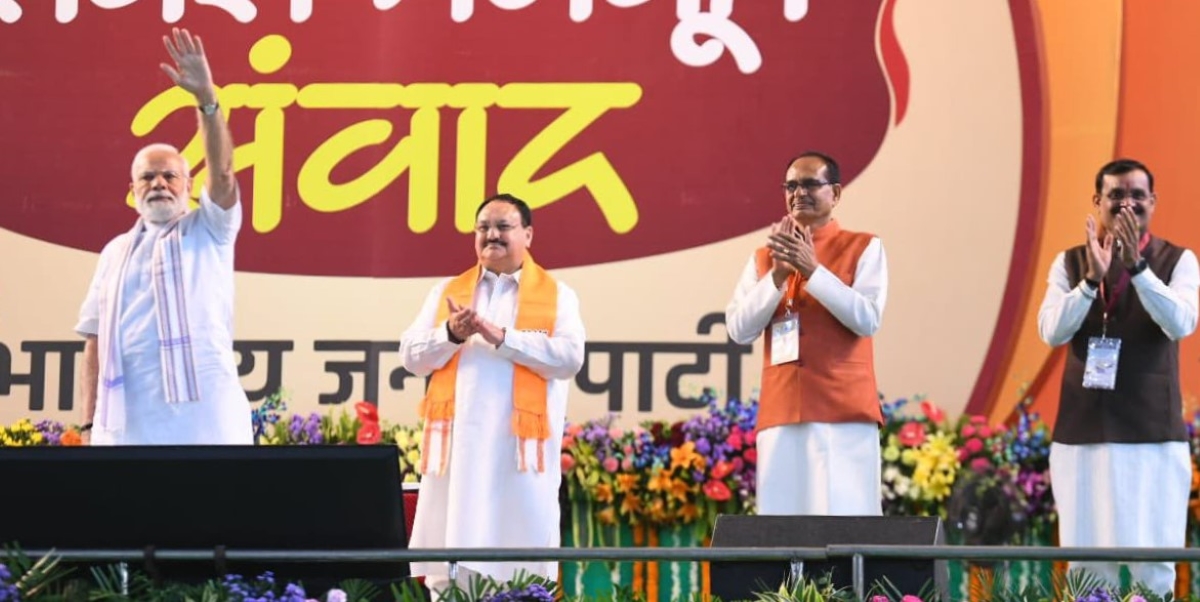
Prime Minister Narendra Modi with other BJP leaders at the Mera Booth Sabse Mazboot Samvad in Bhopal in Madhya Pradesh on Tuesday, 27 June, 2023. (Supplied)
Prime Minister Narendra Modi on Tuesday, 27 June, pointed to Telangana Chief Minister K Chandrashekar Rao by name while slamming him for his “family rule” of Telangana.
He was addressing a huge gathering in Bhopal in Madhya Pradesh as part of the BJP’s “Mera Booth Sabse Mazboot” programme.
His statement came while seeking votes in the state, where Assembly elections are due later this year.
The prime minister, who does not usually name any of his political rivals while criticising them, set aside this practice and called out KCR while trying to explain how deleterious family rule could be to democracy.
He said that if the people wanted Chandrashekar Rao’s daughter’s well-being, they should vote for the BRS.
However, if they want the well being of their families, they should vote for the BJP, he said.
“If you want to help KCR’s daughter, vote for the BRS. But, if you want the well being of your son, daughter, grandson, or granddaughter, then vote for the BJP,” he said.
Telangana Chief Minister and BRS chief KCR’s daughter K Kavitha — herself a BRS MLC in Telangana — is one of the accused in the Delhi liquor scam case.
She is already under the scanner of the Enforcement Directorate in connection with the case, and has been questioned at length by the probe agency.
The prime minister’s reference to KCR — that too by name — at a public meeting in faraway Bhopal came as a surprise to BRS workers in Telangana.
The attack on KCR, which came close on the heels of BJP president JP Nadda’s inflammatory comments, is being seen as an attempt to dispel the notion that the distance between the two parties narrowed in the recent past in Telangana.
Modi, in his speech on Tuesday, drove home the point that KCR’s family rule had to be jettisoned at any cost.
Though BJP leaders have been saying this for quite a long time, coming as it did from Narendra Modi, the comments seemed to have cleared doubts over whether an invisible bonding was taking place between the two parties.
KCR is yet to retaliate against the BJP, but BRS working president KT Rama Rao has already begun the onslaught, hitting back at Nadda at a public meeting in Uppal in Hyderabad.
He tried to shame the BJP leaders for asserting that they would send KCR to jail by asking them whether they wanted him to be in jail because he brought about rapid development in the state.


