

Published Oct 13, 2026 | 8:17 AM ⚊ Updated Oct 13, 2026 | 8:17 AM

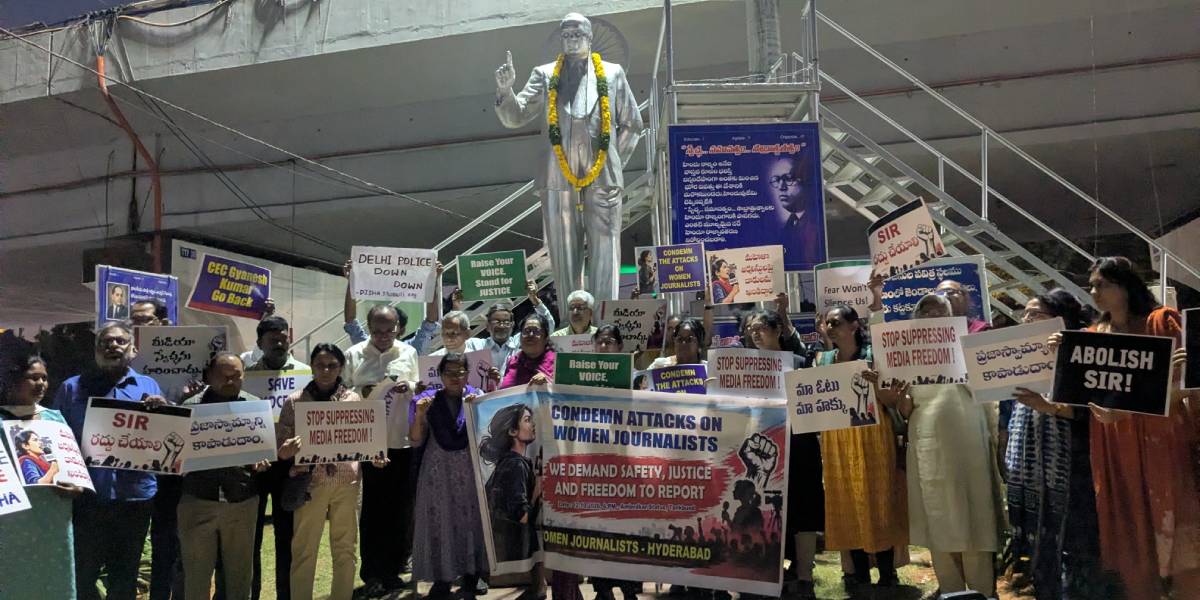
Women journalists protest in Hyderabad

Synopsis: Journalists in Hyderabad protested the detention and assault of reporters covering demonstrations against the Special Intensive Revision (SIR) of electoral rolls in Delhi. They demanded the release of detained journalists, an independent inquiry into the alleged police misconduct and protection for reporters covering protests. Speakers said the attacks fall hardest on women and are pushing a generation out of the profession.
Journalists from Hyderabad’s English and Telugu media gathered at Liberty Circle on Monday evening, 12 October, to protest the alleged mistreatment of reporters during the Delhi demonstrations against the Special Intensive Revision (SIR) of electoral rolls.
Under the Telugu Talli flyover at Tank Bund, with a garlanded Ambedkar statue looking on, they stood behind a banner with “We demand safety, justice and freedom to report,” written on it. They held placards that read: “Stop suppressing media freedom”, “Fear won’t silence us”, “Our vote, our right”.
The protest was held under the banner of Women Journalists – Hyderabad, who condemned the alleged detentions, assault and inappropriate treatment of journalists and protesters, especially women, at the hands of Delhi police. The protesting journalists were joined by their male colleagues, activists and representatives of student and youth organisations.
The protesters said incidents of repression of journalists were not confined to Delhi but also occurred in Mumbai and Hyderabad. The National Human Rights Commission has taken suo motu cognisance of allegations that police personnel sexually harassed three women journalists. It has asked the Delhi Police Commissioner for a detailed report within two weeks, they said.
The group also cited the Supreme Court’s 11 October direction against unlawful detentions, and the authorities’ assurance that journalists would not be obstructed. They said the attacks after that amount to contempt of court.
They made four major demands: release of all detained journalists and withdrawal of cases against them, no detention of journalists covering protests or public events in future, an independent inquiry that holds the personnel involved accountable, and freedom for women journalists to report without intimidation or threats.
Journalist Uma Sudhir, formerly with NDTV and Dekoder, said that an agitation that began over voters’ rights now raises a larger question of whether people can speak, dissent and gather peacefully. She said the images from Delhi were disturbing and urged citizens, not just journalists, to speak up against such police action.
Journalist C Vanaja of Mahua Media addressed the gathering and said, “People who speak out are getting detained, and now people who are recording those words are also getting detained. My blood is boiling looking at the visuals from Delhi.”
She said that young women in their 20s and 30s who entered journalism hoping to change society are now being attacked in ways so degrading that they struggle to talk about it publicly. Vanaja alleged that men in saffron scarves joined the police in attacking journalists and protesters, and that the two groups were hard to tell apart. She alleged the police seemed busier protecting these men than the public.
“What more should happen in this country for us to open our eyes?” she asked.
Also Read: Ex-security guard accused in killing of five-year-old in Kowkoor; residents demand death penalty
Srinidhi Viplava Sri, a reporter with the digital channel G8 News, said that the lack of press freedom is making young people turn away from the profession and that her own classroom exposed the crisis in the news media today.
Speaking to South First, she said, “I am currently pursuing a master’s degree at Osmania University and many in my class do not want to pursue jobs in news media because there is no freedom for press anymore. Such is the state of the field right now. Amid all these insecurities, there are still a few who are continuing to report and the State is making sure that those few also go back”
Recalling an incident where a picture of hers was digitally altered by social media trolls, Srinidhi said that such increasing instances of harassment are pushing women out of the field.
Senior journalist Jyothi told South First that in decades of her reporting experience, she has never seen a more dangerous time for journalists. Detained reporters were thrown to the ground and pushed into vans despite showing their ID cards, she said, and women activists and journalists alike were treated cruelly.
She argued that the present media landscape has left only a handful of independent journalists, and they are being subjected to intimidation while doing their job.
“Now the government says it will officially recognise only those from certain established media houses. It is asking people to show cards in order to not be detained. Obtaining such cards is itself a hurdle for independent journalists, especially women who are trying to make it all by themselves. They are creating conditions that make it impossible for honest, serious women journalists to continue,” she said.
Also in attendance were journalists Radhika, A Aruna, Surya Kumari, N Venugopal, T Karuna and Sajida; activists A Suneetha and Meera Sanghamitra; stand-up comic Vivek Muralidharan, and others.
(Edited by Dese Gowda)



