

Published Oct 12, 2026 | 10:16 PM ⚊ Updated Oct 12, 2026 | 11:00 PM

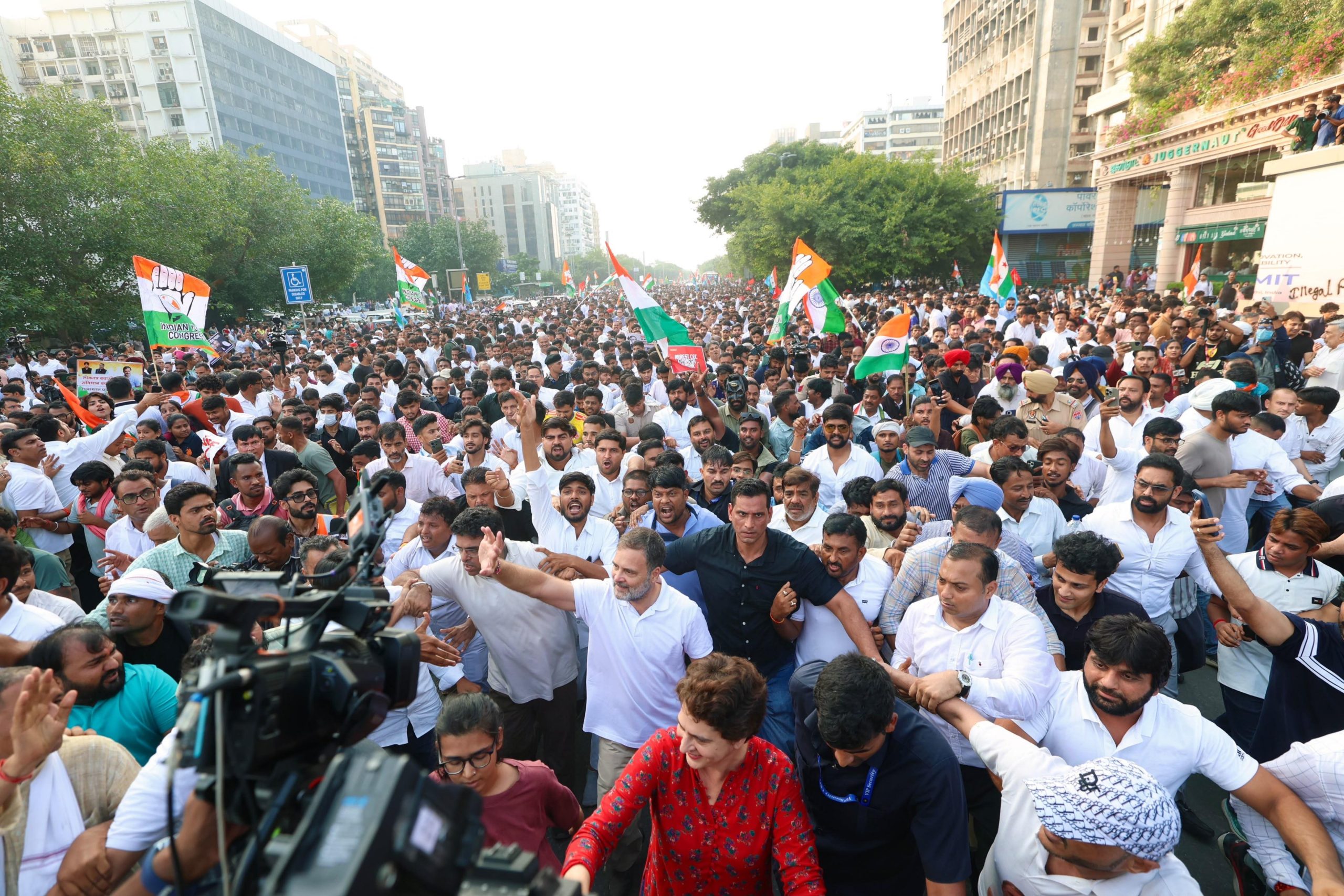
The INDIA bloc rally on Monday.

Synopsis: The INDIA bloc’s ‘Chalo Delhi’ march was the high point so far of the agitation against Chief Election Commissioner Gyanesh Kumar and the Special Intensive Revision (SIR) of electoral rolls. It drew more people onto the road than the Cockroach Janta Party (CJP)’s 10 October call. It also showed how far the movement’s centre of gravity has moved in a week, away from the youth outfit that set its early pace and towards the Opposition parties.
AISA national president Neha Bora rode the same bus as Rahul Gandhi and other senior Opposition leaders at the head of the rally as the INDIA bloc marched down Barakhamba Road on Monday afternoon, 12 October. More than 10,000 people marched on foot behind and around the buses toward the Supreme Court.
Two days earlier, All India Students’ Association (AISA) cadres waited inside Gurdwara Bangla Sahib for a chance to slip into a sealed Jantar Mantar, where the Cockroach Janta Party had called its protest. That Saturday, Delhi Police had deployed over 26,000 personnel on the streets, shut 45 Metro stations, suspended internet services and took around 3,000 people into custody by evening.
On Monday, Delhi was a different city. Over 30,000 police and paramilitary personnel were deployed, but were outnumbered, and they kept their distance. Barricades went up, the march went through, and no one was detained.
The INDIA bloc’s ‘Chalo Delhi‘ march was the high point so far of the agitation against Chief Election Commissioner Gyanesh Kumar and the Special Intensive Revision (SIR) of electoral rolls. It drew more people onto the road than the Cockroach Janta Party (CJP)’s 10 October call. It also showed how far the movement’s centre of gravity has moved in a week, away from the youth outfit that set its early pace and towards the Opposition parties.
Also Read: 11 INDIA bloc leaders sign plea against ECI, commissioners
The march set off from Constitution Club on Rafi Marg, moved down Feroz Shah Road to the Barakhamba Road intersection in Connaught Place, and on to Mandi House. Delhi Metro shut six stations near the route.
Various opposition parties took part in the rally.
The Supreme Court was the destination because the Chief Justice had pointed the way there. Rahul Gandhi and Congress president Mallikarjun Kharge had written to Chief Justice of India Surya Kant seeking a meeting. The topmost judge rejected the request on Sunday night, but said the Opposition was free to approach the court with a petition. Gandhi took him at his word.
At 4.35 pm, with the march still on the road, Gandhi’s counsel Prasanna S lodged a writ petition challenging the SIR. The co-petitioners include Kharge, Akhilesh Yadav, Tejashwi Yadav, Saugata Roy, Sanjay Raut, MA Baby, D Raja, Mahua Majhi, Supriya Sule and Keralam’s IUML MP ET Mohammed Basheer. The Election Commission, Kumar and Election Commissioners Sukhbir Singh Sandhu and Vivek Joshi are the respondents.
Among the key demands is that the Supreme Court scrap every decision Kumar has taken since he became CEC. The CJI has said the court can hear the petition on Tuesday, 13 October, along with the pending SIR matters.
The leaders reached the Supreme Court around 6.30 pm.
Also Read: Why the Delhi crackdown is a crisis of democracy
The senior leaders travelled in buses at the head of the march, with party cadres walking alongside and raising slogans against Kumar. With Rahul and Priyanka Gandhi were CPI general secretary D Raja, CPI(M) general secretary MA Baby, Samajwadi Party president Akhilesh Yadav, NCP (Sharadchandra Pawar) leader Supriya Sule, CPI(ML) Liberation general secretary Dipankar Bhattacharya, TMC MP Mahua Moitra and Swaraj India’s Yogendra Yadav.
SFI leader Aishe Ghosh, Delhi University professor Apoorvanand, and economist Jean Drèze also joined the march, and lawyers joined the procession on its way to the court.
The South was there too. Viduthalai Chiruthaigal Katchi (VCK) president Thol Thirumavalavan from Tamil Nadu was among the march’s leaders, and Basheer’s name appears on the petition. The march came a day after CPI(M) Rajya Sabha MP John Brittas of Keralam alleged that CRPF personnel dragged him into a police van and assaulted him while he was speaking to the press. The CJP has also alleged that volunteers from Karnataka were detained near the Delhi-Haryana border and driven out of the capital.
Also Read: CEO-Delhi says 20 lakh voter discrepancies resolved
Prabhat Kumar, a final-year law student at Delhi University, came with about 20 classmates. “I came here because the government is violating the fundamental right to freedom of speech. We are here to raise our voice for our constitutional and fundamental rights,” he told South First.
Syed Laraib Akram, national spokesperson of the Rashtriya Janata Dal (RJD), said the party was on the road to defend the right to vote. “This government is snatching away our basic fundamental rights. Gyanesh Kumar is working as a puppet of the BJP,” he alleged.
“India belongs to all its citizens, not to the BJP or to Adani and Ambani. India must be a welfare state. They are continuously attacking democratic values and constitutional rights, so we are on the streets to protect them. We will win, and we will send them back,” Akram said.
Harish Bala, national secretary of the CPI’s youth wing, the All India Youth Federation (AIYF), wanted an inquiry. “We want an investigation into all the irregularities that happened right under Gyanesh Kumar’s nose, and the restoration of the approximately 13 crore voters who, we allege, have been wrongfully removed. The INDIA bloc is marching for all those rightful voters, and the CPI’s students and youth are with them,” he told South First.
Also Read: Detained protestors recall Delhi Police’s brutality
At a press conference at Indira Bhawan, the Congress headquarters, before the march, Rahul Gandhi was asked whether the Opposition had a plan. He recounted a conversation with his sister, who had told him they needed one. His reply to her, he said, was: “This is Tandava. This is Shiva’s dance. There is no planning involved in it.” The resistance, he said, would continue.
Asked about the CJP-led protests, he folded them into his own. “There are no parallel protests. They are all part of the same movement,” he said.
Analysis: One movement, but whose?
The answer was generous. It did not name the CJP.
Since the agitation against Kumar began, Gandhi has not named the outfit in a single speech. In Opposition circles, that is widely read as a reluctance to give the CJP standing as a political force. During the CJP’s earlier mobilisation at Jantar Mantar, Gandhi stayed away.
The CJP’s alliances on the ground are thinning too. Until recently, it shared one coordination committee with AISA, AISF and SFI. Since 10 October, AISA under Bora has been protesting on its own, alongside smaller groups such as the Krantikari Yuva Sangathan (KYS) and Disha.
For the past two days, AISA has sent its protest notes to the press separately and skipped both press conferences the CJP held during that time.
On Monday, AISA, AISF, SFI and the rest of the Left marched with the INDIA bloc, and Bora rode in the same bus as Rahul Gandhi. The CJP was the one significant force in the anti-SIR campaign that didn’t take to the streets.
The contrast in policing sharpens the point. When the CJP called, the Left came, and Delhi was locked down. When the Congress called, the Left came, and the police stood back. Whatever the reason, the CJP is now left holding the bill.
Also Read: All protests are one movement to defend Constitution
On Monday, CJP leaders Saurav Das and Ashutosh Ranka went to the Parliament Street police station to seek a date for a peaceful protest at Jantar Mantar. By then, the site was no longer on the list.
A Delhi Police standing order dated 11 October, issued by Commissioner Anurag Kumar, has de-notified Jantar Mantar as a designated protest venue. In its place, the order names Ramlila Ground, Burari Ground and the CBD Ground in east Delhi, chosen on the recommendation of a committee set up by the Union Home Ministry. The order followed the Supreme Court’s direction on 9 October that the Centre identify another venue with amenities for peaceful protesters.
Jantar Mantar was the heart of the CJP’s July agitation, which ended with then Union Education Minister Dharmendra Pradhan’s exit. Since the SIR protests began last week, authorities have virtually cordoned it off. Senior advocate Prashant Bhushan called the de-notification mala fide and illegal.
Akhilesh Yadav had his own answer on the march. “Wherever there is a dharna, that is Jantar Mantar,” he said. For the CJP, the question now is whether it will join that dharna or find its own ground.
(Edited by Majnu Babu).



