

Published May 10, 2026 | 10:51 PM ⚊ Updated May 11, 2026 | 12:45 AM

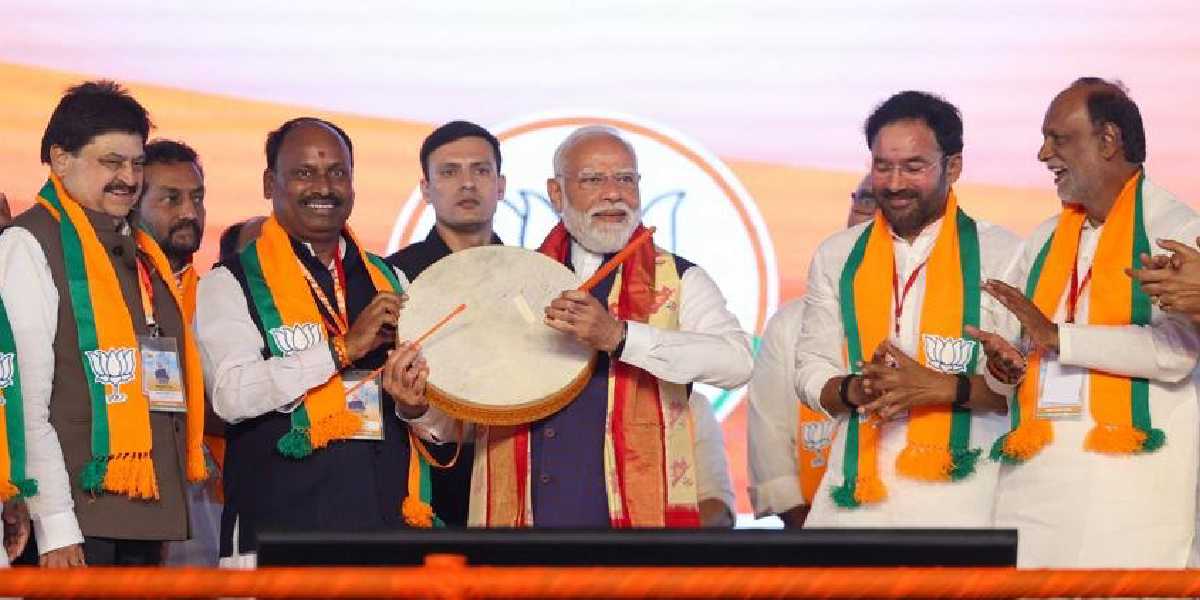
Prime Minister Narendra Modi in Secunderabad on Sunday.

Synopsis: Prime Minister Narendra Modi on Sunday suggested adopting austerity measures in the face of growing global economic challenges. He urged the people to use less fuel, stop purchasing gold for a year, and opt for India-made goods. Modi made the call amid fears of a major fuel crisis arising from the Hormuz blockade.
Prime Minister Narendra Modi on Sunday, 10 May, called for economic self-reliance and urged Indian citizens to avoid purchasing gold for a year, and also to replace foreign goods with India-made products.
Addressing a BJP-organised public meeting at Secunderabad, Modi asked citizens to reduce the consumption of petrol, diesel and cooking gas. He also urged farmers to shift to natural farming, away from chemical fertilisers.
“In the past, people donated gold to the country. Today I urge citizens to take a pledge not to purchase gold for a year during family functions or celebrations — this will help conserve foreign exchange,” he said.
The Prime Minister then urged the people to reject foreign products as part of a national cause.
“Prepare a list of daily-use items at home and identify foreign products unknowingly being used — combs, scissors, toothbrushes and other essentials — and replace them with Indian-made goods wherever possible,” he exhorted.
He also suggested returning to work-from-home mode — similar to Covid-19 lockdown, avoiding unnecessary foreign travels, and shifting to electronic vehicles or public transport.
“This is not a political issue or limited to any one party. It is a national cause that requires collective commitment from every citizen, every party, every organisation,” he added.
Modi further urged the media to carry the message forward and expressed confidence that India, through unity and collective effort, will emerge stronger from the current global challenges.
The Prime Minister’s call for austerity measures came amidst global fears of a major fuel crisis due to the Russia-Ukraine war, the West Asia conflict and the related blockade of the Strait of Hormuz.
Also Read: Modi kick starts projects worth Rs 9,400 crore in Telangana
What the PM said
“Friends, today India is rapidly moving toward the goal of becoming a developed nation. But at the same time, India is also facing several enormous challenges.
During the Covid period itself, the world was hit by a major supply chain crisis. After Covid, the war in Ukraine began, which further increased global difficulties. Food, fuel, and fertilizers were all severely affected.
For the past five to six years, our government has been continuously working to deal with these crises. You may remember that at that time, and even today, a single bag of fertilizer is being sold in many parts of the world for around ₹3,000. Yet the same bag of fertiliser is being provided to Indian farmers for less than ₹300. Against ₹3,000 globally, Indian farmers are getting it for under
Friends, today India is rapidly moving toward the goal of becoming a developed nation. But at the same time, India is also facing several enormous challenges.
During the Covid period itself, the world was hit by a major supply chain crisis. After Covid, the war in Ukraine began, which further increased global difficulties. Food, fuel, and fertilizers were all severely affected.
For the past five to six years, our government has been continuously working to deal with these crises. You may remember that at that time, and even today, a single bag of fertiliser is being sold in many parts of the world for around ₹3,000. Yet the same bag of fertiliser is being provided to Indian farmers for less than ₹300. Against ₹3,000 globally, Indian farmers are getting it for under ₹300.
Amid these supply chain difficulties, for the last two months a major war has been taking place in our neighbourhood. Its impact has been felt across the world, and India has been affected even more seriously.
Friends, India does not possess vast oil reserves. We have to import large quantities of petrol, diesel, and gas from other countries. Because of the war, prices of petrol, diesel, gas, and fertilisers have risen dramatically across the world. Prices have crossed all limits. We see reports in newspapers about the condition of neighbouring countries as well.
For the last two months, the Government of India has been continuously trying to protect citizens from this crisis. To ensure people are not burdened, the government itself is bearing the cost. But friends, when supply chain disruptions continue, difficulties keep increasing despite all measures.
Therefore, keeping the nation first and Mother India above everything else, we must fight this together in unity.We must remember that patriotism is not only about dying for the country. Living for the country and fulfilling our duties toward the nation is also patriotism.
In this period of global crisis, we must place our duties above all else and take certain pledges with complete dedication.
One major pledge is the restrained use of petrol and diesel. We must reduce our consumption of fuel. In cities where metro services exist, we should decide to use the metro as much as possible. If travelling by car is unavoidable, then we should try carpooling. If goods need to be transported, we should try sending them through railway freight services as much as possible, because electric railways do not require petrol or diesel. Those who own electric vehicles should also maximize their use.
During the Covid period, we adopted work-from-home arrangements, online meetings, and video conferences. We became accustomed to these systems. The need of the hour is to revive them again in the national interest. We should once again prioritise work from home, online conferences, and virtual meetings.
Friends, today’s crisis also demands that we focus strongly on saving foreign exchange. Since petrol and diesel have become extremely expensive globally, it is our responsibility to save fuel and thereby save foreign currency reserves.
Even small efforts from all of us can help the country greatly. For example, a growing middle-class culture today involves destination weddings abroad, foreign vacations, and overseas travel. In this time of crisis, and in response to the call of patriotism, we should postpone such foreign trips for at least one year. India itself has many beautiful places to visit and much that can be done domestically.
Friends, we must adopt every possible method to conserve foreign exchange.
Another area where large amounts of foreign exchange are spent is gold purchases. There was a time when, during crises or wars, people donated gold for the nation. Today there is no need for donations, but in the national interest we should decide that for one year, regardless of family functions or celebrations, we will not buy gold jewelry or gold. Patriotism demands that we accept this challenge and save foreign exchange.
Friends, this is also a time for another important lesson. There was a time when India exported copper, but now we are forced to import it. Copper plants in our country were shut down because of strikes and protests, and now we have to import copper using valuable foreign exchange.
Therefore, I appeal to labour unions and major groups to keep such issues in mind. We must distance ourselves from anything that obstructs India’s self-reliance. Those involved in such conspiracies should also be closely watched. I also urge the courts of the country to find solutions that serve the national interest in such situations.
The same applies to edible oils. India spends huge amounts of foreign exchange importing cooking oil. If every family slightly reduces its oil consumption, it can make a big difference. I have repeatedly said: reduce oil consumption by ten percent. Eating less oil is also a form of patriotism. It contributes both to national service and personal health. It improves not only the health of the country’s treasury but also the health of every family member.
Another sector consuming foreign exchange is agriculture. We import huge quantities of chemical fertilisers. Excessive use of chemical fertilizers is harming Mother Earth and damaging our fields. If we do not protect our farmland today, future crops will also be at risk.
Therefore, it is very important that we reduce chemical fertilizer consumption by 25 percent, 30 percent, 40 percent, or even 50 percent, and move toward natural farming. By reducing fertilizer use, we can save foreign exchange, protect our farms, and preserve Mother Earth.
Friends, the Government of India is promoting solar pumps in place of diesel pumps in agriculture. We must encourage the use of solar pumps in farms.
Even during the Covid period, I had appealed to people to buy local products and follow the mantra of “Vocal for Local.” By purchasing Made-in-India products, we can save foreign exchange, and there is no shortage of local production in our country. Whether it is shoes, bags, or daily-use items, we should promote indigenous products.
I am not saying that people should throw away foreign-made products they already own. But my appeal is that we should avoid purchasing new foreign products.
Many times, we do not even realise how many foreign products we use in our daily lives. And when I talk about swadeshi, some people think buying local Diwali lamps alone is enough. That is a misconception. We should make a list of household items and see how many foreign products have entered our homes unnoticed, from scissors and combs to toothpicks and toothbrushes. We should gradually replace them with Indian-made products.
Friends, these are not issues concerning just one government, one party, or one individual. This is not merely a BJP issue. It is a national issue. Every citizen, political party, government, organisation, and section of society must commit themselves to this mission.
I also urge members of the media to come forward in the national interest. Let us awaken the spirit of patriotism and create an environment where India can turn these global crises into opportunities and rise above the circumstances.
When every citizen fulfills these resolutions with honesty and dedication, India will surely emerge victorious in every crisis.”
(Edited by Majnu Babu).



