

Published Jul 25, 2026 | 5:50 PM ⚊ Updated Jul 25, 2026 | 6:07 PM

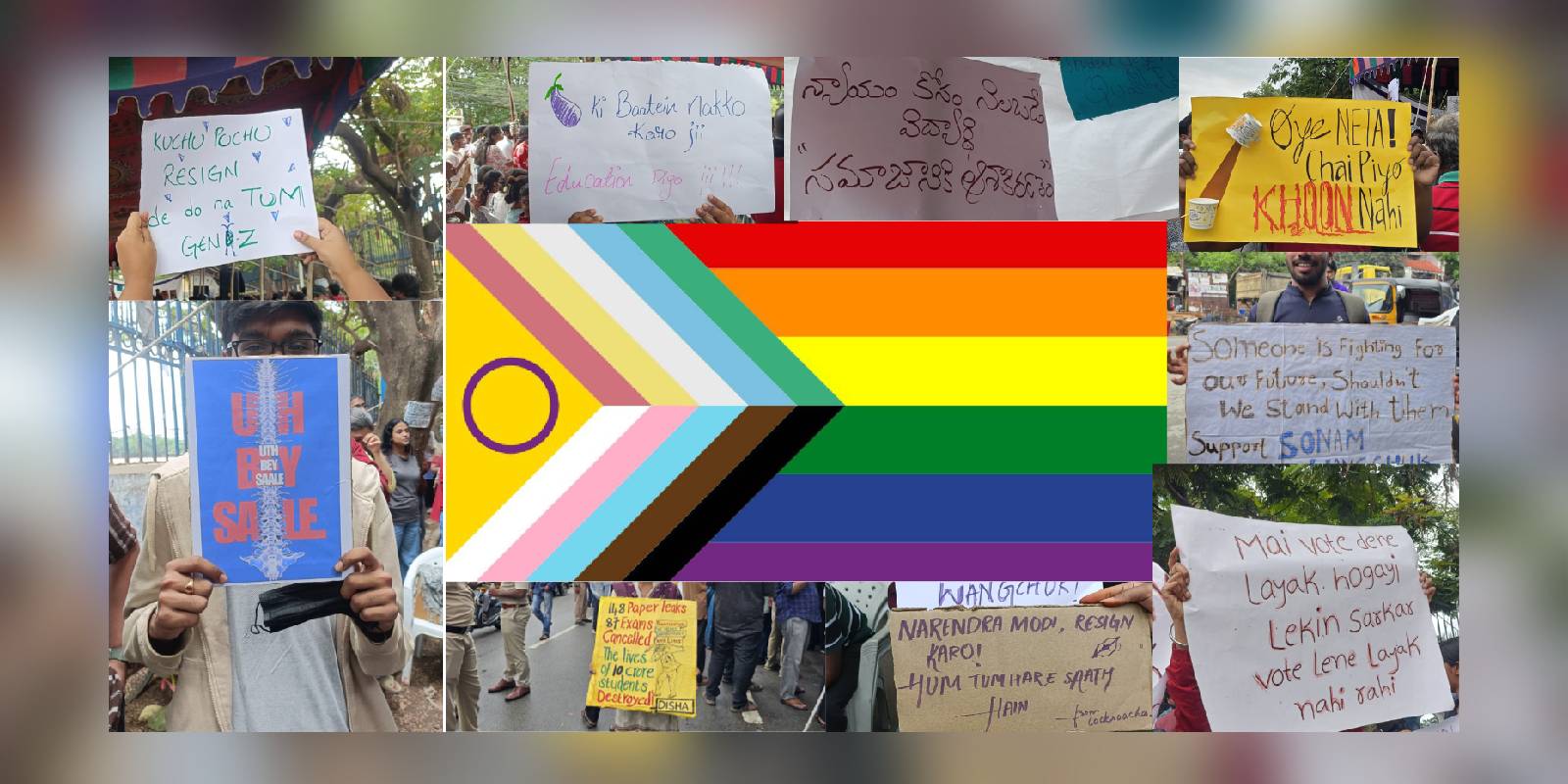
Women, queer people and activists from across Telangana's marginalised communities had gathered for a full day of protest at Dharna Chowk.

Synopsis: The Telangana Women and Transgender Organisations JAC’s protest in support of students in Delhi on 23 July became a sight of resistance for many marginalised identities. Queer and disability rights activists who attended the demonstration spoke to South First at length explaining their perspective of the ongoing student protests.
On 23 July, protestors, mostly women, queer people and activists from across Telangana’s marginalised communities had gathered for a full day of protest at Dharna Chowk.
They turned to songs, placards, and a relay hunger strike, and beneath it all ran a demand for accountability from the Union Government. The protestors also spoke about how the state’s apathy never begins with the people who notice it at the very last.
The demonstration outside Indira Park was organised to extend solidarity to the student protesters in the nation’s capital, and the brutal violence meted out to them by the State.
Also Read: Modi blinks as Dharmendra Pradhan resigns; Ex-Education Minister addresses youth on X
The unrest gripping Delhi, that led to the resignation of Dharmendra Pradhan as the Union Education Minister, did not begin as a protest. It began in May as an online joke, a social media movement calling itself the Cockroach Janta Party. It was born out of anger at a remark from the Chief Justice of India comparing unemployed young people and social media activists to “cockroaches” and “parasites”.
The satire turned into a consequential students movement once the attention turned to the country’s education system. NEET paper leaks and irregularities in board exams had already devastated a generation of students preparing for medical and engineering entrance tests.
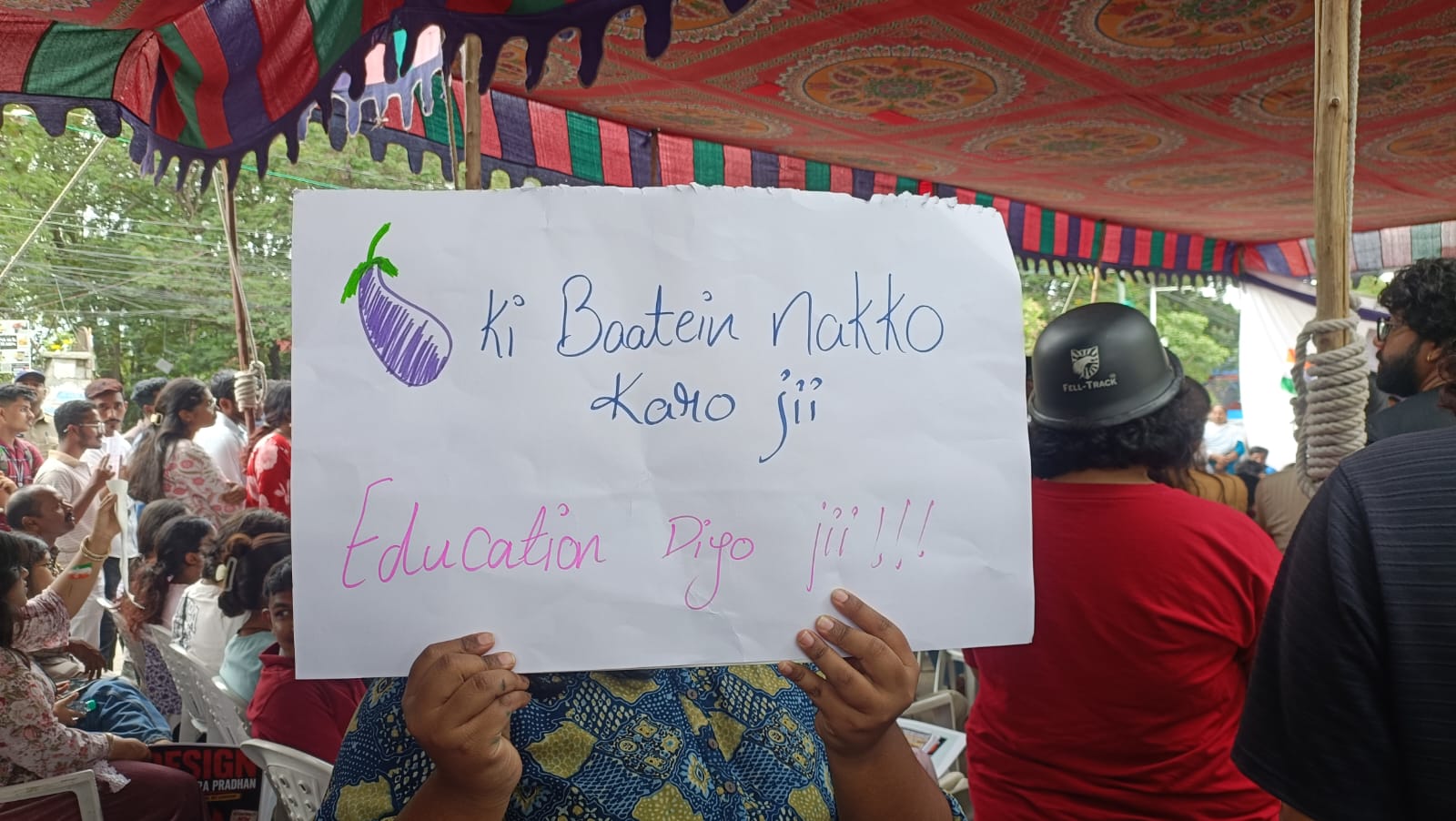
A banner at the Hyderabad student protest
More than twenty students died by suicide in the aftermath of the NEET paper leak, a toll that became the emotional core of the protest. By late June, the demonstration at Delhi’s Jantar Mantar had clear demands: the resignation of Union Education Minister Dharmendra Pradhan and compensation for the families of the deceased students.
Protests erupted across the country in support of the movement. Hyderabad also joined, with a major demonstration on 14 June. Several young people present said they were dissenting for the first time and finally finding their voice. Many believed that the protests had already grown bigger than the CJP.
The student agitations gained an anchor when Ladakh’s education activist Sonam Wangchuk, who had been addressing the nation-wide demonstrations, joined the sit-in on 28 June and began an indefinite hunger strike. Wangchuk was then forcibly taken to a hospital after 20 days of his strike, ahead of the CJP’s call for the Sansad Chalo March, from Jantar Mantar to the Parliament on 20 July.
Also Read: Delhi police detains students attending Jantar Mantar protests; UP Police target volunteer Junaid
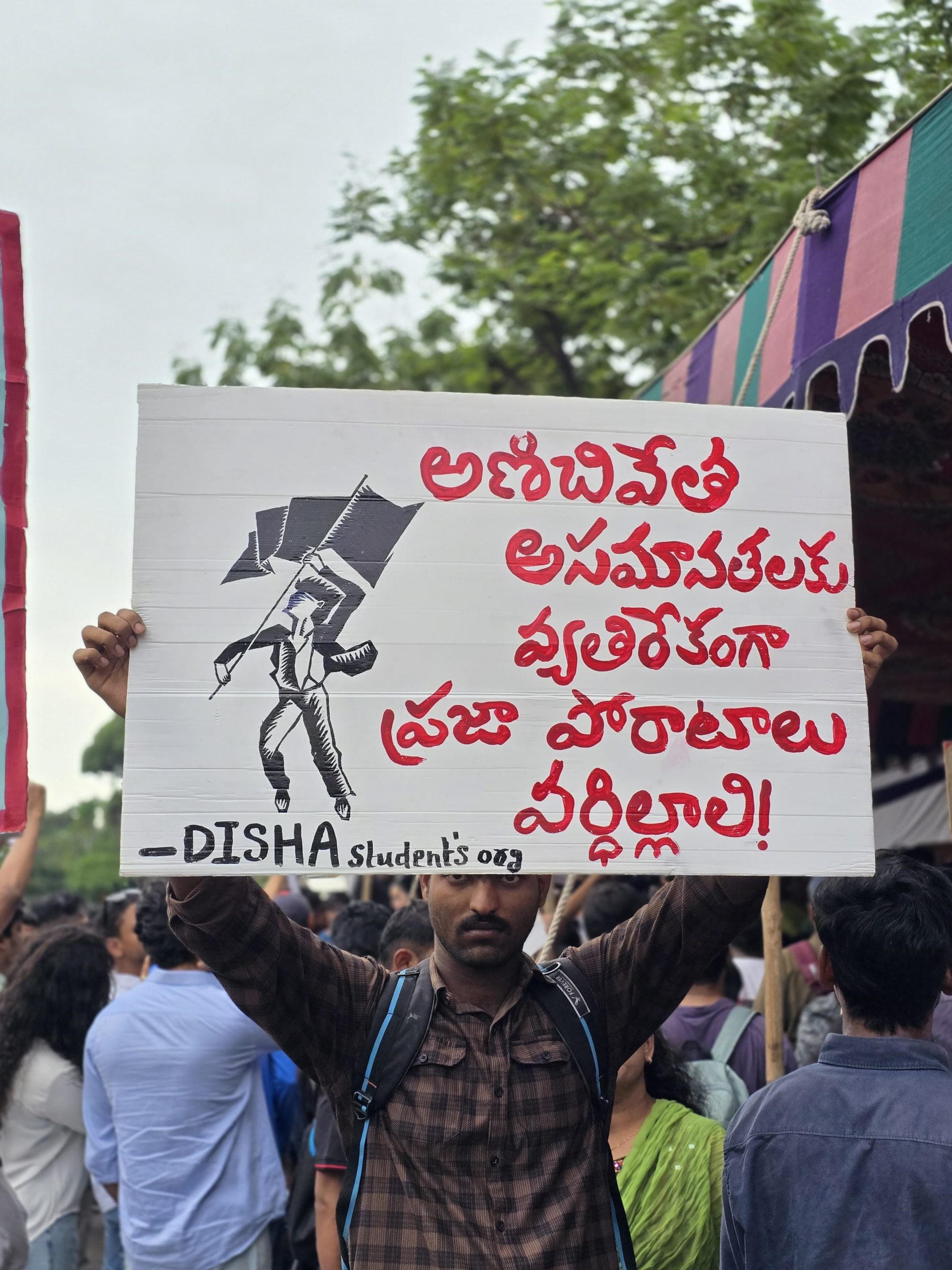
A student at the Hyderabad protest
Tensions escalated further on 20 July, when thousands of protesters, many of them students, went ahead with their march towards the Parliament and were met with violence by the Delhi police and the personnel from the Rapid Action Force (RAF) in the form of baton charges and tear gas shells. Reports suggest that close to 180 people were injured in the police action. Protesters also noted the use of batons with nails and pellet guns by the security forces.
The visuals from the police violence circulated across social media, drawing widespread outrage from all sections of society. People all over India have been conducting solidarity rallies, protests, and candlelight vigils condemning the violence against student protesters.
In Hyderabad, one of the many protests organised by concerned citizens was the full-day sit-in at Dharna Chowk by the Telangana Women and Transgender Organisations Joint Action Committee. Prominent activists addressed the gathering, which drew a majority of women and queer protesters.
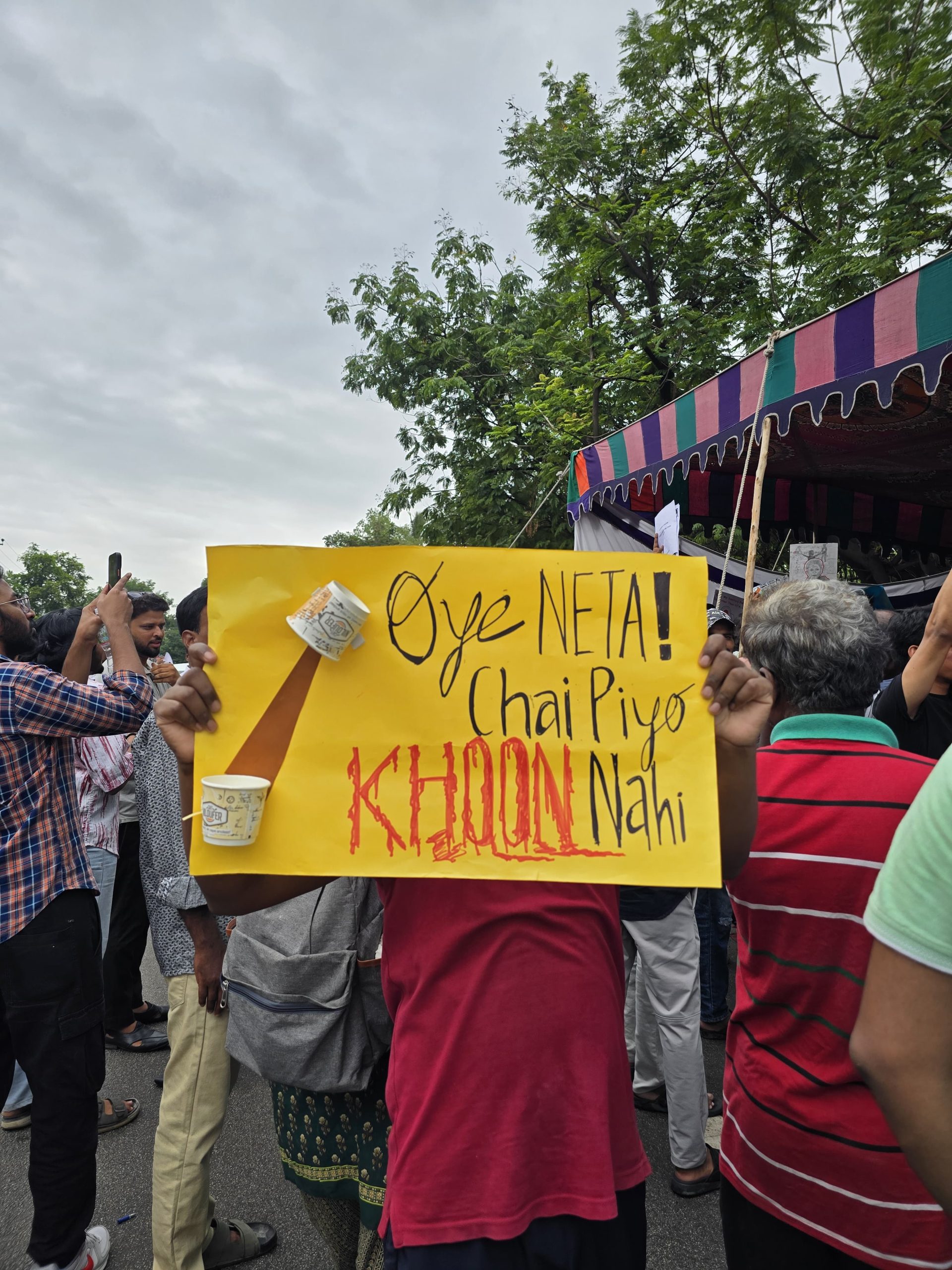
Protesters at the gathering read the Preamble to the Constitution aloud and pledged to defend it. Many carried placards with a creative edge that has become the movement’s signature.
Among the crowd were two organisers who run the Babasaheb Ambedkar Reading Circle (BARC) in the city. Amit, a person with dyslexia, and Nikki, a nonbinary person with autism and dyslexia, spoke to South First at length about their opinions and experiences.
Their conversation cut through the day’s happenings for something even more important. They talked about why these protests are happening at all, and who has been living the warning signs for a long time.
Also Read: Ground report | Paper leaks, broken futures—What Hyderabad ‘cockroaches’ said at CJP protest
When asked what has gone wrong in the government’s handling of the students’ struggle, Amit reached for a word very few use in politics: empathy.
He observed that the current administration’s approach felt like it was fuelled by patriarchal aggression rather than accountability. Amit said that this mindset mistakes holding power for a right to wield it however it likes, without regard for public opinion. He was clear about what kind of resistance he wants to see in return.
Invoking Dr BR Ambedkar, Amit said he did not want India’s unrest to escalate the way Nepal’s recently did. He wants the kind of peaceful, disciplined protest Ambedkar modelled decades ago.
While Amit spoke about a government’s failure of character, Nikki went further back, to the shape of the system itself. In their view, the current administration is only the latest iteration of a much older pattern. A pattern of states that were built on “systems of power rather than systems of care”.
They argued that when left unreplaced, such systems guarantee a repeating cycle. Those in charge continue fighting to protect their own positions, businesses, and advantages, using the judiciary and the police as instruments against the public.
Crucially, Nikki said, the state’s apathy never begins with the people who notice it at the very last, referring to the large number of urban and upper caste youth who are actively protesting today.
“It starts with Adivasi communities, it starts with Dalits, it starts with minorities, and then it will reach here,” they observed. They shared that once a government has grown accustomed to what it can do to those groups without consequence, the same treatment reaches everyone else.
The fact that so many people only recognise the danger once it reaches their own doorstep is precisely why governments like this eventually fail, said Nikki. They believe that the failure becomes inevitable since the very first time a community is brutalised.
Also Read: India’s students’ revolt has exposed BJP’s biggest political blind spot
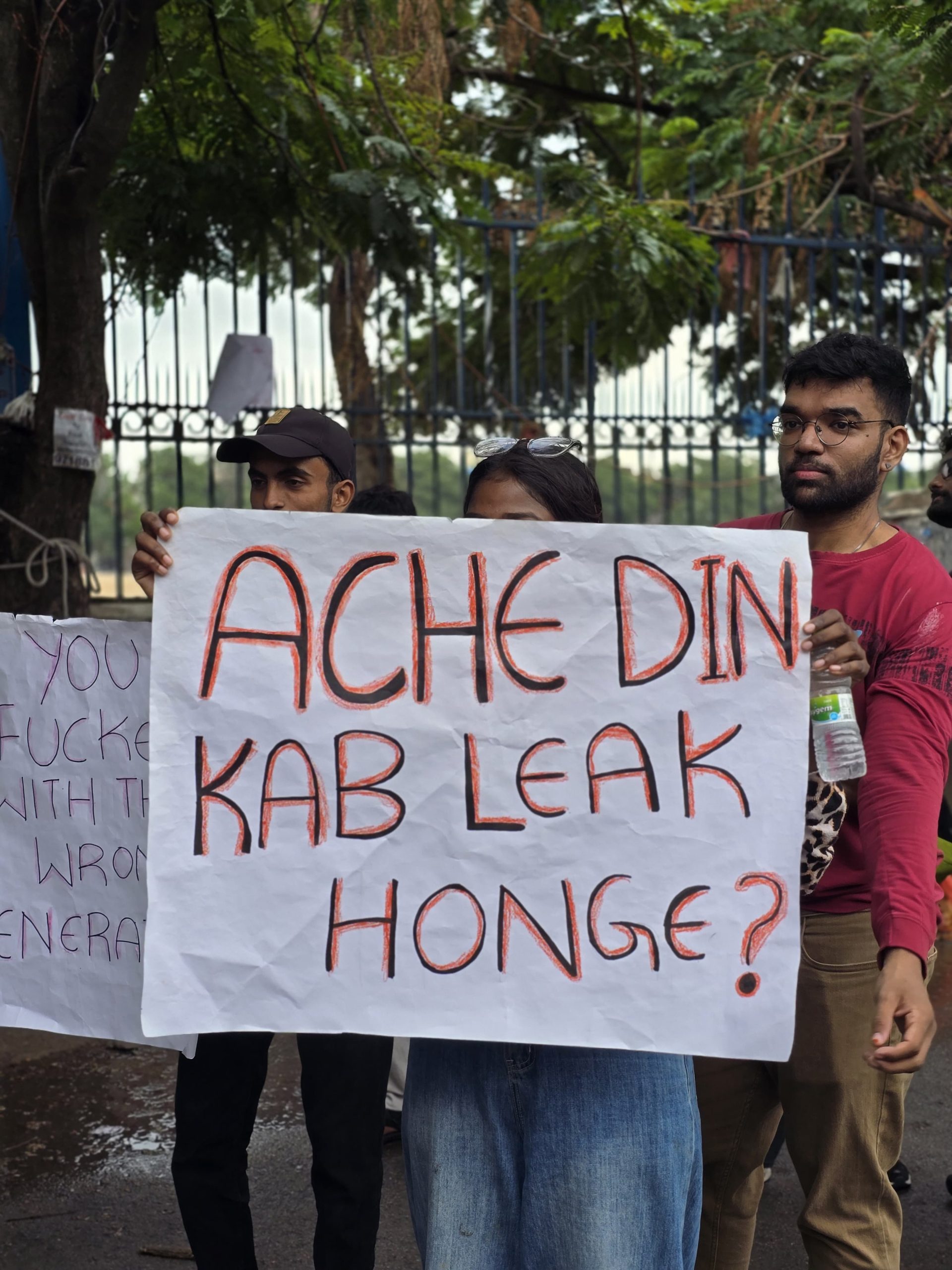
A student with a witty banner at the Hyderabad protest
Nikki was not always convinced the Cockroach Janta Party was worth supporting. When the movement first grew out of anger at the Chief Justice’s remarks, its stated aims felt unclear. Some of the figures associated with it, namely Vijeta Dahiya, had a prior history of transphobia that made Nikki wary. They kept their distance for a while.
What changed their mind was watching the protest stop being about any one organisation and start pulling in people from oppressed communities.
Nikki drew a direct line between the labels used against today’s protesters and a longer Indian history of branding dissent as danger. They recalled how Sikh demonstrators were dismissed as Khalistanis, Muslims as Pakistanis or terrorists, and Adivasis as Naxalites.
They said that when the same playbook started being turned on urban, largely upper-caste protesters, it was finally being read as a tool the state reached for whenever it wanted to delegitimise even the slightest form of resistance.
Nikki’s sharpest observation may be about who gets protected when a protest turns dangerous and who doesn’t. When marginalised communities protest alone, they said, there is little safety net beneath them. Their crises don’t register as everyone’s problems.
 They noted that the privileged always stood on the sidelines, having absorbed the idea that “if it doesn’t hit me, it isn’t mine to fight”.
But movements don’t stay contained. Frustration accumulates from the bottom up.
“What happens is everyone at the bottom of the pyramid is already frustrated with them (the State). And suddenly, when the people at the top are also frustrated, it gets a much wider response,” said Nikki.
The protests then get bigger with more numbers, visibility, and institutional attention than marginalised communities could ever generate on their own.
That, Nikki said, is exactly why people who have been fighting these battles the longest keep showing up for movements that didn’t start with them. It’s not naivety, but a calculated hope that a bigger fight might finally deliver something a smaller one couldn’t. The subaltern believes that there is a way out from under the weight they’ve been carrying the whole time.
Also Read: SFI’s ‘Raat Jago Desh Jago’ at Jantar Mantar echoes across India even as food supplies blocked
Amit and Nikki didn’t arrive at Dharna Chowk as first-timers. Both said they have been showing up to essentially every significant protest the city has staged in recent memory.
Amit described the current mobilisation as eye-opening. He called it evidence of the public’s frustration and said that the idea of staying “apolitical” is losing its grip on people who have been playing it safe.
A protest sparked by young, privileged students discovering political anger for the first time has drawn its clearest structural analysis from two organisers, who are persons with disabilities, who never had the luxury of that late discovery. They turned the lens towards structural inequalities as the root cause of today’s unrest rather any singular event. Their account reinforces the idea that none of us is free until all of us are.
(Edited by Sumavarsha)



