

Published Aug 17, 2026 | 3:54 PM ⚊ Updated Aug 17, 2026 | 3:54 PM

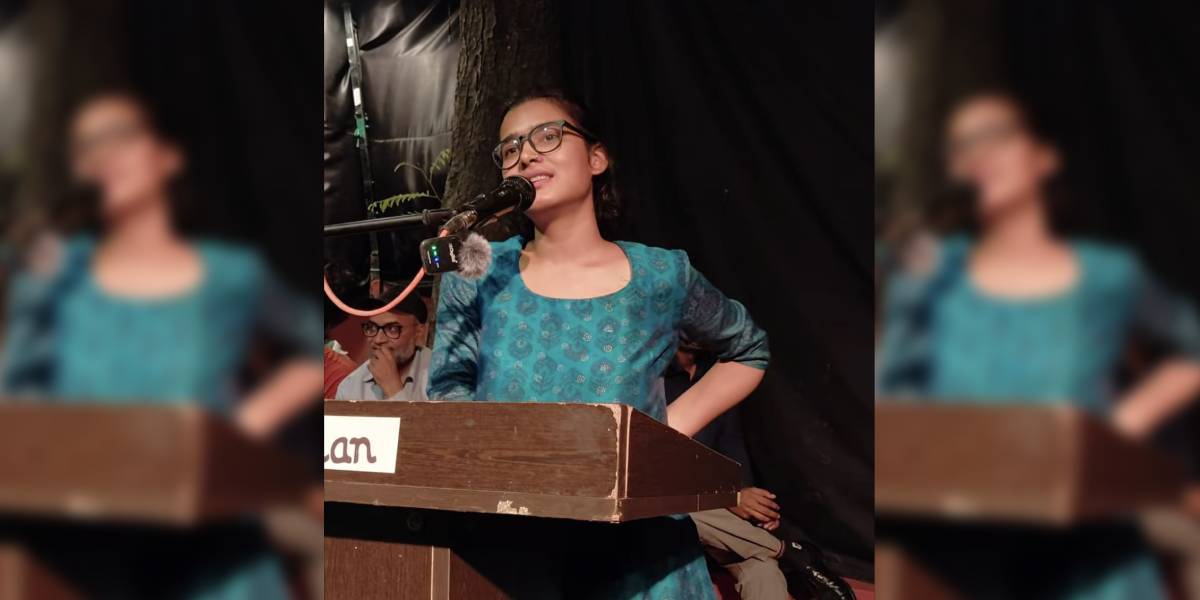
Neha Bora speaking at Lamakaan

Synopsis: Bora opened by thanking Hyderabad for its solidarity after the police crackdown on protesters at Jantar Mantar on 20 July. She said her generation’s entry into student politics began with Rohith Vemula, the Dalit research scholar at the University of Hyderabad whose death by suicide in 2016 became a flashpoint for student politics nationally. She invoked Vemula’s words, where he said that people were never looked at as human beings but as mere votes.
“If you want to take this fight forward and envision a new India, we need more than just your mental solidarity,” said Neha Bora, National President of the All India Students’ Association (AISA), speaking at the 15th Hasan Memorial Lecture at Lamakaan in Banjara Hills on Sunday, 16 August.
“We need every type of solidarity possible. I urge all young people to get organised. I want you to educate yourselves on what this country is, what needs to be done, what it means to be organised, and then agitate. So I reiterate: Educate, Organise, Agitate,” she said to a full house at the cultural space.
Lamakaan hosted the 15th Hasan Memorial Lecture as part of its Independence Day programming. This year’s speakers were Bora and N Sai Balaji, former president of the JNU Students’ Union (JNUSU), on the theme “Young India Speaks: Jantar Mantar and the Way Forward.”
Instituted in 2014, the lecture series is held annually around Independence Day, with an eminent speaker invited each year to engage with a pressing social, economic, or political question. It is named after Moyed Hasan, a scientist, photographer and environmentalist who gave his home to establish Lamakaan. Past editions have featured V Geetha, Prof Gail Omvedt, Apoorvanand, TM Krishna and Siddharth Varadarajan, among others.
This year’s edition fell about three weeks after the 2026 students’ protests at Jantar Mantar ended. The nearly two-month student agitation demanding the resignation of Union Education Minister Dharmendra Pradhan over irregularities in NEET-UG 2026 and other national exams ended with Pradhan’s resignation on 25 July.
Alongside Cockroach Janta Party, student activists from SFI, AISA, and AISF actively led the movement at Jantar Mantar. Bora, a PhD scholar at JNU’s School of Arts and Aesthetics and a trained theatre artist, emerged as one of the movement’s more visible faces. She took part in the hunger strike along with her peers from AISA.
The venue was packed well beyond its capacity on Sunday night, with the crowd spilling out of its premises. The diverse gathering included people of all ages who enthusiastically interacted with the speakers.
Bora opened by thanking Hyderabad for its solidarity after the police crackdown on protesters at Jantar Mantar on 20 July. She said her generation’s entry into student politics began with Rohith Vemula, the Dalit research scholar at the University of Hyderabad whose death by suicide in 2016 became a flashpoint for student politics nationally. She invoked Vemula’s words, where he said that people were never looked at as human beings but as mere votes.
Speaking of patriotism, Bora said love for the country is inseparable from confronting how “broken” it is and that working to fix it is the true patriotism.
“To be truly in love with this country is to be aware of how broken this country is. To know how many regular people had their lives upended due to demonetisation. To be truly in love with your country means to understand that in 2019, they tried to take away people’s citizenship; they made people fight against each other as enemies. To know that the state doesn’t love you, and to know how deeply the likes of Umar Khalid, Sharjeel Imam, Stan Swamy, GN Sai Baba, and Vara Vara Rao cared about the country, and to know they were punished for it,” said Bora.
Bora said her generation wore the tags such as ‘urban naxal’ and ‘dimagi naxal’ with pride, calling it a badge rather than an insult. She shared that when those in power undermine citizens with such insults, they risk exposing themselves.
“They don’t know that when they brand some people in the country with such terms, such as calling JNU students urban naxals, referring to NEET as protesters cockroaches or Muslims as terrorists, the common people will figure out that those in power are on one side, and the rest of us on the other,” Bora added.
Also Read: A village betrayed: Why Siddapur Eco-Town project has left residents a worried lot
On the occasion of Independence Day, Bora said that the founders of this country, whose sacrifices are the reason for the freedom, would be ashamed of its state today. She made pointed criticisms of the ruling BJP and its ideological parent, the Rashtriya Swayamsevak Sangh (RSS).
“Everyone in power thinks history began with them. But these people forgot their own history. They were busy bootlicking the British, writing mercy petitions, and asking people not to take part in the freedom movement. How would they know the value of sacrificing for the country?” asked Bora.
She extended solidarity to the students of NALSAR University of Law, whose graduating cohort had objected to Chief Justice of India Surya Kant being invited as chief guest for the convocation. She thanked students at the English and Foreign Languages University (EFLU) for resisting ABVP aggression. She cited student agitations at Osmania and the University of Hyderabad as inspiration.
She ended her speech by hoping that the agitations started at Jantar Mantar would serve as the beginning of the end of the fascist forces in power.
“We want to be registered as the generation which brought about the downfall of this fascist regime. We want history to remember us as the generation that put an end to the politics of hate in this country,” declared Bora to rousing support from the crowd.
Sai Balaji described the student mobilisation as a wave that those in power struggled to answer. He added that supporters of the current regime, who are primarily WhatsApp users, couldn’t figure out the younger Instagram-user generation.
“When we make fun of your MPs or ministers, you think we are laughing with you. But you can’t figure out that you are being mocked. In this generation, democracy is watching you,” he added.
Also Read: Called a ‘kafir’ for joining Bonalu, actor Faria Abdullah responds with message of love and unity
The lecture wrapped up close to 8 pm, and both speakers took a round of questions from the audience.
A member of the audience posed a question about the inadequate representation of Muslims and Muslim issues in the recent agitations, saying that failing to speak about the treatment of Muslims today was no different from staying silent about Jews under Nazi Germany.
Bora agreed with the sentiment and said that Muslims have been at the receiving end of the government’s politics of hate and division. She reiterated the need to speak up against hate crimes committed against the community and legislation such as CAA NRC brought in to specifically target them. She argued that the country’s resources were being sold off to corporates while communities were being scapegoated.
N Sai Balaji talked about Najeeb Ahmed, the JNU student who went missing from campus in October 2016 after an alleged scuffle with ABVP-affiliated students. He recalled the legal battle that followed and the struggles his friends and family faced in seeking justice for him.
“We know why Najeeb was attacked. They thought no one would stand with him. If they think we would not stand for Najeebs and Rohit Vemulas among us, they are wrong,” Balaji said.
Responding to a question about taking the movement forward, Bora urged students to organise.
“Join a student organisation,” she said, pressing the point further.
“Understand that to defeat people who are highly organised, to defeat people who captured everything from your phone screens to local parks with their shakha meetings, to defeat such a force like RSS and BJP, we need to become an organised force that talks about people’s lives, that talks about democracy, constitution, and it cannot be achieved without organised politics,” said Bora.
Bora wished that the momentum generated by the student protests is kept alive.
“Let us recognise what the people in power have turned this country into. Let’s take responsibility and march on with hope to make a new India,” Bora said.
(Edited by Dese Gowda)



