

Published May 08, 2026 | 8:00 AM ⚊ Updated May 08, 2026 | 8:00 AM

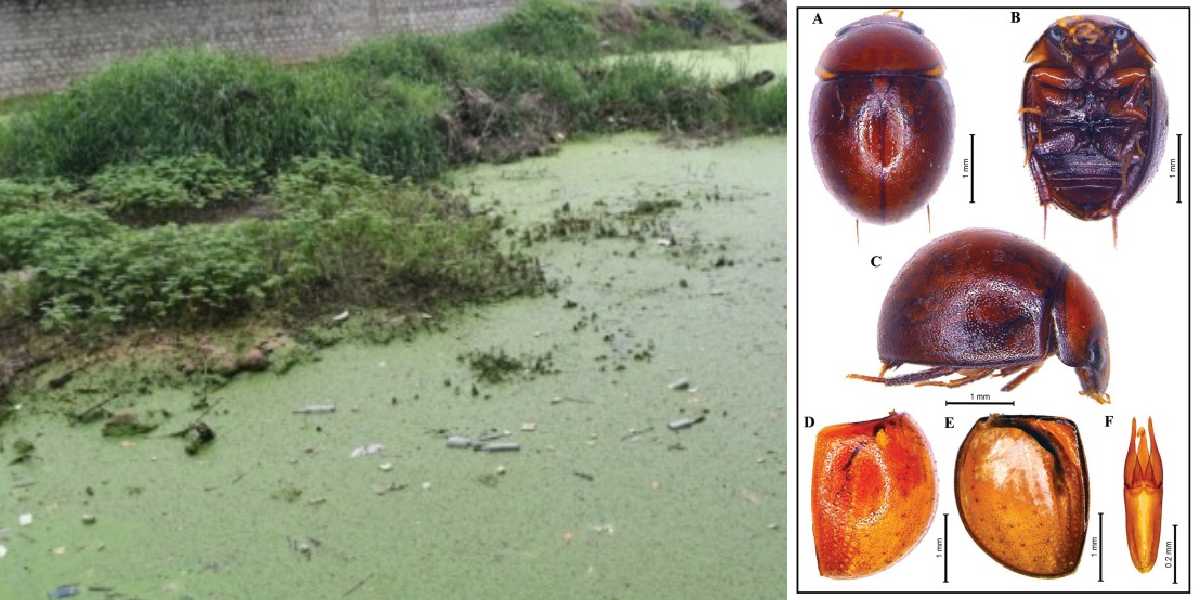
The researchers write that "further surveys and molecular studies could reveal more undiscovered aquatic species in India."

Synopsis: A forgotten seasonal pond in Attapur, Hyderabad, yielded Amphiops hyderabadi, a beetle species new to science. Published in the Journal of Natural History (April 2026), the study also identified two more species from Telangana and Uttar Pradesh, doubling India’s known Amphiops diversity. The discovery highlights South India’s overlooked freshwater habitats and urgent need for wetland conservation.
A forgotten pond in Hyderabad just put South India on the map of freshwater science. A 3mm beetle pulled from a seasonal pond in Attapur carries Hyderabad’s name into global scientific literature. What researchers found alongside it may reshape how science understands South India’s freshwater systems.
A weed-choked seasonal pond in Attapur, Hyderabad, has produced a beetle species unknown to science. Researchers from the Zoological Survey of India named it Amphiops hyderabadi. The name registers permanently in scientific literature, and it opens a question that reaches well beyond the city: how much life do South India’s vanishing water bodies still hold that science has never catalogued?
The study, published on 29 April 2026 in the Journal of Natural History, describes three new species of aquatic scavenger beetles from freshwater habitats across India. Two come from Telangana. One from Uttar Pradesh. Together they double the known diversity of the Amphiops genus in India, from three species to six.
Also Read: Cheap obesity drugs are finally here in India, but what if you plan to stop one day?
Shiva Shankar and Deepa Jaiswal, scientists at ZSI’s Freshwater Biology Regional Centre in Hyderabad, waded into the Attapur pond on 27 December 2021 with steel strainers and aquatic sweep nets.
The pond fills seasonally. Water runs no deeper than a metre over sand and mud. It carries no signboard, no boundary wall, no formal documentation as a water body of ecological value.
The beetle they retrieved measures 3.6 to 3.8 mm, its body curving into a compact oval, red-brown to dark chestnut. Researchers dissected its reproductive structures, the most reliable anatomical marker for separating Amphiops species, and found a genital structure that matched nothing previously recorded from India.
DNA sequencing of the mitochondrial COI gene confirmed what the microscope suggested. Amphiops hyderabadi showed 13 to 17 percent genetic divergence from known Amphiops species.
The authors describe the genus as characterised by “its rounded and convex, semiglobular body; antennae eight-segmented; scutellum elongate, visible; pronotum punctuate; and elytra bearing punctation”, and the Attapur beetle, while fitting that description, carried combinations of those characters that science had never recorded before.
The same study describes Amphiops kinnerasani, collected from a permanent pond inside Kinnerasani Wildlife Sanctuary in Bhadradri Kothagudem, a forested wetland where the Eastern Ghats meet the Godavari basin.
That pond runs three metres deep. Lotus plants and aquatic grass cover its surface. The beetle found here carries a darker colouration with a metallic sheen, finer punctation and a reproductive structure distinctly different from the Hyderabad species.
Genetic analysis placed Amphiops kinnerasani at 16 to 17 per cent divergence from Amphiops hyderabadi. The two Telangana species, separated by roughly 300 kilometres of terrain, belong to distinct lineages that diverged long before researchers set foot in either pond.
A third species, Amphiops sandi, emerged from Sandi Bird Sanctuary in Uttar Pradesh. Remarkably, it sits closer to the Hyderabad beetle genetically, showing only 7 to 9 per cent divergence, than the Hyderabad species shares with its Telangana forest neighbour.
Also Read: India’s go-to diabetes test under scrutiny as experts argue over biological blind spots
The Amphiops genus spreads from Japan and China through Southeast Asia into South Asia and across to Africa. Globally, 24 species carry the name.
The study argues that India sits at a biogeographical hinge in that range. The researchers write that “the Indian peninsula represents a secondary centre of diversification for the genus, likely derived from an Oriental ancestral stock that dispersed westward during the late Tertiary.”
The Indian species, they note, occupy “an intermediate position both geographically and morphologically,” suggesting the subcontinent bridges evolutionary histories that span continents.
The Eastern Ghats corridor running through Andhra Pradesh and Telangana sits at the centre of that argument. The discovery of Amphiops kinnerasani from Bhadradri Kothagudem places a new species directly within that landscape, a biodiversity corridor that has historically received less conservation attention than the Western Ghats.
ZSI director Driti Banerjee said the discovery highlighted the need to conserve wetlands, ponds and freshwater habitats threatened by urbanisation, pollution and habitat degradation.
The Deccan plateau holds thousands of tank systems constructed over centuries. Hyderabad alone has lost a significant portion of its historical water bodies over four decades of urban expansion. Seasonal ponds like the one in Attapur, unmapped, unprotected, disappear with minimal documentation.
The researchers write that “further surveys and molecular studies could reveal more undiscovered aquatic species in India.” Three new species emerged from limited sampling sites. What systematic surveys of South India’s remaining freshwater systems would yield remains an open question.
The type specimens of all three beetles now reside in the National Zoological Collections at ZSI’s Freshwater Biology Regional Centre in Hyderabad, the same city whose name one of them carries, from a pond the city nearly forgot it had.



