

Published Sep 26, 2026 | 2:36 PM ⚊ Updated Sep 26, 2026 | 2:36 PM

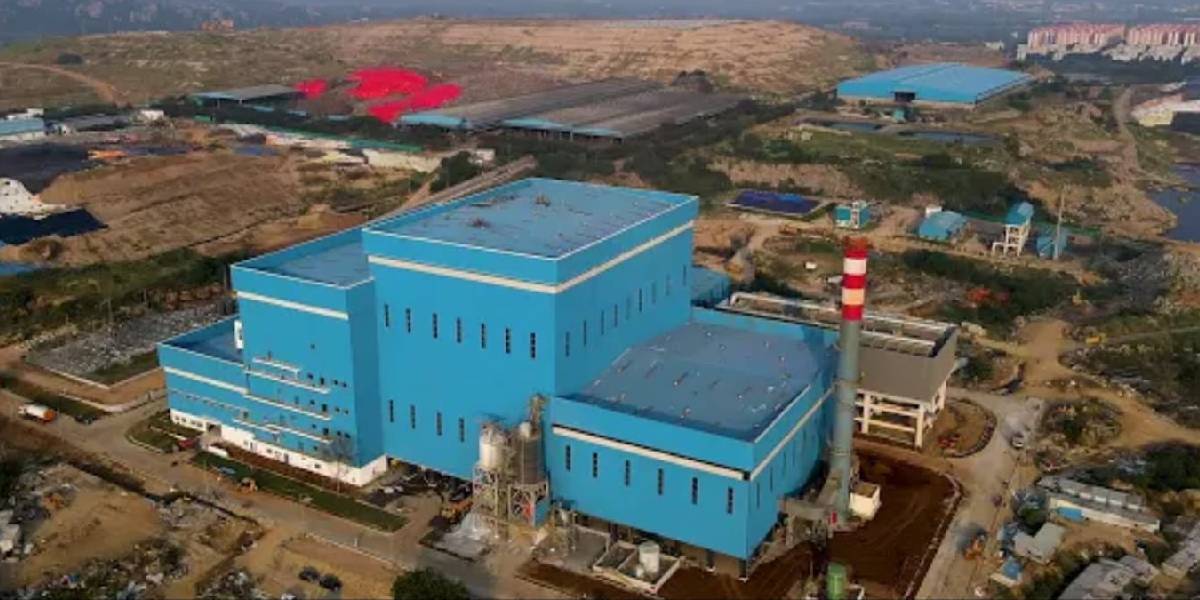
The Hyderabad Municipal Solid Waste (MSW) Energy Solutions Pvt Ltd Plant at Jawaharnagar

Synopsis: Telangana’s recently passed Core Urban Region (Integrated Governance) Act, 2026, gives waste-to-energy plants a central role in Hyderabad’s waste and climate policy despite years-long opposition to the plants from local residents, civil society groups and environmental activists. The industry was also found to be the highest-polluting sector in India, while the Telangana Electricity Regulatory Commission is investigating allegations that the Dundigal facility used municipal solid waste instead of the refuse-derived fuel required under its power agreement.
Over the past few years, waste-to-energy (WtE) plants in Telangana have become controversial. Civil society groups and citizens have pushed back against the plants over environmental concerns, while activists have dubbed them tools for ‘greenwashing’ and profit generation in the garb of sustainability. The plants have also repeatedly come under regulatory scrutiny for violations.
Yet the Core Urban Region (Integrated Governance) Act, 2026, the civic code governing the three major corporations of Hyderabad City, doubles down on WtE plants.
Passed in the Assembly on 12 September, it received Governor Shiv Pratap Shukla’s assent on 22 September. It features a dedicated chapter on the environment, titled ‘Environmental Sustainability, Climate Action and Net Zero’. It sets up a Net Zero and Climate Action Framework for the CURE region under Section 246.
Sub-section 2(b) empowers the government to notify circular-economy targets that include waste diversion rates, recycled-content mandates, extended producer responsibility, and “near-complete resource recovery through biomethanation, composting, and waste-to-energy.”
A separate clause allows the state to set up a Green Energy and Carbon Transition Fund, channelling carbon credits, green bonds, and climate finance into projects that fall under this framework.
Also Read: Telangana clears registration of Section 22-A properties with valid approvals
A September 2026 report by the Centre for Financial Accountability (CFA), based on Central Pollution Control Board (CPCB) and Delhi Pollution Control Committee data submitted to the Supreme Court and the National Green Tribunal, found that WtE incineration plants have a cumulative Pollution Index score of 100 out of 100.
This makes these facilities the highest-polluting industrial sector in India, ranked above open-cast coal mining, copper smelters, and thermal power. The CFA’s own scoring gave WtE plants 100 for air pollution, 95 for water pollution, and 95 for hazardous waste.
The report says dioxins and furans exceed prescribed limits by up to 900 per cent, along with lead, mercury, cadmium, thallium, and more than 5,000 tonnes of toxic ash generated annually.
The CPCB report states that fly ash from the Jawaharnagar plant contains cadmium at 858.65 mg/kg, which environmental activists in Telangana flagged as far above the WHO’s permissible limit of 0.8 mg/kg.
Despite these concerns, the CPCB moved WtE incinerators out of the ‘Red’ category, reserved for the most polluting industries, into a new ‘Blue’ category for ‘essential environmental services’. The shift lets these facilities skip mandatory public hearings and environmental impact assessments.
Also Read: Disqualified, but still in the race: The Danam Nagender paradox
Hyderabad currently has two WtE plants, both tied to the same corporate group, Re Sustainability, formerly known as Ramky Enviro Engineers Limited, under a public-private partnership arrangement.
The Hyderabad MSW Energy Solutions Pvt Ltd plant at Jawaharnagar started with a capacity to generate 19.8 MW of energy but later received environmental clearance to expand to 48 MW.
The Dundigal WtE Pvt Ltd facility, operational at Dundigal in Medchal-Malkajgiri district, has a capacity of 14.5 MW.
Telangana’s own power utility has flagged violations concerning the facilities before its regulator, the Telangana Electricity Regulatory Commission (TGERC).
Proceedings from TGERC’s hearings accessed by South First show that the Southern Power Distribution Company (TGSPDCL) alleged in a counter-affidavit against Dundigal WtE that the plant was running on Municipal Solid Waste rather than the Refuse Derived Fuel its Power Purchase Agreement required.
The distinction matters because RDF is processed combustible waste used for energy generation, whereas MSW is raw, unprocessed waste that is more hazardous. RDF-based plants also receive a far higher tariff than MSW-based ones.
TGERC’s June 2025 interim order sidestepped the dispute, fixing a provisional rate of ₹6.87/kWh while noting that the fuel question “need not be gone into” at that stage. By January 2026, the Commission had reversed course. It ruled that the fuel dispute had to be settled before the main tariff hearing could proceed and ordered an expert inspection.
In June 2026, TGERC constituted a three-member committee comprising Dr Anoop Singh of IIT Kanpur, Dr Gaurav Mishra, scientist at the Ministry of New and Renewable Energy, and Rajeev Kumar Mittal, Director of Thermal Engineering & Technology Development. The expert committee was directed to physically inspect the Dundigal plant and file a report before the TGERC.
Also Read: How Telangana’s great distraction can land it in trouble
Resistance has followed the WtE model to every site it has touched. In Jawaharnagar, residents have organised for over 15 years against the region’s garbage dumping yard. The WtE plant here was first proposed as a solution to the large-scale damage caused by the landfill.
However, recent reports have found that the area still suffers from severe environmental pollution, and that the plant’s emissions are reportedly worsening it further.
A joint fact-finding report by the Anti-Dumping Yard Joint Action Committee Jawaharnagar, Climate Front India, The Voice of Earth, Forum Against Economic and Environmental Injustice Towards Marginalised Communities, and other civic groups found significant impacts on residents’ living conditions.
The coalition found citizens battling skin infections, breathing difficulties, and kidney failure. They said ash from the plant was depositing on everything nearby, while a foul stench hung in the air. The group found that the plant was not disposing of waste properly, worsening the existing landfill and polluting water bodies.
Residents have been pushing for the plant’s removal and have submitted multiple representations to government officials seeking action. Despite CM Revanth Reddy assuring a solution in May 2026, no action followed.
Proposals for WtE plants at new locations have also drawn citizens’ ire. Residents of Pyaranagar in Sangareddy district took the matter to court when a similar facility was proposed in the area. The Telangana High Court stayed the project, leaving the GHMC to scout for other areas.
At Siddapur in Rangareddy district, residents allege they were blindsided by a May 2026 announcement converting 86 acres of land originally acquired for an industrial park into a 4,000-tonnes-per-day WtE facility. Siddapur and neighbouring villages have opposed the proposal and have been protesting to scrap it altogether.
BRS working president KTR recently claimed credit for the WtE model and welcomed its inclusion in the Centre’s September 2026 Compendium of Best Practices under the National Clean Air Programme (NCAP).
However, BRS MLA T Harish Rao has repeatedly spoken out against Siddapur’s Ecotown project and the WtE plant, and demanded that the government immediately withdraw GO Rt No. 641. He warned that the new facility would contaminate local water bodies and farmland across roughly 20 villages.
Similarly, while the Union government continues to support WtE facilities by moving them to the Blue category and recognising them as best practices for clean air, BJP leader and Mahabub Nagar MP DK Aruna has extended solidarity to protesting Siddapur residents.
She also submitted a memo to Union Minister for Environment, Forest and Climate Change Bhupender Yadav, requesting the relocation of the Ecotown project.
Ruchith Asha Kamal, deputy director of Climate Front India alleged the Act “”effectively gives the incineration industry a licence to pollute while deepening existing environmental injustice.”
“The Cure Bill talks about waste-to-energy being proposed as a solution for the waste problem, but without segregation, how does waste-to-energy work?” he said, speaking to South First.
“Waste management policy must protect people and ecosystems, not legitimise technologies that shift pollution and risk onto those who have the least power to resist it.”
(Edited by Dese Gowda)



