
Published Sep 24, 2026 | 4:05 PM ⚊ Updated Sep 24, 2026 | 4:19 PM

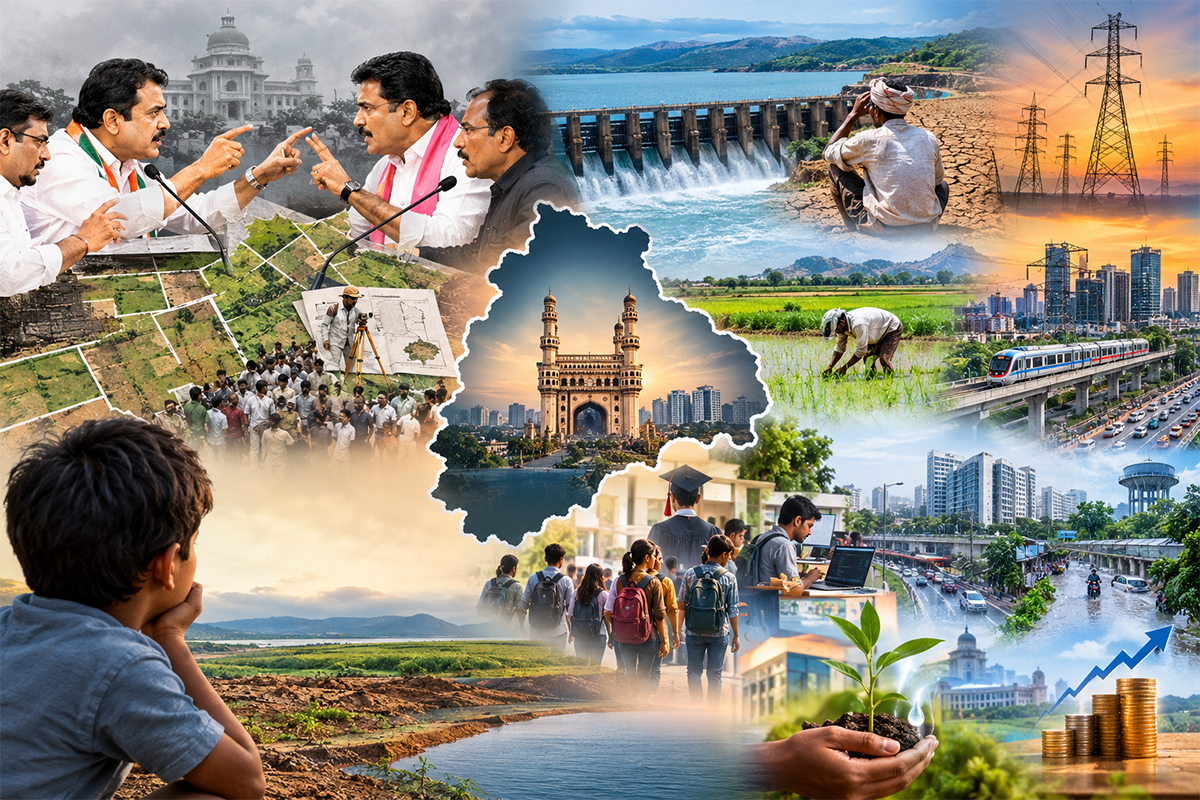
Image used for representational purpose. (AI generated image) generated image

Synopsis: Land controversies cannot become a permanent substitute for governance as Telangana faces interconnected challenges in water, electricity, agriculture, employment, urban infrastructure and fiscal pressure. Political accountability and development are not competing priorities, but governance must remain focused on the future.
Land controversies dominate the political conversation, but the problems that will determine Telangana’s future are piling up elsewhere.
Telangana’s political discourse appears to be caught in an endless cycle of land allegations, counter-allegations, surveys, encroachments, family properties and political accusations. Every controversy produces another controversy. Television studios find new material for heated debates, social media turns every allegation into a political weapon and political parties compete to control the narrative.
Meanwhile, the ordinary citizen is left asking a much more basic question: what happens to the problems that cannot be postponed?
There is nothing wrong with investigating allegations relating to government land, assigned land, illegal occupation or manipulation of revenue records. If public property has been encroached upon, the law must establish the facts and recover what belongs to the State. If wrongdoing has occurred, those responsible must face due process. But investigations and political controversies cannot become a permanent substitute for governance.
The danger is that Telangana may be allowing the politics of distraction to overwhelm the politics of anticipation.
Water is perhaps the clearest example.
Telangana’s dependence on irrigation and groundwater has increased enormously, while climate uncertainty is making rainfall less predictable. A deficient or badly distributed monsoon is no longer merely an agricultural problem. It immediately affects drinking water, electricity consumption, crop production, rural incomes and food prices.
The warning signs are already visible. Reservoir levels, groundwater availability and rainfall patterns require constant attention. Farmers cannot plan their crops around political speeches. They need dependable irrigation, electricity, crop insurance, remunerative prices and timely procurement.
The water question is also rapidly becoming an urban question. Hyderabad’s expanding population, construction activity and increasing demand are placing extraordinary pressure on water resources. Groundwater cannot be treated as an inexhaustible reserve. Every additional borewell may offer temporary relief while deepening the long-term problem.
This leads directly to another looming pressure point: electricity.
Agriculture, urbanisation, industries and rising temperatures are all pushing up power demand. Telangana’s dependence on groundwater for irrigation creates an especially difficult cycle. When rainfall fails, farmers turn increasingly to borewells. More borewells require more electricity. More pumping lowers groundwater levels further. The State then faces simultaneously a water problem and a power problem.
This is precisely where governance requires long-term planning rather than political firefighting.
Agriculture itself needs a larger conversation. Telangana’s transformation into a major paddy-producing State has brought economic benefits to farmers, but it has also increased pressure on water resources. Climate variability makes it necessary to rethink cropping patterns in water-stressed regions. Crop diversification cannot simply be announced from Hyderabad; farmers need assured markets, price support, irrigation planning, storage, processing facilities and credible procurement mechanisms.
The next major concern is employment.
For Telangana’s young population, the central question is not which political leader dominates the news cycle. It is whether education leads to employment and whether the State can create enough productive opportunities outside government recruitment. Competitive examinations and government jobs are important, but they cannot absorb an entire generation.
Telangana needs a broader employment strategy connecting universities, technical institutions, industries, start-ups, agriculture, services and small businesses. The State’s young people need skills that correspond to actual market demand. Otherwise, educational expansion without employment expansion will produce frustration rather than opportunity.
Urban Telangana presents another set of challenges. Hyderabad is growing faster than its infrastructure in several areas. Traffic, drainage, waste management, pollution, public transport, housing and water supply require sustained investment. Every heavy rainfall exposes weaknesses in urban planning. Every summer exposes weaknesses in water management.
These problems do not generate the same political excitement as a land controversy. But they affect millions of people.
There is also the larger question of Telangana’s finances. Development promises require money. Infrastructure requires money. Welfare programmes require money. Salaries, pensions, interest payments and public services require money. If economic growth slows or agriculture suffers a major shock, government revenues can come under pressure. Fiscal management therefore cannot remain an issue discussed only by economists and bureaucrats. It directly determines the State’s ability to deliver its promises.
Land administration itself deserves a more serious and comprehensive approach.
Instead of making land disputes politically prominent only when powerful individuals are involved, Telangana needs a system in which every citizen can obtain a clear, reliable and legally defensible land record. Accurate surveys, transparent mutation procedures, accessible grievance mechanisms, protection of assigned and tribal lands, and speedy resolution of disputes would do far more for public confidence than political accusations exchanged across party lines.
The test of governance is not how loudly a government exposes the previous government. It is how effectively it prevents the next crisis.
Telangana cannot afford to spend an entire political season looking backwards while the next set of problems gathers momentum. Water scarcity, groundwater depletion, electricity demand, agricultural vulnerability, youth unemployment, urban infrastructure and fiscal pressure are not distant possibilities. They are interconnected challenges requiring preparation now.
Political accountability and development are not competing priorities. Both are necessary. But accountability must be institutional, evidence-based and subject to due process, while governance must remain focused on the future.
The people of Telangana cannot drink political rhetoric. They need water. They cannot irrigate their fields with accusations and counter-accusations. They need electricity. They cannot build their children’s future through endless political controversy. They need education, employment and economic security.
The State can investigate every disputed acre. It must.
But while politicians are busy measuring yesterday’s land, who is measuring tomorrow’s water?
That is the question Telangana cannot afford to divert.
Also Read:
Telangana’s quiet double-engine Sarkar — Part 3: What the Congress and BJP protect
Even a dead worker’s family wasn’t spared: The decline and fall of Telangana’s police
Telangana’s invisible farmers need a name before they need a scheme
(Edited by R Rajesh Kumar.)



