

Published Apr 26, 2026 | 11:40 AM ⚊ Updated Apr 26, 2026 | 11:40 AM

Invoking anti-terror legislation against digital media represents a disturbing escalation with far-reaching implications for freedom of expression.

Synopsis: The Congress government in Telangana recently invoked the UAPA against a social media news handle over its criticism of the state government. The action has drawn condemnation from journalists and activists, who highlighted that criticism should not be handled by criminalising critics.
With a series of developments unfolding in Telangana that are politically damaging to the government and the Chief Minister, it is unclear who is advising the Telangana state government, or whether it is moving like an unrestrained, blind bull going amok.
During the campaigning ahead of the 2023 Assembly elections, Chief Minister A Revanth Reddy had prominently spoken not just about the six guarantees, but even a “seventh guarantee”.
While democracy may have seen some degree of revival in other respects, the present Telangana government has, from the outset, experimented with various forms of restrictions on the media, especially social and digital media.
More than targeting Opposition parties and leaders, the chief minister has repeatedly spoken out strongly and openly against media outlets that criticise him. All that is one level; now, invoking something as severe as the Unlawful Activities (Prevention) Act (UAPA) against a social media platform is quite another.
Until now, such actions were largely associated with BJP governments. But that gap now appears to be closing under the Congress government in Telangana.
Also Read: ‘Defenders of rights’ elsewhere but invokers of UAPA in Telangana
The media entity or social media handle called “Telugu Scribe” may have its own approach and editorial line. It may have consistently adopted an anti-government stance. Even so, it remains, at its core, a medium of information, a platform that communicates with the public through social media.
Its policies can be criticised. Counter-narratives can be presented on competing platforms. In a democratic information space, truth and falsehood can be contested openly. But can the media itself be criminalised? Can allegations of spreading dissent or hostility against the government justify invoking a law meant for counter-terrorism?
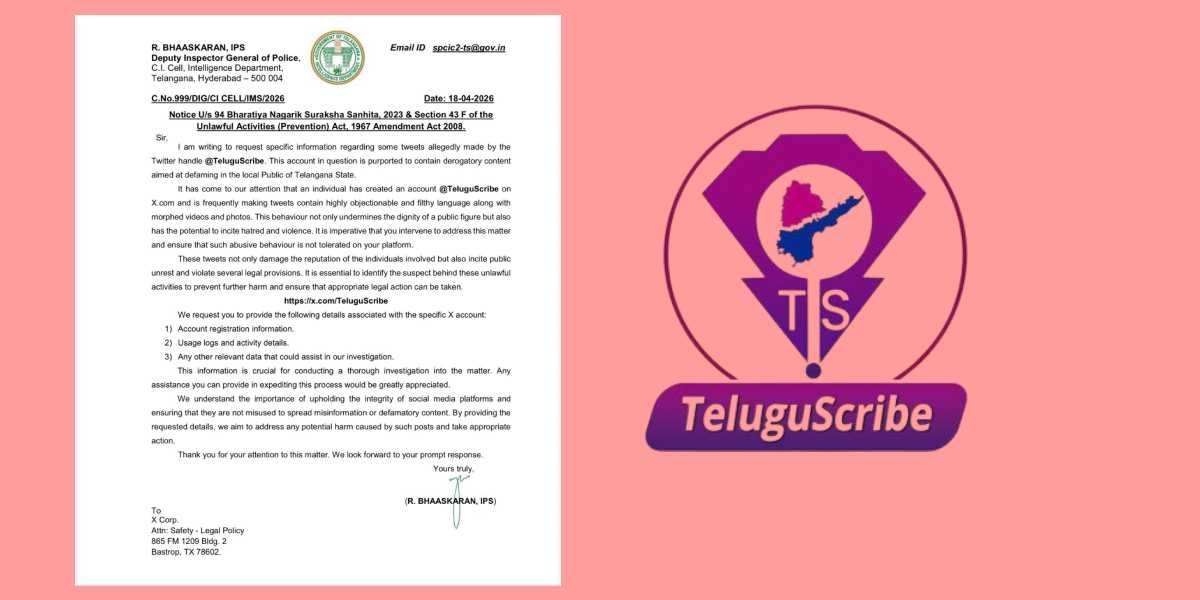
No UAPA case has yet been directly filed against this entity. However, the Telangana government machinery appears to be taking preliminary steps in that direction. On 18 April, the Telangana Intelligence wing issued a notice to the administrators of the “X” platform, seeking comprehensive details about posts made by @TeluguScribe, including the IP addresses from which they were uploaded.
These notices were issued under Section 94 of the Bharatiya Nagarik Suraksha Sanhita, 2023, and Section 43F of the Unlawful Activities (Prevention) Act, 1967 (as amended in 2008).
In fact, there already exist multiple legal provisions to obtain information from social media platforms or to request the removal of content. The IT Act of 2000, along with the rules and guidelines framed in 2021, provides several such mechanisms. Section 69 of the IT Act grants even state governments the authority to regulate social media and access stored computer data. Section 91 permits the issuance of notices to obtain information related to posts. These laws also require platforms to preserve relevant data for up to 180 days for investigative purposes. All of these provisions, in themselves, impose certain limits on freedom of expression in digital spaces.
Bypassing these avenues and resorting instead to a controversial law like the UAPA for such purposes is deeply concerning.
In the past, states like Tripura and Uttar Pradesh have taken action against media outlets. Even in cases linked to the banned PFI, action has been taken against the media under UAPA. Now, under a Congress-led government, Telangana appears to be moving toward deploying this “ultimate weapon” against what is essentially a media platform that supports opposition political narratives.
Also Read: Telangana Governor approves MLC nominations
The impact of these notices is already visible on the government’s reputation. Amnesty International has strongly condemned the move. The Internet Freedom Foundation criticised the notices issued to Telugu Scribe.
At a time when criticism of the government is mounting across newspapers and rights platforms, such an approach is unlikely to yield any political benefit and, instead, it risks bringing avoidable disrepute. The belief that criticism in the media creates public opposition is a flawed inversion of reality. It is public discontent that finds expression through media criticism.
Those who believe social media is politically harming them often forget that they themselves once used the very same platforms as tools to gain power. What is considered “strategy” when done by oneself suddenly becomes a “crime” when done by others.
At a time when traditional media is either being controlled through various means or is self-regulating under pressure, social media has been fulfilling an important democratic role.
Admittedly, some platforms misuse this space, spreading unverified or baseless information. Such practices must be challenged in the public domain. Governments and well-wishers of the media should engage with digital media organisations and individuals to encourage self-regulation.
When governments crack down on digital media platforms and individuals, the muted response from journalist bodies only emboldens further restrictive actions. The heavy hand that has now reached social media can just as easily extend to established mainstream media institutions as well.
(This article is translated from a Facebook post by the author with permission. Views are personal.)



