

Published Apr 24, 2026 | 4:40 PM ⚊ Updated Apr 24, 2026 | 4:40 PM

Invoking anti-terror legislation against digital media represents a disturbing escalation with far-reaching implications for freedom of expression.

Synopsis: The Telangana Police’s decision to invoke UAPA provisions to gather details about a digital media handle marks a significant escalation in the state’s approach to dissent. While governments have a legitimate interest in curbing hate speech, misinformation, and defamation, the tools used to achieve these ends do matter.
Telangana seems to have crossed the red line in its handling of media critical of the government.
The latest flashpoint is the invocation of provisions under the Unlawful Activities (Prevention) Act (UAPA) — India’s most stringent anti-terror law — to get the details about a social media-based news platform.
The move has whipped up a storm of criticism from civil society groups, legal experts, and journalists, who warned that invoking anti-terror legislation against digital media represents a disturbing escalation with far-reaching implications for freedom of expression, guaranteed by the Constitution.
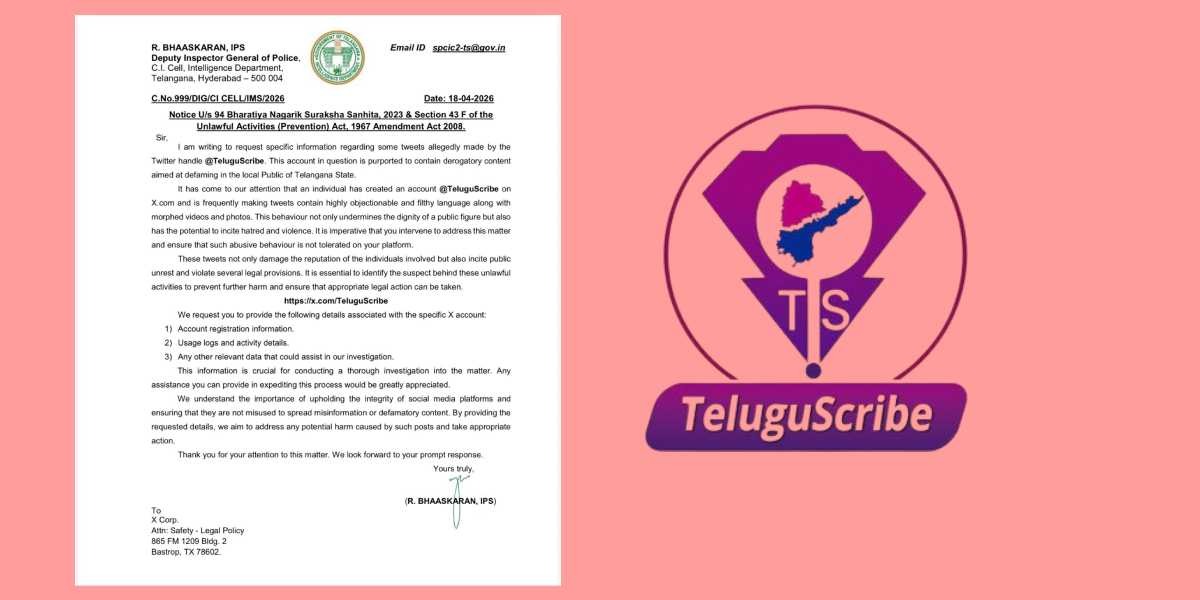
At the centre of the controversy is a letter dated 18 April 2026, by R Bhaaskaran, Deputy Inspector General (DIG) of the Counter Intelligence Cell, Hyderabad, to the social media platform X (formerly Twitter).
The letter sought detailed information about the account @TeluguScribe, a widely followed digital news handle operating in Telangana.
Also Read: Murky politics within Telangana Congress
The police communication invoked Section 94 of the Bharatiya Nagarik Suraksha Sanhita (BNSS), 2023, and Section 43F of the UAPA, demanding that the platform furnish account registration details, usage logs, activity records, and “any other relevant data” about the handle.
The Telangana Police alleged that the account had posted “defamatory content on public figures,” including “highly objectionable and filthy language” and morphed videos and photographs that “undermine dignity” and have the “potential to incite hatred and violence.”
Normally, such allegations would fall under provisions dealing with defamation, obscenity, or public order under general criminal law. However, the invocation of UAPA—a law designed to combat terrorism and threats to national security—has raised fundamental questions about proportionality and intent.
Section 43F of UAPA, inserted through the 2008 amendment, allows investigators to compel any individual or entity to provide information relevant to a terrorism-related investigation.
It overrides other legal protections and prescribes up to three years of imprisonment for non-compliance. The provision was originally intended to facilitate swift access to financial and digital records in cases involving terror financing and organised networks.
Also Read: ‘If it were Emergency…’ police commissioner’s confrontational presser
By contrast, critics argued that its application in a case involving alleged defamatory or objectionable online content represents a category error—one that risks diluting the distinction between national security threats and political dissent.
Civil liberties groups have responded sharply. The Internet Freedom Foundation described the move as an “ex facie illegal abuse of an anti-terror statute,” stating that UAPA was never intended to “police political commentary or journalism critical of state governments.”
The organisation warned that employing such a law to seek subscriber information from a platform engaged in public-interest reporting—even if biased or inaccurate—amounts to a “grave overreach” that could chill constitutionally protected speech under Article 19(1)(a).
A broader civil society appeal went further, calling on the media fraternity to “condemn the Telangana government’s usage of draconian UAPA on digital media.”
The statement noted that the police letter did not specify any FIR, nor did it clearly identify the offending content, but instead relied on vague assertions of “derogatory” material.
“This sets a dangerous precedent where serious laws meant for national security are used to target media personnel who question those in power,” the statement said.
Also Read: SIT against media raises questions over Telangana’s approach
The targeted platform, TeluguScribe, issued a strong rebuttal. In a statement, TeluguScribe said it was “shocked and appalled” that the UAPA has been invoked against it.
“We are not terrorists,” the statement declared. “This is a law primarily meant to deal with threats to the sovereignty and integrity of the nation. Its use against a media platform is nothing but a blatant abuse of power.”
The platform insisted that all its content is in the public domain and lawful. It rejected the allegations made by the police. It also claimed that it has faced sustained pressure from the Telangana government, with nearly 70 cases filed against it over the past two-and-a-half years.
Describing itself as a “people’s voice,” TeluguScribe said it would continue to question elected governments and appealed to journalists, intellectuals, and the public to resist what it termed an “intimidation tactic.”
The controversy does not exist in isolation. Critics pointed to a broader pattern of action against journalists, activists, and social media users in Telangana since Chief Minister A Revanth Reddy assumed office.
Civil society groups alleged that over 250 cases have been filed against social media activists in the past two-and-a-half years. These cases related to posts on issues ranging from farmers’ protests and tribal land rights to student movements and urban demolition drives.
Several journalists have reportedly faced arrests, while others have alleged physical attacks. In one widely cited case, social media activist Shashidhar Goud was arrested for retweeting a post. The Telangana High Court quashed the cases against him in September 2025 and issued guidelines to prevent the filing of frivolous FIRs that curb free speech.
The state government challenged this ruling in the Supreme Court in February 2026, but the apex court upheld the High Court’s judgment, reinforcing the need for safeguards against misuse of criminal law in matters of expression. Despite this judicial pushback, critics argued that enforcement practices have not fundamentally changed.
Also Read: Telangana’s farcical debate over journalism
Legal analysts said the core concern with invoking UAPA lies not merely in eventual conviction, but in the process itself.
The law’s stringent bail provisions meant that an accused person could remain in custody for extended periods. Investigative agencies are given up to 180 days to file a chargesheet, and courts must be satisfied that the case is not prima facie true before granting bail—a high threshold that often results in prolonged detention.
Senior journalist and former Information Commissioner Budha Murali argued that this is precisely why such provisions are used.
“The government knows these cases may not stand in court. But by the time the judiciary intervenes, the person would have spent months in jail. The process itself becomes the punishment,” he said.
Murali also suggested that the rise of independent digital media—less susceptible to traditional forms of control—has made governments more sensitive to online criticism.
Also Read: Who can make a list of journalists?
K. Venugopal, the editor of a Telugu monthly journal Veekshanam and himself previously booked under UAPA, described the law as “draconian” with an “extremely broad definition of crime.”
“Anyone can be brought under its ambit because of how loosely terms like ‘unlawful activity’ are defined,” he said. “It strikes at the roots of freedom of speech guaranteed under Article 19.”
Venugopal pointed out that while governments may justify such actions as necessary for law enforcement, the lack of precise definitions and the wide discretionary powers granted to officials create scope for arbitrary application.
The use of UAPA in Telangana has a complex history. In August 2022, police registered cases under the Act against human rights activist and retired University of Hyderabad professor G Haragopal and 151 others, accusing them of conspiring to overthrow the government.
Many of those named—including academics, lawyers, and activists—later said they were unaware of the charges and had not received notices.
Similarly, journalist Venugopal was booked under UAPA in 2019 in connection with alleged Maoist links, though he later received relief from the High Court, which directed police not to arrest him.
More recently, the National Investigation Agency (NIA) issued summons to several journalists in Telangana in April 2026 as part of a UAPA-linked investigation into alleged Maoist activities. The notices, served under procedural law, sought to examine their reporting and interactions related to certain events and individuals.
These instances have contributed to a growing perception among rights groups that UAPA is increasingly being used in contexts that extend beyond its original anti-terror mandate.
The UAPA, enacted in 1967 and significantly expanded through amendments in 2004, 2008, and 2013, is India’s primary anti-terror legislation. It grants sweeping powers to the state, including the ability to designate individuals as terrorists, seize property, and conduct extended investigations.
Also Read: In Telangana, social media posts can make you a history-sheeter
Its broad definition of “unlawful activity”—which includes actions or speech that may cause “disaffection” against India—has long been a subject of debate. Critics argue that such wording allows authorities to conflate dissent with threats to national integrity. Supporters, however, maintain that the law is essential for dealing with complex and evolving security challenges.
Opposition voices and civil society groups have framed the issue as a contradiction between the Congress party’s national rhetoric on constitutional freedoms and its actions at the state level, like in Telangana, where the grand old party is in power.
For journalists and activists, the larger concern is the potential chilling effect. Even the possibility of being booked under a stringent anti-terror law could deter individuals from engaging in critical reporting or commentary.
“Once such a precedent is set, it can be replicated elsewhere,” Murali said. “That is why this moment is significant—not just for Telangana, but for the country as a whole.”
The Telangana Police’s decision to invoke UAPA provisions against a digital media handle marks a significant escalation in the state’s approach to dissent. While governments have a legitimate interest in curbing hate speech, misinformation, and defamation, the tools used to achieve these ends do matter.
Deploying an anti-terror law in such contexts risks normalising extraordinary measures for ordinary disputes. It blurs the line between national security and political criticism—a line that, once crossed, is difficult to redraw.
(Edited by Majnu Babu).



