

Published Jun 10, 2026 | 1:30 PM ⚊ Updated Jun 10, 2026 | 1:30 PM

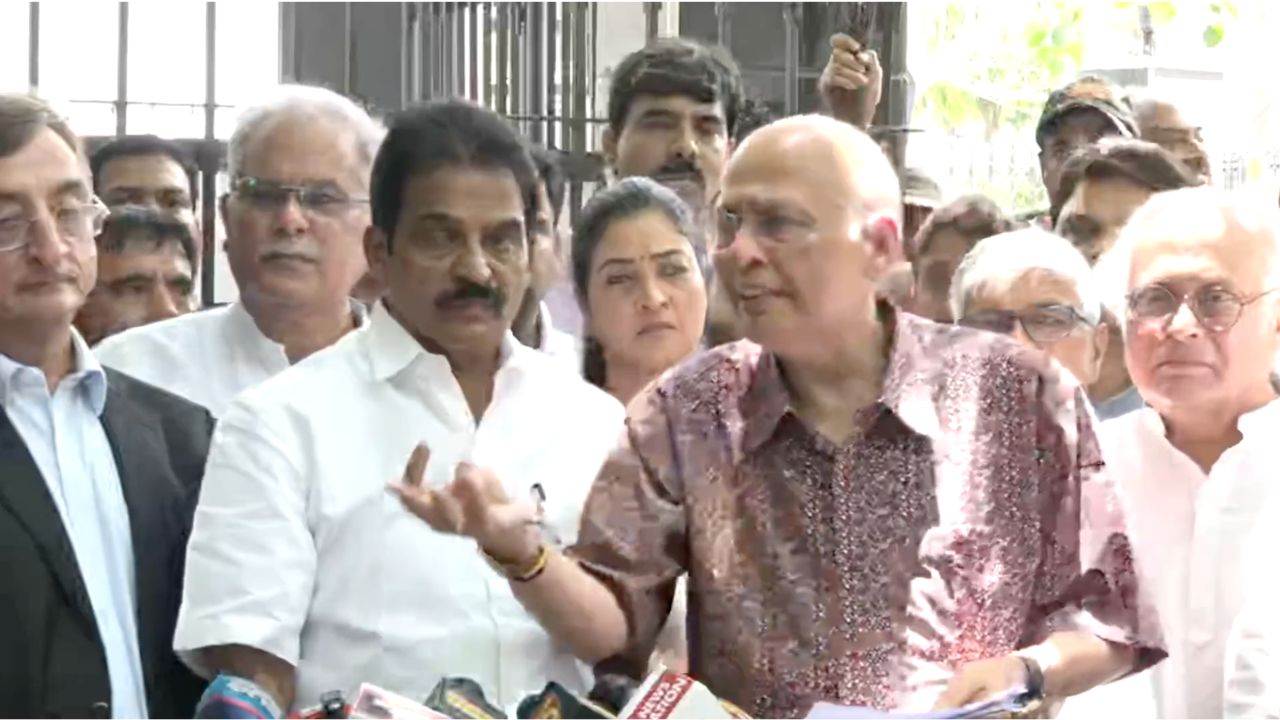
Senior lawyer Abhishek Manu Singhvi briefing the press after meeting the EC.

Synopsis: A delegation of 10 Congress leaders met the Election Commission after the nomination of Madhya Pradesh Congress Rajya Sabha candidate Meenakshi Natrajan was rejected the previous day. They said that the criminal case on the grounds that the nomination of Natarajan was rejected does not exist, as the competent judge has yet to take cognisance.
A delegation of 10 Congress leaders, including MPs KC Venugopal, Jairam Ramesh and Randeep Surjewala, met the Election Commission (EC) on Wednesday, 10 June, after the nomination of Madhya Pradesh Congress Rajya Sabha candidate Meenakshi Natrajan was rejected the previous day.
Natarajan was also among the people who met the EC.
Congress General Secretary Venugopal said the delegation has had a detailed discussion with the Chief Election Commissioner and other Election Commissioners. He added that they presented the proper facts and figures.
Senior lawyer Abhishek Manu Singhvi said that the criminal case on the grounds that the nomination of Natarajan was rejected does not exist, as the competent judge has yet to take cognisance.
Also Read: Who sank Meenakshi Natarajan’s Rajya Sabha bid? BJP points to Congress infighting in Telangana
Singhvi said they have demonstrated beyond doubt that such a case does not exist.
“We have demonstrated to the Commission, beyond any shadow of doubt, that the Returning Officer (RO) has passed a completely perverse order by rejecting the nomination papers of our candidate, Meenakshi Natarajan. This is not a borderline error; it is a profound legal absurdity. It is the equivalent of a public official declaring that two plus two equals seven,” Singhvi said.
“The rejection was based on the false premise that Natarajan suppressed information regarding a ‘pending criminal case’ in her nomination affidavit. The absolute reality is that no criminal case exists against her in the eyes of the law,” he added.
He said that no criminal case exists since the judge has not taken cognisance.
Any kindergartner or first-year law student understands that a criminal case cannot exist before a court takes formal cognisance (sangyan) of an offence. In this instance, Natarajan merely received a preliminary notice from a magistrate’s court to appear and show cause as to whether the court should take cognisance of a private complaint. Taking cognisance is a judicial process where a magistrate decides if there are even grounds to let a case proceed. Because the magistrate has not yet taken cognisance, no criminal case has been born,” Singhvi said.
Also Read: Karnataka reshuffles senior bureaucracy, assigns additional charge in key departments
Singhvi said the RO completely misapplied the statutory disclosure requirements. “Under Section 33A of the Representation of the People Act, a candidate is only required to disclose pending criminal cases under very specific, advanced conditions. The offence must carry a potential punishment of two years or more, and the charges must have been formally framed by a competent court.”
“For charges to be framed, a case must progress through multiple distinct judicial milestones that have not occurred here. To reject a nomination at a pre-cognisance stage is a bizarre, unlawful overreach that throws out a candidate before they even reach the starting line of the election,” he added.
He claimed that this “arbitrary disqualification” severely distorts the level playing field essential to fair elections. “It strikes at the very heart of our democracy and violates the basic structure of our Constitution by forcing a candidate out of the race through administrative whim rather than due process.”
Singhvi said the Election Commission possess vast, plenary, and uncircumscribed powers under Article 324 of the Constitution to ensure justice and rectify patent wrongs committed by its subordinates.
“An aggrieved candidate should not be told to wait three, four, or five years for the conclusion of a lengthy election petition in the courts while an improperly elected individual occupies the seat. The Commission is fully empowered to act immediately. We provided the Commission with clear precedents where they have previously intervened to correct such errors, notably: A precedent in Haryana, where the Commission stepped in after an RO wrongly attempted to reject two nominations. A precedent in Gujarat, where corrective measures were taken regarding cast ballots to preserve electoral integrity,” he said.
Adding that Wednesday is the final date for the withdrawal of nominations, he said there is ample time for administrative intervention. “We have submitted all relevant legal notes, statutory citations, and precedents to the Commission. We trust that the Election Commission of India will recognise the gravity of this unlawful order and exercise its constitutional authority to set it aside immediately.”
The alleged case pertains to a complaint by a woman, A Srilata, who approached the Metropolitan Magistrate Court in Hyderabad on 20 August 2025. The complainant had named Natarajan as accused number four.
The court issued a notice to Natarajan on 17 September 2025, asking her to submit a response in person. In a counter-affidavit filed on 24 October, Natarajan’s lawyer denied the charge and alleged that the complaint was politically motivated.
Though the lawyer sought the dismissal of the case, the court did not entertain the request. The case is pending before the court.



