

Published Jul 14, 2026 | 4:02 PM ⚊ Updated Jul 14, 2026 | 4:02 PM


Construction is expected to begin within the next few weeks.

Synopsis: Telangana has secured the Centre’s assurance that the long-delayed Mamnoor Airport in Warangal will be completed by June 2028. The State is also pursuing proposed airports at Adilabad and Kothagudem as part of its plan to expand aviation infrastructure beyond Hyderabad, with the projects expected to support economic growth by improving access to key industrial, tourism and agricultural regions.
Telangana’s ambition to build a network of airports beyond Hyderabad received fresh momentum on Tuesday after Chief Minister A Revanth Reddy received an assurance from Union Civil Aviation Minister K Rammohan Naidu that the long-delayed Mamnoor Airport in Warangal would be completed before 2 June 2028.
The Union Minister also said construction would begin within the next few weeks, offering the clearest timeline yet for a project that has languished for decades.
The assurance came during a meeting in New Delhi, where the Telangana government also urged the Centre to speed up plans for airports at Adilabad and Kothagudem. The discussions are part of a sustained effort by the State over recent months to expand aviation infrastructure beyond the capital.
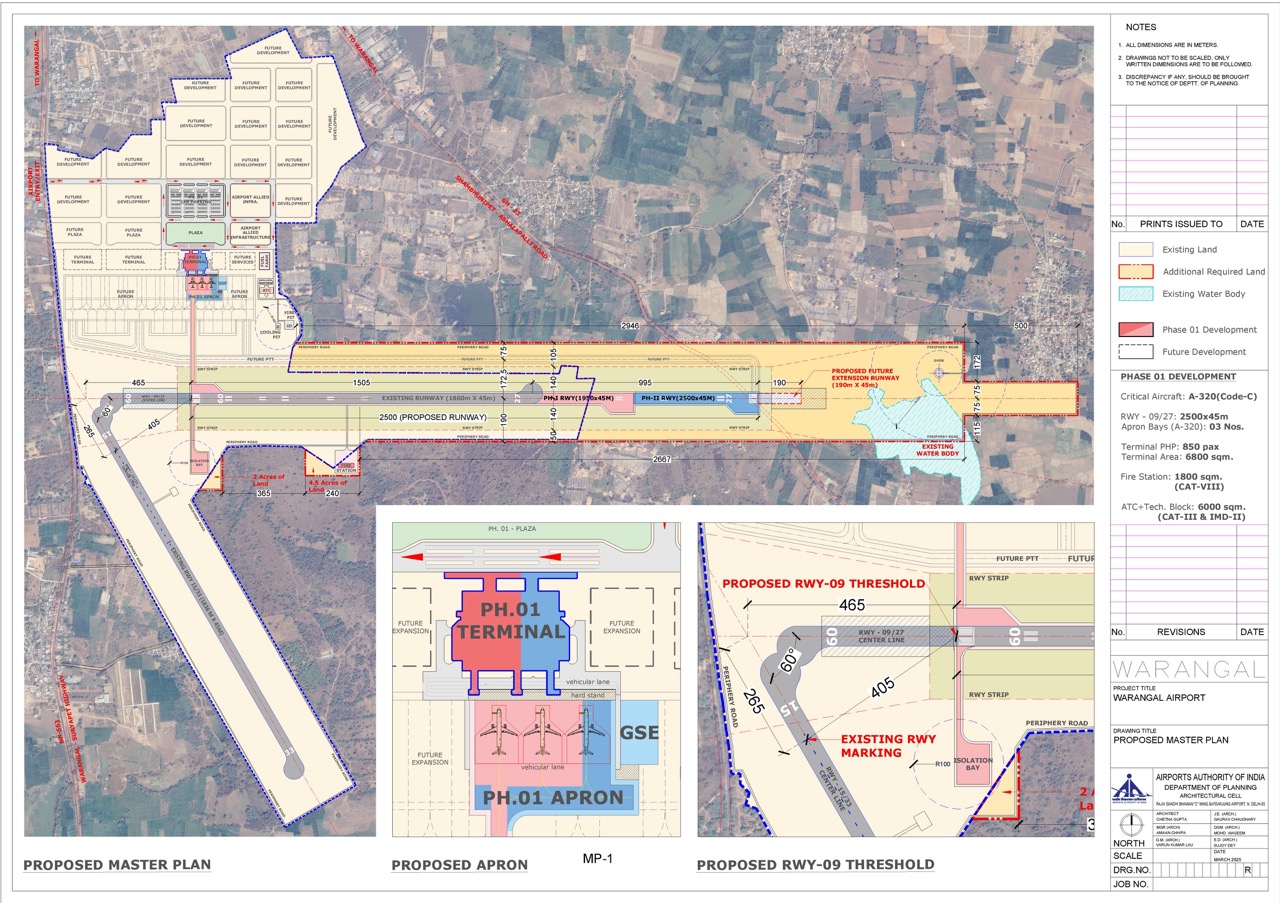
Proposed airport masterplan.
Earlier this year, the Chief Minister, along with Members of Parliament from Telangana, reviewed the status of the airport projects and pressed the Centre to prioritise the development of Mamnoor Airport, including modern passenger and cargo facilities.
With land acquisition now largely complete, attention has now turned to construction.
Also Read: The politics of Tollywood: Jr NTR says no, Allu Arjun keeps everyone guessing
Hyderabad has grown into one of India’s busiest aviation hubs, but for people in much of Telangana, catching a flight still means hours on the road. The proposed airports at Warangal, Adilabad and Kothagudem are meant to change that by bringing commercial air services closer to regions that have long been without them.
Among the three, Warangal occupies a pivotal position. As Telangana’s second-largest urban centre, it has steadily developed into a hub for higher education, healthcare, textiles and tourism.
The Kakatiya Mega Textile Park, growing industrial investment and the UNESCO World Heritage-listed Kakatiya monuments have strengthened the city’s economic profile. Direct air connectivity could improve investor confidence, reduce travel time and integrate the region more closely with national markets.
The airport also carries political and emotional significance. For decades, successive governments promised to revive Mamnoor Airport, but the project remained stalled because of regulatory hurdles, land acquisition issues and procedural delays.
Meanwhile, Adilabad, located along Telangana’s northern frontier, has considerable agricultural, forest and tourism potential but has remained relatively isolated from major economic centres.
Improved air connectivity could encourage investment, boost tourism and improve administrative access to the region.
Kothagudem, meanwhile, is central to Telangana’s mining and power economy. An airport there could support industrial mobility, facilitate business travel and strengthen logistics in the State’s eastern coal belt.
India’s experience with regional airports has shown that physical infrastructure alone does not guarantee commercial success. Several airports developed under regional connectivity programmes continue to operate below capacity because passenger demand and airline interest have not matched initial projections. Airlines ultimately base their decisions on commercial viability rather than administrative priorities.
The challenge before Telangana, therefore, extends beyond building airports. The proposed airports must be integrated with industrial corridors, logistics infrastructure, tourism circuits and urban development plans.
Implementation will be equally critical. Large infrastructure projects often encounter delays arising from clearances, financing and intergovernmental coordination. The State’s recent engagement with the Centre appears intended to minimise these bottlenecks and establish clear timelines.



