

Published May 08, 2026 | 1:44 PM ⚊ Updated May 08, 2026 | 1:44 PM

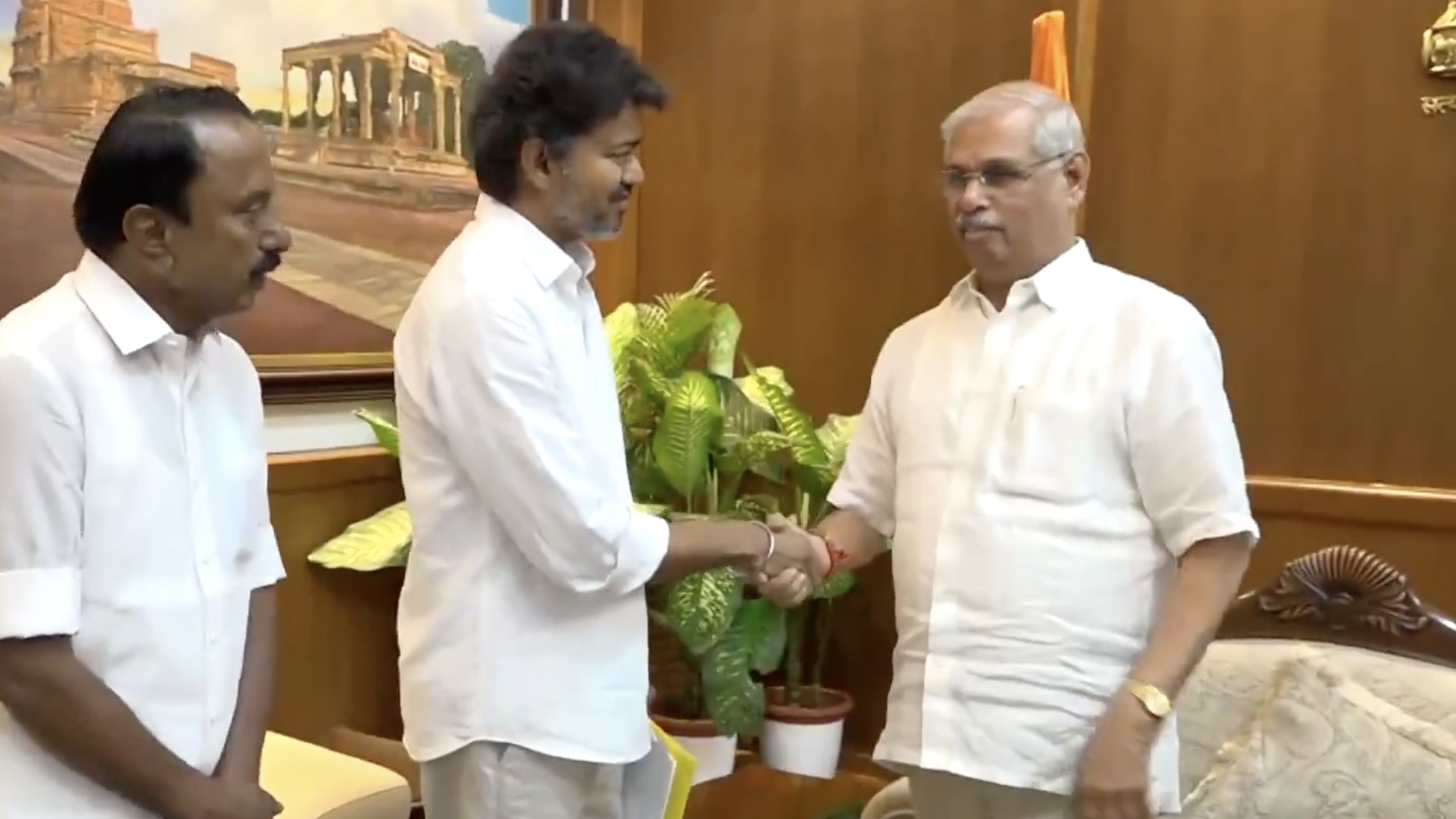
TVK chief Vijay with Tamil Nadu Governor.

Synopsis: The Constitution remains notably silent on the precise procedure to be followed when the electoral verdict is fractured, and no party commands a clear majority. If the single largest party alone seeks the opportunity to govern, the Governor’s duty is to facilitate the democratic process by inviting it to form the government and directing it to prove its majority within a reasonable period.
The framers of the Indian Constitution understood that democracy cannot always be governed through rigid textual formulas. Certain situations, by their very nature, require constitutional authorities to act not merely according to written provisions, but in accordance with democratic principles, constitutional morality, and established conventions.
One such situation arises in the aftermath of a hung Assembly, when no political party secures an absolute majority to form the government.
Article 164 of the Constitution empowers the Governor to appoint the Chief Minister and the Council of Ministers. Yet, the Constitution remains notably silent on the precise procedure to be followed when the electoral verdict is fractured, and no party commands a clear majority.
This silence has often generated political controversy and legal debate. However, India’s constitutional history demonstrates that this silence is not a flaw in the constitutional design. Rather, it is an intentional space left for democracy itself to resolve political uncertainty through legislative processes.
Also Read: Will the INDIA bloc survive this challenging hour?
The current political scenario in Tamil Nadu presents a compelling illustration of this constitutional challenge. The TVK has emerged as the single largest party in the Assembly with 108 seats in a House of 234, falling short of the majority mark by nine seats. At the same time, no other political formation or coalition has publicly staked a claim to form the government. In constitutional terms, this distinction is extremely significant.
India has witnessed similar situations at both the Union and State levels. The general elections of 1989, 1996, 1998, and 1999 produced fractured mandates that compelled the President to exercise constitutional discretion under Article 74. Likewise, states such as Karnataka, Goa, Jharkhand, and Maharashtra have repeatedly experienced political uncertainty following hung verdicts.
In nearly every such case, the eventual resolution emerged not from gubernatorial discretion alone, but through the democratic mechanism of the floor test.
Broadly speaking, two distinct situations arise in a hung assembly. The first is where multiple parties or alliances approach the Governor, each claiming to possess the numerical support necessary to form a stable government. In such circumstances, the Governor may reasonably seek letters of support or other material to assess which claimant is more likely to command confidence in the House.
The second situation is fundamentally different and constitutionally more straightforward. This occurs when only the single largest party comes forward to stake a claim, while all other parties remain silent or refrain from presenting any alternative arrangement. The present Tamil Nadu scenario falls squarely within this category.
In such circumstances, the Governor’s constitutional options become considerably narrower. The Governor cannot indefinitely postpone the formation of government merely because the claimant does not yet possess an absolute majority on paper. Nor can the Governor speculate about hypothetical alliances that have not formally emerged. Constitutional governance cannot be based upon assumptions or political conjecture.
The logic behind inviting the single largest party in such a situation is rooted in democratic necessity. In a parliamentary democracy, governments are ultimately tested not in the Governor’s residence but on the floor of the legislature. The Constitution does not contemplate a “preliminary examination” of majority support conducted outside the Assembly.
If there is no rival claimant before the Governor, insisting upon proof of majority before inviting the leader to form the government would amount to constitutional overreach.
This principle was decisively reinforced by the Supreme Court in the landmark SR Bommai v. Union of India judgement. The Court held that the appropriate forum to determine majority support is the floor of the House and not the subjective satisfaction of constitutional authorities. Over time, this doctrine has become one of the foundational principles of Indian parliamentary democracy.
Indeed, subsequent constitutional developments have consistently reaffirmed the centrality of the floor test. Whether in Karnataka, Maharashtra, Uttarakhand, or Madhya Pradesh, courts have repeatedly intervened to ensure that questions of legislative majority are settled transparently within the Assembly.
The judiciary’s consistent message has been clear: democracy functions through elected representatives voting in the House, not through private political calculations outside it.
Also Read: As Vijay seeks support for TVK government, Congress sees ‘secular’ excuse to split from DMK
The constitutional silence regarding the hierarchy of invitation in a hung assembly should therefore be understood as an enabling silence rather than a dangerous vacuum. It grants the Governor flexibility, but that flexibility is not absolute. It must operate within the larger framework of democratic accountability and constitutional restraint.
If the single largest party alone seeks the opportunity to govern, the Governor’s duty is to facilitate the democratic process by inviting it to form the government and directing it to prove its majority within a reasonable period. Such an approach neither guarantees power to the claimant nor prejudges the final outcome. It merely allows the constitutional process to unfold in its proper institutional setting.
If the government succeeds in obtaining the confidence of the House, democratic legitimacy stands established. If it fails, the Constitution provides its own corrective mechanisms. If the government falls, alternative formations may emerge, or fresh elections may become necessary. In every scenario, the final verdict rests with democratic institutions rather than individual constitutional authorities.
A hung assembly should not be viewed as a constitutional crisis. It is, instead, a natural consequence of a fragmented electoral mandate in a vibrant democracy. The Governor’s role during such moments is not to engineer political outcomes, but to preserve constitutional balance with neutrality, restraint, and fidelity to democratic principles.
Ultimately, the legitimacy of a government in a parliamentary democracy does not flow from the Governor’s invitation. It flows from the confidence of the elected House. That principle remains the true constitutional compass in times of political uncertainty.
(Views are personal.)



