

Published Jul 30, 2026 | 1:48 PM ⚊ Updated Jul 30, 2026 | 1:48 PM

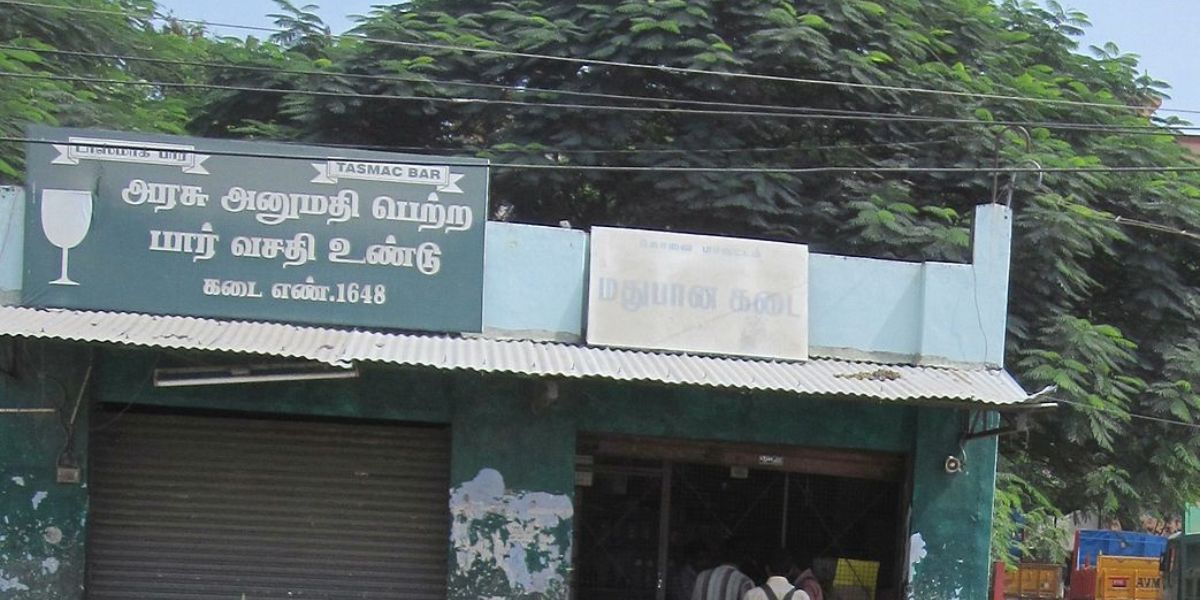
A TASMAC outlet in Tamil Nadu. (Creative Commons)

Synopsis: The FIR states that TASMAC operates around 5,380 retail liquor shops and 3,240 TASMAC bars across Tamil Nadu. District managers were authorised to invite tenders for operating bars and for selling empty carton boxes. Although revenue from TASMAC retail liquor sales increased every year, revenue generated from TASMAC bars declined significantly.
The Directorate of Vigilance and Anti-Corruption (DVAC) carried out simultaneous searches at 45 locations across Tamil Nadu after registering a corruption case against former Electricity, Prohibition and Excise Minister V. Senthil Balaji, former TASMAC Managing Director S. Visakan, IAS, former senior regional managers Rama Durai Murugan and Panneer Selvam, former personal assistant Bhaskar, Senthil Balaji’s close associates Rathesh Raj Shanmugavel and Karthik alias Moolanur Karthik, officials of TASMAC, distillery and brewery companies, transport firms, bottling companies, other unidentified public servants and private individuals over alleged large-scale irregularities in the functioning of the State-run liquor corporation.
According to the DVAC, the action follows a discreet enquiry conducted on materials forwarded by the Tamil Nadu government. The enquiry, the agency said, revealed a prima facie case involving cognisable offences, leading to the registration of Crime No. 5/2026 on July 28, 2026.
Also Read: TN Assembly adopts resolution against Mekedatu dam project
The FIR has been registered under Sections 120(B), 167, 409, 109 and 420 of the Indian Penal Code (IPC); Sections 61(2), 201 and 316(5) of the Bharatiya Nyaya Sanhita (BNS), 2023; and Sections 13(2) read with 13(1)(a), and 7(c) read with 12 of the Prevention of Corruption Act, 1988, as amended by the Prevention of Corruption (Amendment) Act, 2018.
As part of the investigation, DVAC teams searched the residences of the accused, premises belonging to distillery and brewery companies, transport firms, bottling companies and district TASMAC offices across the State.
During the searches, officials seized valuable documents, digital evidence, TASMAC-related records and other incriminating materials. In one of the locations, the owner of the premises could not be traced during the search. Since investigators had reasonable grounds to believe that incriminating documents and materials were available inside the premises, the house was sealed in the presence of Revenue officials. The investigation is continuing.
The FIR states that TASMAC operates around 5,380 retail liquor shops and 3,240 TASMAC bars across Tamil Nadu. District managers were authorised to invite tenders for operating bars and for selling empty carton boxes. Although revenue from TASMAC retail liquor sales increased every year, revenue generated from TASMAC bars declined significantly.
The FIR alleges that in 2021, tenders were invited for 857 TASMAC bars in Coimbatore, Tiruppur, Erode, Namakkal, Karur and the Nilgiris, with bids being finalised in December that year.
According to the investigation, TASMAC district managers violated tender norms by allowing only a selected bidder to witness the tender opening instead of permitting all applicants to be present as required under the rules.
Investigators further alleged that bidders formed a syndicate, submitting demand drafts with consecutive serial numbers issued by the same bank, indicating collusion in the tender process.
The FIR also alleges that 284 out of the 857 bars were officially shown as closed. However, field verification reportedly found that these bars continued functioning without licence renewals. Under government rules, bars that fail to submit monthly demand drafts are required to be shut down and fresh tenders issued.
Instead, TASMAC district managers and other officials allegedly colluded with bar operators, allowing the bars to continue functioning, resulting in substantial losses to the government. The FIR estimates the revenue loss at ₹17.27 crore in Coimbatore North, ₹13.58 crore in Coimbatore South and ₹1.95 crore in the Nilgiris during 2022-23 alone.
The FIR further alleges large-scale irregularities in tenders relating to the transportation of liquor from 45 TASMAC depots.
It cites the example of Ravichandran of Sun Transports, who applied for transport contracts covering 16 depots, submitting 16 demand drafts of ₹50,000 each, all issued by the Bank of Baroda in March 2023.
Although he was awarded only one depot, the FIR alleges that while six unused demand drafts were returned to him, the remaining nine demand drafts were allegedly misused by TASMAC officials to facilitate transport contracts for other companies, including S.S. Transport, A1 Travels and Speed Parcel Service, Sri Venkateswara Logistics, Surya Cargo Movers and Dharana Logistics Pvt. Ltd. across various depots in Tamil Nadu.
According to the FIR, TASMAC pays nearly ₹100 crore annually towards transport contracts, and senior regional managers and other officials allegedly violated tender procedures, committed fraud and facilitated illegal financial transactions. The alleged offences occurred during the tenure of Rama Durai Murugan and Panneer Selvam as senior regional managers.
Also Read: The NTA has failed India’s students once too often. Is it time to pull the plug?
The FIR further alleges that in many cases, the individual who was officially awarded a bar licence did not actually operate the establishment. Instead, demand drafts were allegedly purchased using one person’s bank account, submitted by another applicant and the bars were eventually run by entirely different individuals.
An example cited in the FIR relates to Sivaganga district, where an individual allegedly deposited ₹25 lakh to obtain 42 demand drafts, despite never applying for any bar tender. Investigators allege that this was done at the direction of Moolanur Karthik.
The FIR further alleges that all TASMAC bars in Karur district were effectively controlled by Moolanur Karthik and the “Karur gang,” who operated as a syndicate and pressured TASMAC senior regional managers and officials to allot bars only to individuals approved by them.
Investigators have also alleged that politicians operating in Coimbatore, Karur and neighbouring districts collected money from bar operators in the name of “party funds.” These individuals have been referred to in the FIR as the “Karur gang.”
Alleged bottle procurement and liquor supply irregularities
The FIR alleges that distributors dealing in used bottles generated fake invoices or inflated invoice values to obtain money from distilleries. After deducting their commissions, they allegedly returned the remaining cash to the liquor manufacturers, who then used the money to bribe TASMAC officials in exchange for supply orders.
It further states that GLR Holdings transferred ₹23.27 crore to Niha International Pvt. Ltd. between 2020-21 and 2021-22, and another ₹12.55 crore to Southern Agrifurane Industries Pvt. Ltd. (SAFL) between 2022-23 and 2024-25.
The FIR also alleges that Crystal Bottles, a major supplier of used bottles to SNJ Breweries and SNJ Distilleries, transferred nearly ₹108 crore to the SNJ Group between 2020-21 and 2024-25.
According to the FIR, Rathesh Raj Shanmugavel, described as a close associate of Senthil Balaji, acted as an unofficial “power broker” within TASMAC.
Investigators allege that the then Managing Director S. Visakan, IAS, acted on instructions received from the then Minister and subsequently followed Rathesh Raj Shanmugavel’s directions in matters concerning TASMAC administration.
The FIR alleges that Rathesh Raj Shanmugavel exercised influence over official decision-making, including approval of liquor brands, manipulation of bar licence tenders and transfers of DRO-level officers, despite holding no official government position.
The investigation alleges that senior TASMAC officials, including the former Managing Director, favoured selected liquor manufacturers by procuring and distributing their brands even when there was no demand from retailers or shops.
It also alleges that liquor was sold above the Maximum Retail Price (MRP) between 2021 and 2025, with customers allegedly being charged up to ₹500 extra for imported liquor and ₹10 to ₹100 extra on Indian Made Foreign Liquor (IMFL) depending on the brand.
The FIR further alleges that former ministerial personal assistant Bhaskar and close associate Rathesh Raj Shanmugavel influenced the transfer and posting of TASMAC officials to generate illegal financial gains.
According to investigators, preliminary evidence suggests that public servants, TASMAC officials, private individuals and companies worked together under the influence of former Minister Senthil Balaji to commit multiple irregularities.
Also Read: Horse trading or strategy? Inside the TVK’s play for AIADMK leaders
The FIR states that the investigation is based on materials gathered through the Enforcement Directorate (ED) investigation and complaints received by the government.
According to the FIR, preliminary evidence indicates that between 2021 and 2025, former Minister Senthil Balaji, former TASMAC Managing Director S. Visakan, senior regional managers Rama Durai Murugan and Panneer Selvam, former personal assistant Bhaskar, Rathesh Raj Shanmugavel, Moolanur Karthik, liquor manufacturers, bottling companies and transport firms conspired to commit criminal breach of trust, forgery, cheating and misappropriation, causing substantial losses to the State exchequer through illegal financial transactions.
The FIR also alleges that unofficial power brokers, backed by political leaders and senior officials, exercised influence over TASMAC’s decision-making process, enabling undue favours and causing significant losses to the government.
It notes that the Enforcement Directorate had earlier estimated irregularities worth around ₹1,000 crore involving TASMAC, including transport tenders, empty bottle procurement, liquor pricing and other alleged financial irregularities. The DVAC has now intensified its investigation based on those findings.
(With inputs from Subash Chandra Bose)



