

Published Jun 16, 2026 | 6:56 PM ⚊ Updated Jun 16, 2026 | 10:10 PM

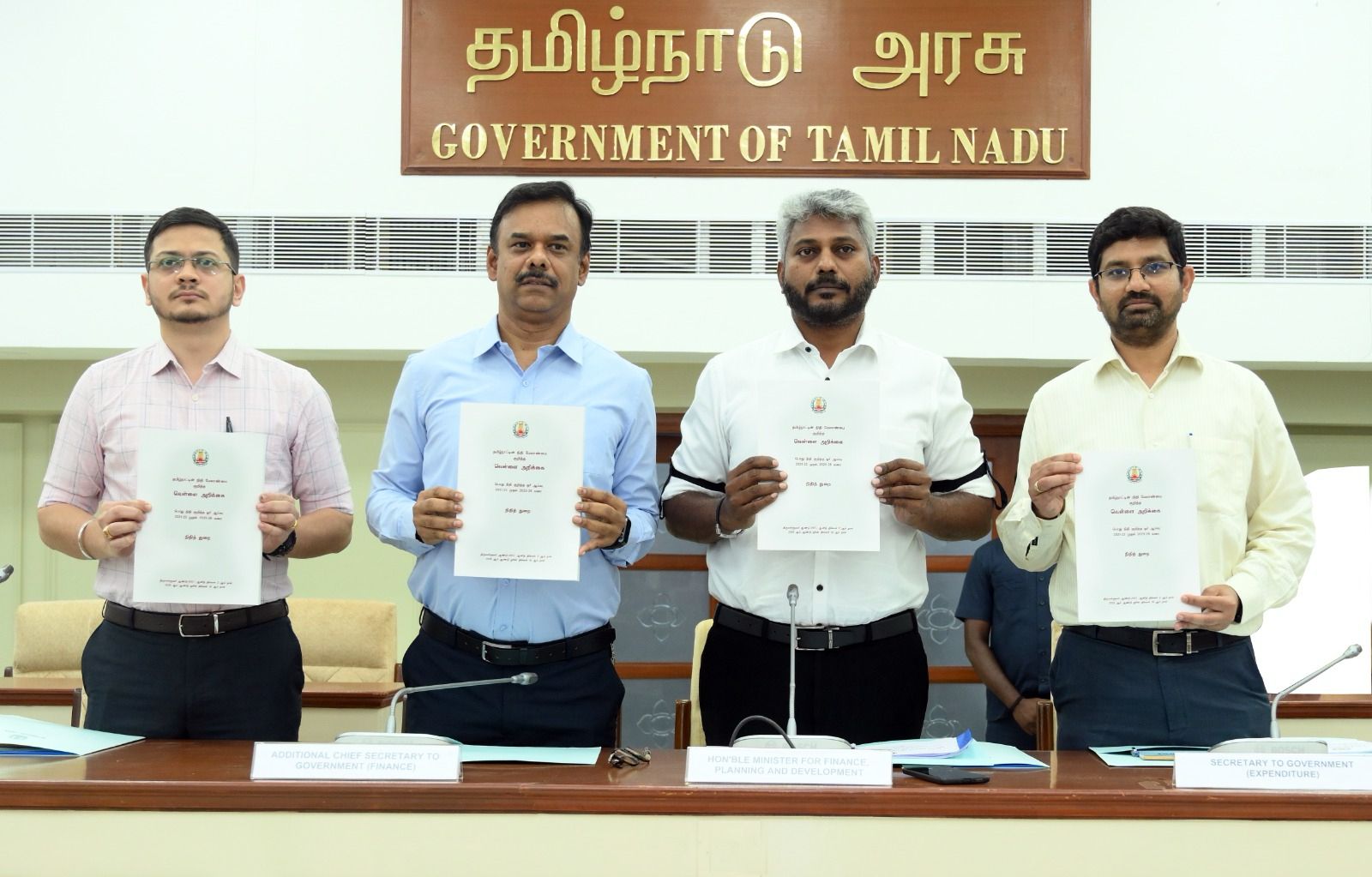
Finance Minister Maria Wilson (second right) releasing the white paper in Chennai on Tuesday.

Synopsis: Finance Minister Maria Wilson released a white paper on the state of finances on Tuesday. The report did not paint a rosy picture, but the minister expressed confidence that the situation could be handled if expenditure did not exceed limits. The white paper, however, took serious note of the state’s burgeoning ageing population.
Tamil Nadu’s total debt doubled to ₹10 lakh crore in the financial year 2025-26 from ₹5 lakh crore in 2021-22, accounting for 28.3 percent of the Gross State Domestic Product (GSDP), a white paper on the state’s finances revealed on Tuesday, 16 June.
However, the total debt burden would come to ₹13.18 lakh crore while considering those not fully reflected in the state budget.
The white paper Finance Minister Maria Wilson released at the Namakkal Kavignar Maligai in the state Secretariat stated that GSDP has fallen to 8.32 percent in 2025-26 from 10 percent in 2021-22.
Compared with other states, Tamil Nadu’s debt burden remained significantly higher, compared with Karnataka at 23.4 percent, Maharashtra at 19.7 percent and Gujarat at 17.6 percent.
Wilson pointed out a sharp decline in central government grants to Tamil Nadu during the review period. The white paper grants to Tamil Nadu with states such as Maharashtra, Gujarat and Karnataka.
The paper on the state’s fiscal health claimed that central grants to Maharashtra increased by 15 percent, while Gujarat recorded a 2.14 percent decline and Karnataka registered a 14.52 percent decline. Tamil Nadu, however, recorded the steepest fall at 16.26 percent.
Also Read: The new ideological grammar of Vijay’s TVK
Raising concerns over the new pension scheme introduced under the previous Dravida Munnetra Kazhagam government, the white paper stated that the scheme had created additional long-term expenditure pressure.
The status report said the one-time transition fund requirement for the pension scheme has been estimated at nearly ₹13,000 crore, while recurring annual expenditure would be around ₹5,000 crore and projected to rise by nearly 10 percent annually. The burden was in addition to already rising pension expenditure obligations.
On capital expenditure, the report said Tamil Nadu was spending significantly less compared to peer states.
Capital expenditure currently stood at only 1.44 percent of the GSDP, accounting for just 11.8 percent of total expenditure, placing Tamil Nadu behind comparable states.
The report noted that debt was increasing at almost twice the pace of capital expenditure growth. While debt recorded a compound annual growth rate of 14.3 percent, capital expenditure grew at only 8.3 percent. For every ₹1 spent on new capital expenditure, the state has been borrowing ₹2.26.
It further estimated that Tamil Nadu suffered a capital opportunity loss of nearly ₹28,217 crore between 2023 and 2026. The report said that if the state had maintained its 2021-22 capital expenditure ratio of 1.79 percent, the additional spending could have funded nearly 1,000 kilometres of expressways, 30 multi-speciality hospitals or 2,000 school buildings.
The white paper alleged that Tamil Nadu breached the fiscal deficit target prescribed under amendments to the Tamil Nadu Fiscal Responsibility legislation in 2025.
Also Read: What’s behind Tamil Nadu’s growing power outages?
Serious concerns have also been raised over the financial health of state-run public sector undertakings.
The Tamil Nadu Electricity Board group has a debt of ₹2.47 lakh crore and it has accumulated losses to the tune ₹1.82 lakh crore, the report said.
The report stated that government financial support to the power sector between 2021 and 2026 totalled ₹1.45 lakh crore, including ₹33,478 crore in 2025-26 alone.
It also said a recent Supreme Court order would require the state to provide an additional ₹11,800 crore annually between 2026-27 and 2030-31.
The report highlighted severe financial stress in the state transport corporations, stating that eight transport corporations together have accumulated losses of ₹72,667 crore, while pending liabilities stood at ₹61,642 crore.
Operational data showed expenditure per kilometre at ₹78.81 while revenue per kilometre is only ₹25.97, leaving a structural gap of ₹52.84 per kilometre.
The total operating expenditure in transport corporations doubled between 2020-21 and 2025-26, while operational revenue declined by 13 percent, compared to 2019-20 levels.
The white paper also stated that the Tamil Nadu Civil Supplies Corporation has a working capital debt of ₹27,181 crore.
It said water supply boards in Tamil Nadu have accumulated losses of ₹7,776 crore, including losses in the Chennai Metropolitan Water Supply and Sewerage Board and the Tamil Nadu Water Supply and Drainage Board.
The report stated that the government’s actual debt burden was much higher than the officially stated ₹10 lakh crore.
Including liabilities of public sector undertakings, the total debt burden has been estimated at ₹13.18 lakh crore, of which ₹3.18 lakh crore came from public sector enterprise debt not fully reflected in the state budget.
Government guarantees increased sharply from ₹65,659 crore in 2021 to ₹1,79,782 crore as of March 2026, nearly tripling in five years.
Also Read: Stalin questions Vijay’s silence after Chennai sees 12 sexual assault cases
The report also flagged demographic challenges ahead, stating that Tamil Nadu was expected to become one of India’s fastest ageing large states.
The share of the elderly population has been projected to rise from 10.6 percent in 2011 to 18.2 percent by 2031, marking a 71.7 percent increase, higher than Karnataka, Maharashtra and the national average.
It further noted that the working-age population, which peaked at 66.4 percent in 2021, has been projected to decline to 63.6 percent by 2036.
The report said rising social welfare obligations combined with a shrinking working-age population may significantly reduce the number of taxpayers, placing greater pressure on future state finances.
The white paper further stated that the government was increasingly borrowing for day-to-day expenditure rather than for long-term investment.
In 2025-26, interest payments stood at ₹67,050 crore, exceeding capital expenditure of ₹50,911 crore, indicating that more money was being spent on servicing debt than on asset creation.
The white paper Wilson presented was the first financial report released by the Tamilaga Vetri Kazhagam government. Earlier, after the Dravida Munnetra Kazhagam government had come to power in 2021, the then Finance Minister Palanivel Thiaga Rajan had released a similar white paper.
Explaining the objective of the report, Wilson said the document aimed to provide the people with a transparent and fact-based assessment of the state’s financial position. He said the report was not intended as political criticism of the previous government, but an honest review of the financial situation.
Quoting Thirukkural, the minister said that despite the limited income, no harm would come to the state if the expenditure did not exceed limits.



