

Published Jun 29, 2026 | 1:49 PM ⚊ Updated Jun 29, 2026 | 1:49 PM

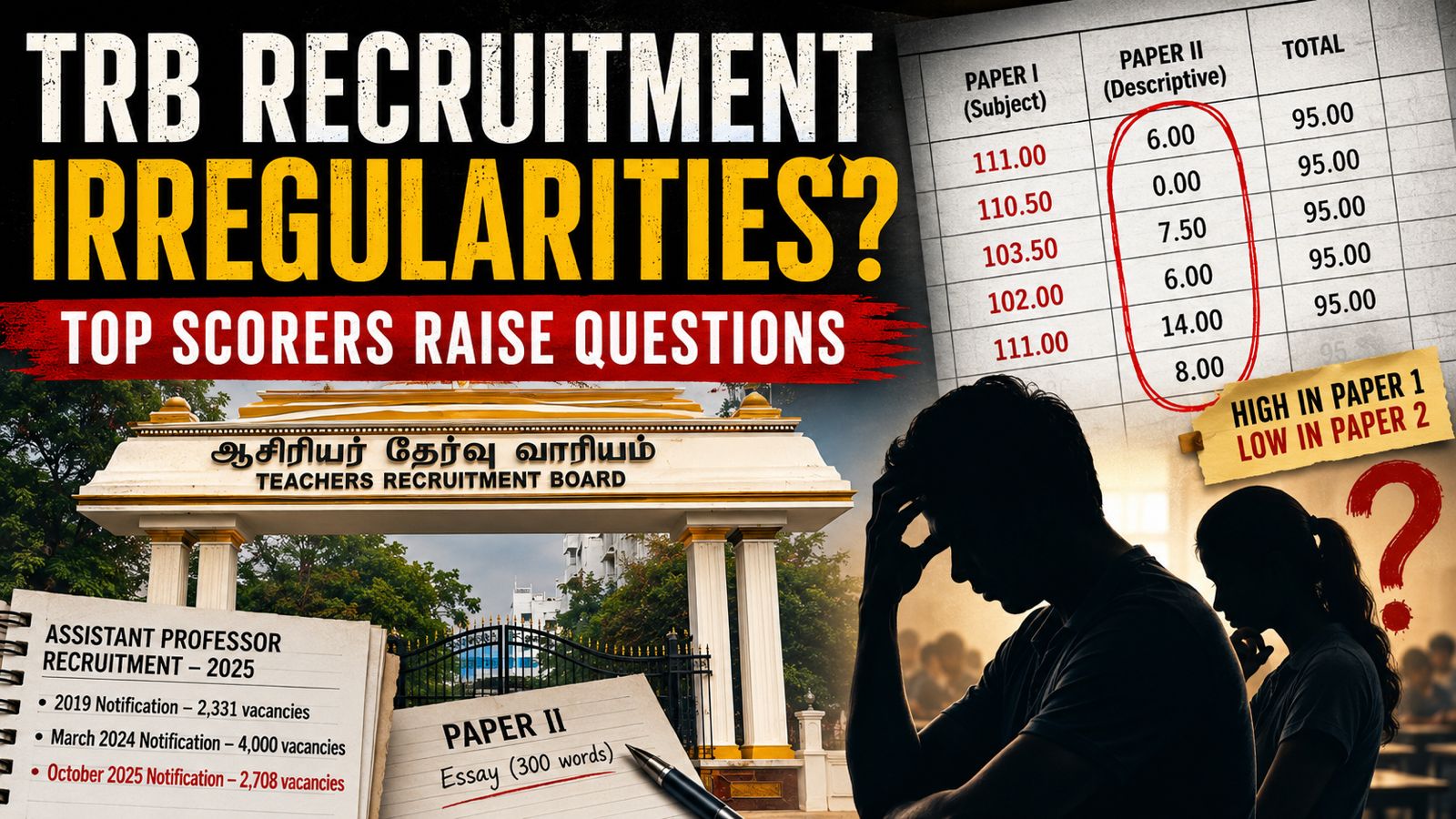
TRB recruitment. (AI-generated)

Synopsis: Candidates allege serious irregularities after several top scorers in the objective paper of the Assistant Professor recruitment exam received shockingly low marks in the descriptive section. The controversy has also raised questions over TRB’s last-minute exam pattern change months before the recruitment test.
More than 40,000 candidates who appeared for Tamil Nadu Teachers Recruitment Board’s (TRB) Assistant Professor recruitment examination are questioning the credibility of the evaluation process. Multiple candidates who were among the highest scorers in the subject paper were reportedly awarded shockingly low marks in the descriptive section, including one candidate who secured the second rank in Paper 1, receiving just six marks out of 50 in Paper 2.
The examination, conducted by the TRB on 27 December 2025, was held for direct recruitment to 2,708 Assistant Professor posts in Government Arts and Science Colleges and Government Colleges of Education under the Tamil Nadu Collegiate Education Service.
While the results were released on 25 June, candidates have now come forward alleging serious irregularities in the evaluation process, particularly in Paper 2.
As allegations intensify, candidates, along with multiple political parties, have demanded a formal inquiry into the recruitment process.
Also Read: AIADMK Karur MLA MR Vijayabhaskar resigns from Tamil Nadu Assembly
Manikandan (name changed), a 32-year-old candidate, has spent more than a decade preparing for competitive examinations ranging from Tamil Nadu state recruitment exams to national-level tests, including NET, JRF, and UPSC. He has successfully cleared both NET and JRF in his subject.
It was after nearly 14 years that Tamil Nadu conducted the long-awaited Assistant Professor recruitment examination, and Manikandan appeared with high expectations. However, when the results were released on 25 June, the outcome left him stunned.
The TRB recruitment process consists of three written stages before the interview. Candidates must first qualify in the Tamil language paper by securing at least 33 percent marks. Only then are their Paper 1 and Paper 2 answer sheets evaluated.
Paper 1 consists of 150 marks worth of objective-type subject questions. Paper 2, under the revised exam pattern introduced in 2025, required candidates to write one essay of not more than 300 words from five given topics, carrying 50 marks.
In Paper 1, Manikandan secured the second-highest score in Tamil Nadu in his subject category. However, in Paper 2, he was awarded only six marks out of 50.
What makes the result particularly unusual is that the topic he selected for Paper 2 is an area in which he has already published multiple academic research papers.
But Manikandan is not an isolated case. Multiple candidates, including those already working as teachers, allege they have faced similar outcomes.
Gayathri (name changed), belonging to the Most Backwards Community (MBC) category, is one such candidate.
Despite scoring more than 110 marks in Paper 1, Gayathri received only 13 marks in Paper 2. She said the topic she selected was basic enough that even school students could comfortably answer it. The low score drastically pushed down her rank.
Under TRB recruitment rules, candidates are shortlisted for interview in a 1:3 ratio, meaning only three candidates are called for every vacancy. Gayathri said the Paper 2 score may now prevent her from even qualifying for an interview despite a strong performance in the subject paper.
Candidates who spoke to South First raised two major concerns.
First, candidates who scored exceptionally high marks in Paper 1 were given zero, single-digit, or unusually low scores in Paper 2.
Second, candidates who scored relatively low marks in Paper 1, in some cases less than half of the total 150 marks, were awarded as high as 49 marks in Paper 2, pushing them significantly ahead in the final ranking list.
Candidates argue that this scoring pattern appears highly unusual.
Several candidates who scored above 103 marks in Paper 1 were awarded just six or seven marks in Paper 2.
In one of the most striking cases, a candidate named Saravanadevi, who scored 111 marks in Paper 1, was allegedly awarded zero marks in Paper 2.
In another case, a candidate who scored 85 out of 150 in Paper 1 was awarded 40 marks in Paper 2, while another candidate who scored 87 marks in Paper 1 reportedly received only 1.25 marks.
Candidates said the unexplained scoring pattern has effectively pushed several otherwise high-ranking candidates out of interview eligibility.
The unusually sharp divergence in scoring patterns has now led candidates to question whether Paper 2 functioned as a mechanism to alter rankings after the objective examination had already established merit positions.
The roots of the controversy go back several years.
The recruitment notification for Assistant Professor posts was first released in 2019 for 2,331 vacancies.
Later, in March 2024, TRB issued a fresh notification increasing vacancies to 4,000 posts.
However, in October 2025, both earlier notifications were cancelled, and a new notification was issued, reducing vacancies to 2,708 posts.
More importantly, the examination pattern for Paper 2 underwent a significant change between the 2024 and 2025 notifications.
In its 2024 notification, TRB had prescribed a 100-mark Paper II comprising Section A with 50 objective-type subject questions carrying 50 marks and Section B with five descriptive subject-based answers out of eight questions carrying another 50 marks.
However, in its 2025 notification, the board replaced this with a 50-mark descriptive paper requiring candidates to answer just one essay-type question on a general topic within a 300-word limit in one hour.
The shift marked a major departure from an examination model focused on subject expertise through objective and descriptive evaluation to one largely centred on general essay-writing ability.
Candidates are now questioning why the board altered the examination pattern twice and, more importantly, why the final change was introduced just months before the examination.
They also pointed out that the board did not clearly specify in advance the academic domain from which the descriptive paper questions would be asked.
Also Read:
Candidates have also flagged possible inconsistencies in the evaluation process itself.
The five essay topics provided in Paper 2 were:
According to candidates, those who answered Question 1, relating to the Constitution, and Question 3, relating to Tamil Nadu government schemes, were reportedly awarded between zero and 20 marks.
In contrast, candidates who chose Question 5, relating to renewable and non-renewable energy sources, were allegedly awarded significantly higher marks, ranging from 15 to 49.
Candidates argue this indicates uneven evaluation standards depending on the question selected.
Speaking to South First, Gayathri said, “There are only two possible solutions now. Either TRB must conduct a revaluation of Paper 2 and publicly release the answer sheets for transparency, or the entire Paper 2 should be scrapped, and final results should be prepared based only on Paper 1 marks and candidate experience.”
Meanwhile, the Opposition, including AIADMK General Secretary Edappadi K Palaniswami, Pattali Makkal Katchi (PMK) leader Anbumani Ramadoss and the CPI, demanded the cancellation of the results, an independent probe into the evaluation process, and suspension of appointments until the controversy is investigated.
Responding to the allegations, Jayanthi told the media that the descriptive papers were evaluated according to the Higher Education Department guidelines through a two-stage correction process involving professors appointed by the Directorate of Collegiate Education.
She added that complaints regarding discrepancies in marks are now being examined, and a clarification will be issued after discussions with the Higher Education Department.
With multiple candidates reporting similar scoring anomalies, questions are now being raised over whether the revised descriptive paper and its evaluation process significantly altered final rankings in ways that disadvantaged otherwise high-performing candidates.
As demands for revaluation intensify, the controversy has placed the credibility of one of Tamil Nadu’s largest higher education recruitment exercises under serious scrutiny.
(Edited by Muhammed Fazil.)



