

Published Oct 06, 2026 | 4:03 PM ⚊ Updated Oct 06, 2026 | 4:03 PM

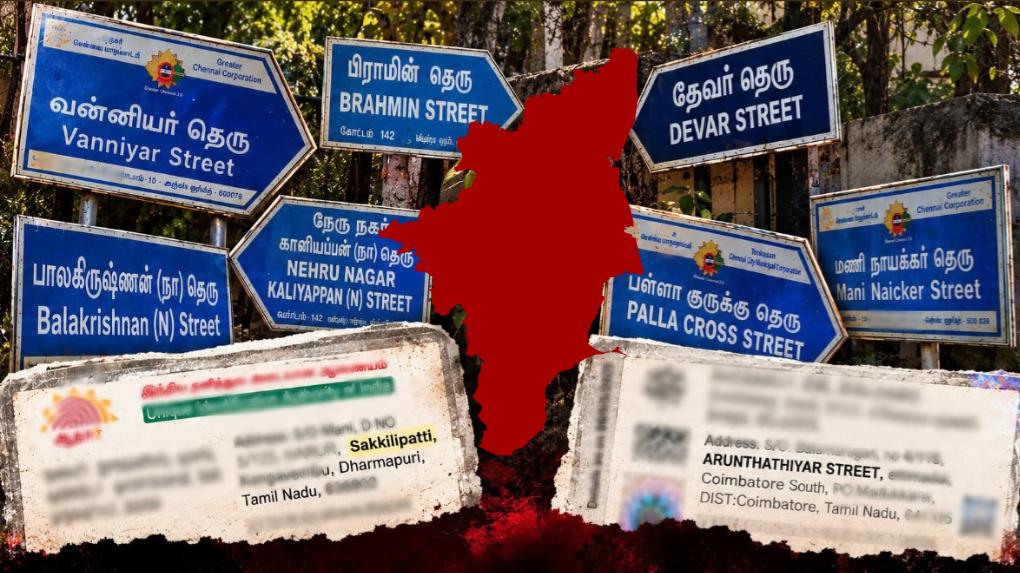
For residents of such villages and streets, their addresses become involuntary markers of caste.

Synopsis: Tamil Nadu’s caste-associated village, street and habitation names act as involuntary social markers for their residents. The previous DMK government issued an order last year to identify and rename such places, with 8,171 habitations and 17,993 streets among those identified for changes; the Madras High Court has upheld the order and directed the State to identify more such names. Residents of such villages say removing caste markers from addresses and official records could free them from everyday discrimination and prejudice.
Sixteen-year-old Vanaja is a class 12 student hailing from Vadakku Achamthavizhthan village, Srivilliputhur taluk, Tamil Nadu’s Virudhunagar district. Once she called a schoolmate from the same village to ask about homework she had missed.
While the two girls were talking over the phone, the classmate’s mother took the phone and enquired where Vanaja was from.
“Acham Thavizhthan,” Vanaja told the woman. “Which part of the village?” came the woman’s reply. “Paracheri,” Vanaja replied.
The woman then turned to her daughter, with Vanaja still on the call: “Why are you talking to a Paracheri girl? Don’t associate with her anymore.”
Vanaja is Dalit. The name of her locality carried caste connotations.
“If our locality had simply been called Acham Thavizhthan, nobody would have questioned us. Because the name identifies our caste, people immediately know who we are. Whether it is friends or their parents, wherever we go, we are subjected to humiliation,” she told South First.
Vanaja’s experience is not unique. Across Tamil Nadu, villages, streets, habitations and water bodies continue to bear caste-associated names.
For residents of such villages and streets, their addresses become involuntary markers of caste, leaving them with no choice about whether to disclose it.
On 6 October 2025, the then DMK government sought to address this through G.O. (Ms) No. 313, laying down guidelines for identifying and removing caste-based or objectionable names from public places.
The order was subsequently challenged in the Madras High Court. On 23 September, the Madurai Bench dismissed the challenge, upholding the guidelines and directing the State to continue identifying places left out of the exercise.
Also Read: TN bypoll: Move over Vijay, Vanniyar factor and Maragatham’s ground connect matter at Maduranthakam
Arunthathiyar Veethi in Ettimadai Town Panchayat in Coimbatore district is home to thousands of Dalits.
Shanmugam, a 24-year-old resident, says several young people from the locality have struggled to find employment despite being graduates. He says he experienced this himself.
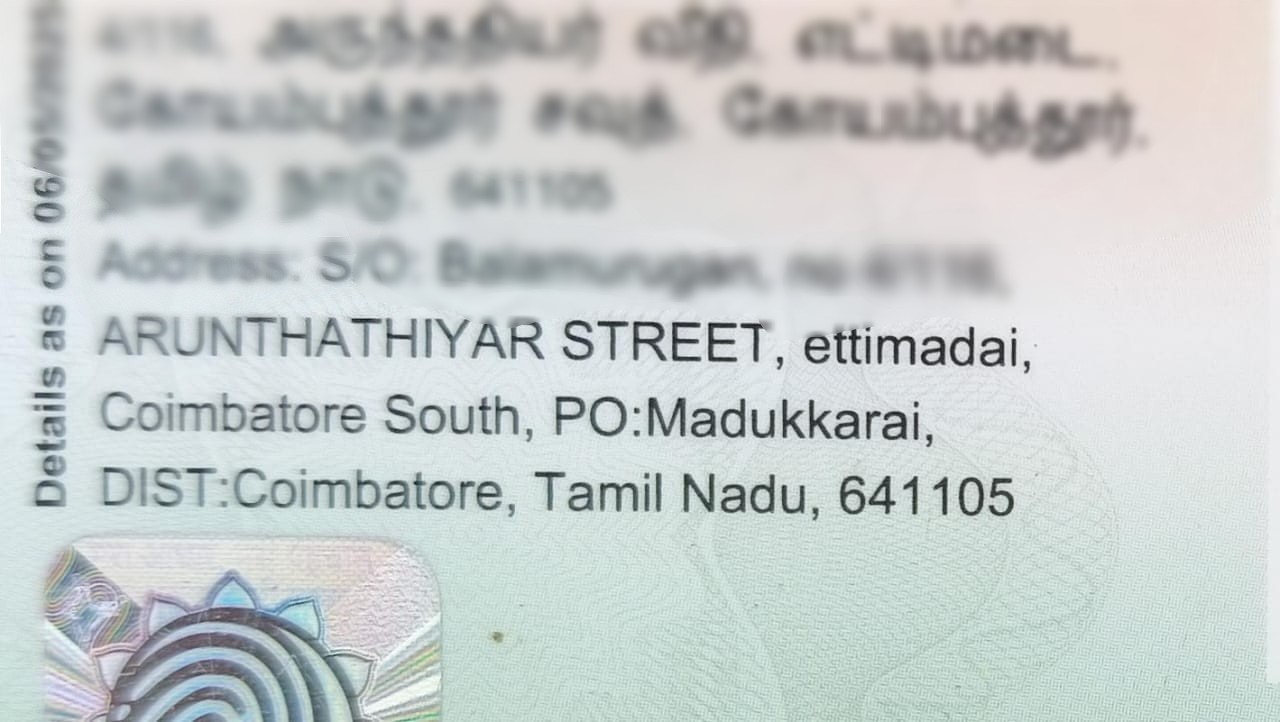
An Aadhaar card showing “Arunthathiyar Street” as part of the holder’s residential address in Ettimadai, Coimbatore district.
“I once went for a job interview. While filling in my address, the moment I said that I lived in Arunthathiyar Veethi, their attitude changed. They also asked about my caste. After that, they never called me back,” Shanmugam said.
He acknowledges that there could have been other reasons why the company did not contact him again. But what stayed with him was the change in the employee’s expression after hearing the name of his street.
Dr Selvamani, a Dalit from Sakkilipatti, near Kongavembu Post in Harur taluk of Dharmapuri district, studied medicine and is now a government doctor. Yet, he says he has never felt comfortable openly mentioning the name of his native village.
Today, Sakkilipatti is commonly displayed as S. Patti on public signboards. However, several official documents, including Aadhaar records, continue to carry the name Sakkilipatti.
“I am educated and work as a doctor. But whether it was at the schools I studied in or medical college, I could never openly say the name of my village. The way people treated me and the humiliating looks I received changed the way I saw myself. That is why I stopped mentioning my village name,” Selvamani said.
For years, names such as Arunthathiyar Colony, Adi Dravidar Colony, Pallar Colony, Paraiyar Colony and Paracheri have appeared in government records and public usage for localities predominantly inhabited by Dalits.
Tamil Nadu also has numerous streets, villages and water bodies named after intermediate and Forward communities, including Iyer, Pillai, Mudaliar, Reddy, Chettiar, Naicker, Vanniyar, Konar, Thevar and Naidu.
In many such places, residents belong to multiple communities, including Dalits. Their experience can be very different from that of members of the community after whom the locality is named.
Social activist Joy Andrew, who lives in Chennai, usually tells people that he is from Neyveli when they ask where he is from.
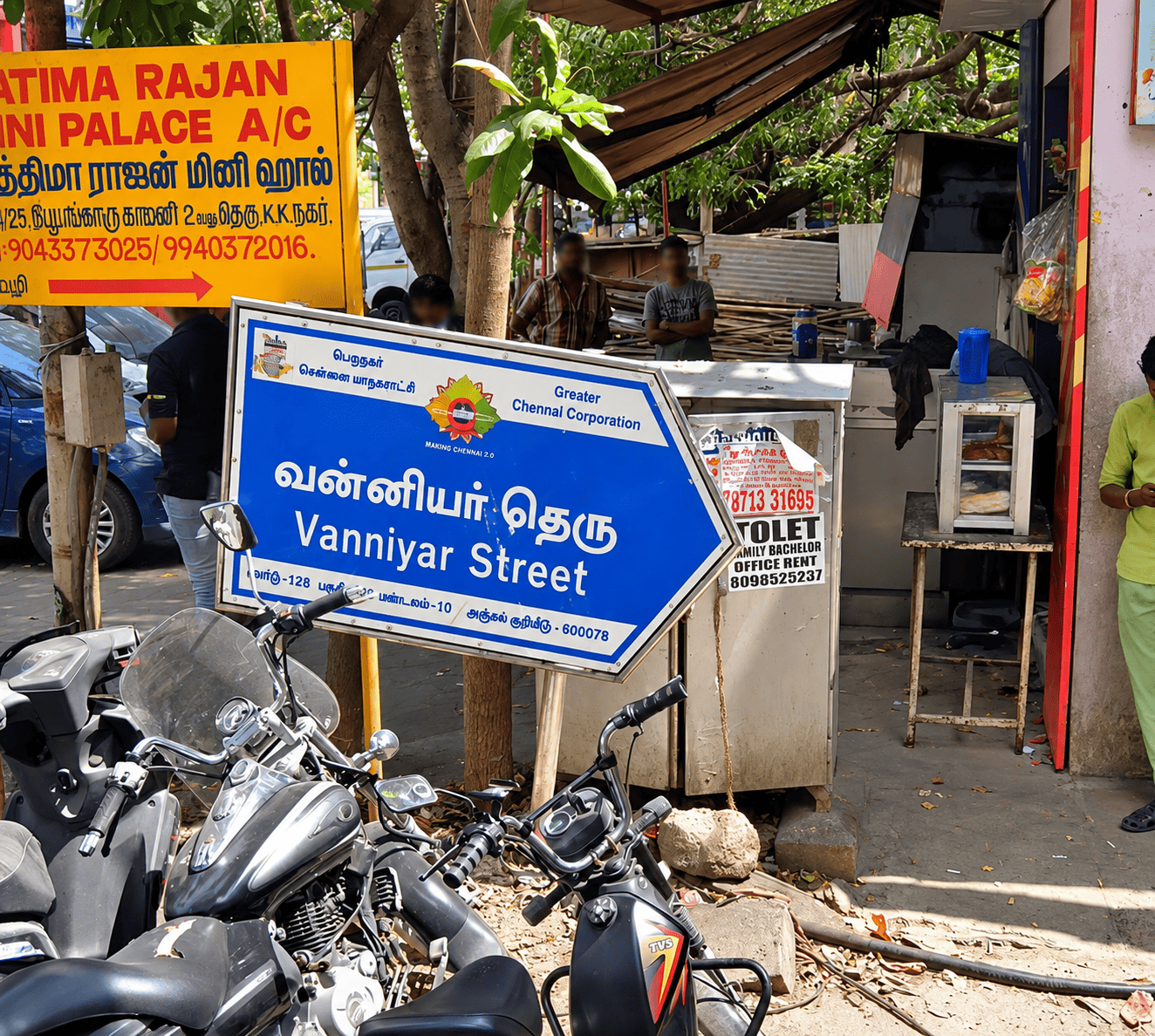
A Greater Chennai Corporation sign marking Vanniyar Street in Chennai.
Neyveli, however, is not his native place. His actual birthplace is Reddy Thathur, a remote village in Cuddalore district. Joy, a Dalit Christian, says his experiences during school made him uncomfortable even mentioning the name of his own village.
“When I was in Class 11, a teacher from what is considered a dominant caste assumed that I also belonged to his community because I came from Reddy Thathur. He was very affectionate towards me and showed a lot of concern. That made me feel close to him as well. But once he came to know my actual social background and caste, he distanced himself from me. After that, he routinely scolded and even hit me in class over small matters,” Joy said.
“That experience left a deep impression on me, that once people know our background, they will exclude us,” he added.
Since then, whenever someone asks him where he is from, Joy simply names the nearby larger town, Neyveli.
“There were a few families belonging to the Reddy community, and that is why our village was given that name. But Dalits were actually the majority there. Those Reddy families are no longer even there, yet the name remains. Wherever we go and say Reddy Thathur, people immediately associate it with Reddys. Once they realise that there are no Reddys there anymore, they identify us as Dalits and maintain a distance,” Joy said.
Bhimarao, a Dalit social activist from Inam Reddiyapatti in Virudhunagar district, asked whether naming a village after one community was fair.
“If people from all communities live in a village, how can naming that village after just one community be considered fair to everyone else? How can that be called treating everyone equally?”
Also Read: Vettri Payanam: CM Vijay turns bus conductor as free travel for women expands in TN
Twenty-nine-year-old Delhi Ganesh’s family has lived in Chennai’s KK Nagar for generations. The area has streets named East Vanniyar Street and West Vanniyar Street, among others. People from several communities live there, while many Vanniyar families own houses in the area and people from other communities live there as tenants.
For Ganesh, however, the name has never been a source of discomfort.
“I have lived here since I was born. I have never really thought much about the name. I have never had any bad experience because of it when I mention it outside,” he said.
Ganesh said he has never felt the need to change the name. At the same time, he said he would not object if the government changes it, provided the authorities make the necessary changes to residents’ official documents without creating difficulties.
Satheesh, who lives on Vanniyar Street in Choolaimedu, has a similar experience. His family has lived there for generations.
“In the last 40 years, I have never felt that the name should be changed. I have never had any bad experiences because of the name. In fact, I have never really considered it an issue,” he said.
The Madras High Court, in its judgement, recorded that 8,171 habitations, 17,993 streets, 349 roads, 2,095 water bodies and 10 public institutions had been identified for changes in village panchayats.
The judgement also records separate proposals from municipal corporations, town panchayats and the Greater Chennai Corporation. It directed the government to identify additional names that had been left out and bring in further orders.
The G.O. (Ms) No. 313 requires local bodies to identify such names, consult residents and place proposals before the Gram Sabha or Area Sabha.
After verification, the proposed changes are published in the District Gazette, giving the public 21 days to submit objections or representations before the proposals move forward for a final decision.
The 21-day period has become an important part of the debate because the provision allows the general public, rather than only residents of the affected locality, to submit objections.
The High Court considered the period reasonable, observing that there must be some limit to the time available for objections.
But some residents say the objections could be used by those opposing the changes to inordinately delay the process and have demanded caste-based names to be removed mandatorily across Tamil Nadu rather than leaving the process dependent on individual requests.
Separately, the High Court rejected the petitioner’s argument that removing caste names could create confusion, saying that confusion would exist only among those who continued to retain caste in their minds.
Those who removed caste from their minds, it said, would have no difficulty identifying places without caste-based names.
The court said that after a period of time, caste names would “disappear into oblivion.”
The court also specifically rejected the argument that there could be pride in referring to a residential area as “Sakkiliyan Kulam”, saying there needed to be a change in the mindset of the general public.
It observed that residents themselves should ideally have approached the government voluntarily seeking the removal of caste names.
Also Read: South First impact: Virudhunagar village caste-name issue moves towards renaming
SC/ST Commission Chairman and writer Imayam told South First that the move to remove caste names began within the Commission in 2025, before then Chief Minister M.K. Stalin announced the reform in the Assembly on 29 April 2025.
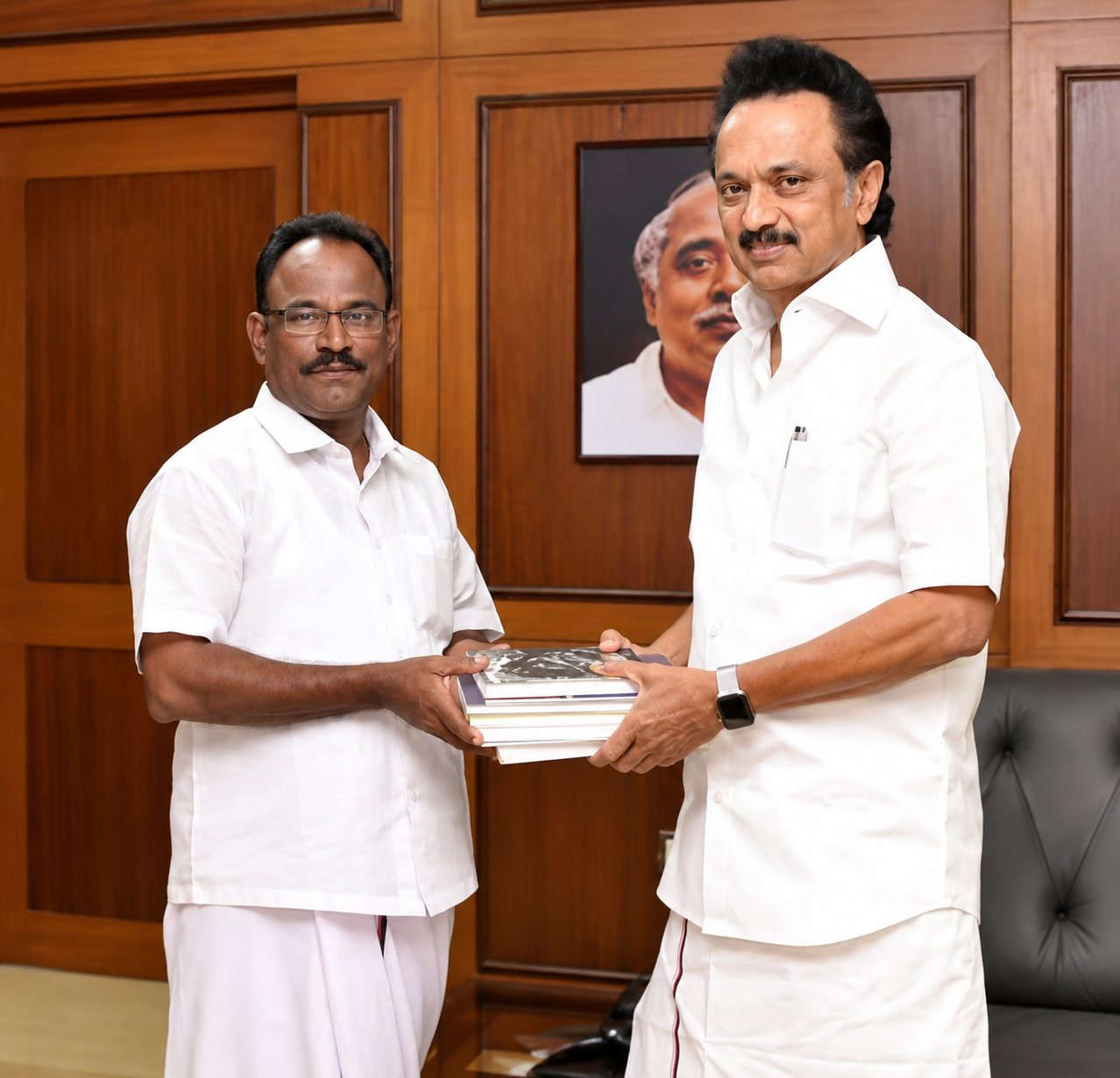
Former Tamil Nadu Chief Minister M.K. Stalin with writer Imayam, Chairman of the Tamil Nadu State Commission for Scheduled Castes and Scheduled Tribes
According to Imayam, the issue was discussed at a meeting of the SC/ST Commission, where names such as Adi Dravidar Colony, Harijan Colony, Arunthathiyar Colony, Mettu Colony and Old Colony were raised as examples of names that continued to carry caste identities and could contribute to humiliation and discrimination.
Following the discussion, Stalin announced the decision, saying caste-based names, including the use of “colony” to identify Scheduled Caste habitations, would be removed from government records and public usage.
“This was not merely about changing a name on a signboard. It was about removing a caste identity that people were being forced to carry in their addresses and official documents,” Imayam said.
“For me, this is one of the biggest achievements of the SC/ST Commission since I assumed office. In fact, I consider this the defining achievement of my tenure here. I believe this is an achievement that can outlive the government that introduced it. Governments may change, but if these names are permanently removed from official records and public usage, the impact will remain for generations.”
Following the High Court’s decision, Imayam said the SC/ST Commission, along with the Social Justice Department and Social Justice Minister Vanniarasu, had stepped up efforts to implement the order across Tamil Nadu.
The Commission has written to all District Collectors, directing them to take necessary action within a month and submit reports on the progress.
(Edited by Dese Gowda)



