

Published Jun 27, 2026 | 11:50 AM ⚊ Updated Jun 27, 2026 | 12:41 PM

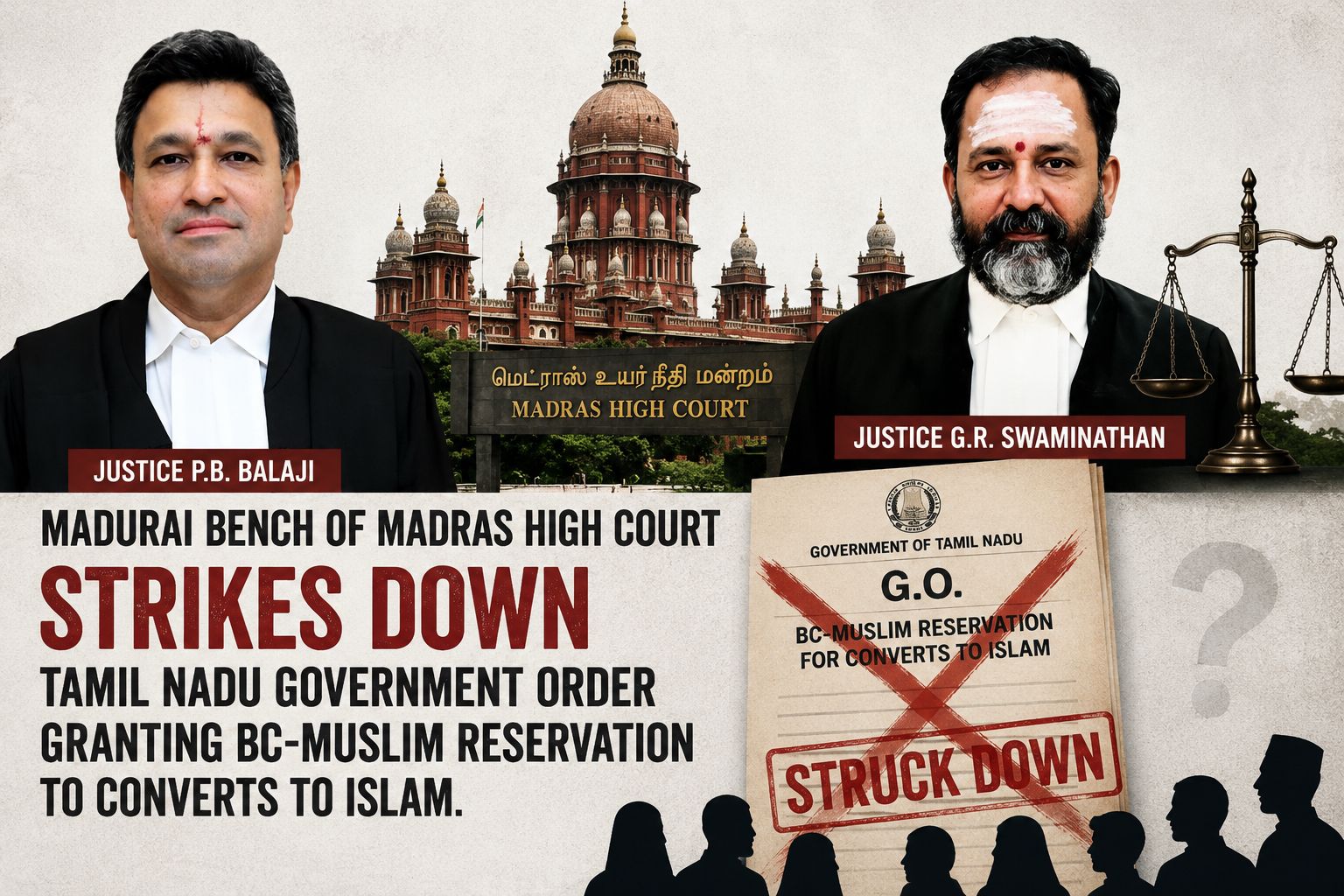
The June 25 verdict has triggered anxiety among thousands of people across Tamil Nadu who had converted to Islam. (Collage)

Synopsis: The Madras High Court struck down Tamil Nadu’s 2024 order allowing backward class converts to Islam to retain reservation benefits under the BC-Muslim category. The verdict could impact thousands across the state who now risk losing quota access in education and government jobs.
A 2024 Government Order by the Tamil Nadu government that allowed people from backward communities of other religions who convert to Islam to continue availing reservation benefits by being classified as Backward Class Muslims (BCM) has now been struck down as unconstitutional by the Madras High Court. Strikingly, the petitioner had continued his case filed in 2022, as he had not learned of the 2024 government order.
Advocate R Maheswaran, counsel for petitioner Sameer Ahamed, revealed this when asked why the case had continued despite the 2024 Government Order being in force. Maheswaran told South First that people from poor backgrounds, like Sameer, were often unaware of such orders being passed.
In Sameer’s case, he simply did not have any knowledge of it, the advocate said. Maheswaran clarified that even the change of vakalat filed during the final hearing only came about because of certain personal issues involving him and not Sameer.
The June 25 verdict has triggered anxiety among thousands of people across Tamil Nadu who had converted to Islam and depended on reservation benefits for education and government employment opportunities.
Among those affected is 32-year-old A Ashika. Born into a backward-class Christian family, she later married a man from the Muslim Labbai community and converted to Islam, changing her official records accordingly after marriage.
Since 2022, Ashika has been appearing for government recruitment examinations. Before the Tamil Nadu government’s order, she was uncertain of whether she could apply under the BCM category and mostly ended up writing exams under the “Others” category.
Had she remained a Christian, she would have continued receiving reservation benefits under the backward class category.
After the government introduced the order, she hoped to benefit from BC-Muslim reservation. But following the High Court verdict now, she finds herself unable to claim reservation benefits either as a backward class Christian or under the BC-Muslim category, forcing her once again to compete under the general “Others” category.
Thousands of similarly placed individuals who converted to Islam now face the possibility of losing reservation benefits entirely in education admissions, employment opportunities and other welfare-linked benefits.
A division bench of the Madras High Court, comprising Justice GR Swaminathan and Justice PB Balaji, struck down the Tamil Nadu government’s 2024 order that allowed individuals belonging to BC, MBC, DNC and Scheduled Caste communities who convert to Islam to retain reservation benefits under the BC-Muslim category.
The case had been filed in 2022 by Sameer, a Thoothukudi resident born as Paramasivam in a Hindu family who converted to Islam in 2015. He had approached the court after his application for a BC-Muslim (Muslim Lebbai) community certificate was rejected by the Tahsildar. The legal dispute should have taken a major turn after the Tamil Nadu government issued G.O. No. 31 on March 9, 2024, which strengthened his claim. But as his lawyer said, Sameer ended up remaining unaware of it.
During hearings, the bench noted that the petitioner’s claim rested entirely on the validity of this government order and therefore examined whether the order itself was constitutionally valid.
The judges referred to earlier precedents, including the landmark G Michael (1952) ruling, which held that once a person converts to Islam, caste identity ceases and the individual becomes “just a Muslim.” The court held that the state government could not override settled judicial precedent through an executive order.
The bench further ruled that membership in Tamil Nadu’s recognised backward Muslim communities such as Labbai, Rowther, Marakkayar, Syed and Sheik is determined by birth and not by religious conversion. In effect, a person can convert to Islam, but cannot convert into a birth-based backward Muslim community.
The judges also criticised the government for clubbing together BC, MBC, DNC (De-Notified Communities) and Scheduled Caste converts under a single reservation category, observing that Scheduled Castes and OBC communities are constitutionally distinct categories and cannot simply be merged to preserve reservation benefits after conversion.
In one of its strongest observations, the bench said Islam historically preaches equality and does not recognise caste hierarchy, making it contradictory for Muslims to subsequently claim caste-based backwardness within Islam for reservation purposes.
The court ultimately declared GO No. 31 unconstitutional, rejected the petitioner’s application and ruled that a convert to Islam cannot automatically claim BC-Muslim reservation status.
Also Read | TNPSC Group-1 exam: Sharp fall in vacancies leaves aspirants worried
The Tamil Nadu government issued G.O. (Ms) No. 31 on March 9, 2024 through the Backward Classes, Most Backward Classes and Minorities Welfare Department after receiving representations from sections of the Muslim minority community seeking continuation of reservation benefits for individuals converting to Islam.
Based on the recommendations of the Tamil Nadu Backward Classes Commission, the order allowed individuals belonging to BC, MBC, DNC and Scheduled Castes who converted to Islam to continue availing the 3.5 per cent reservation earmarked for Backward Class Muslims under the Tamil Nadu Backward Class Muslims Reservation Act, 2007.
The order further clarified that such converts could be issued BC-Muslim community certificates under one of Tamil Nadu’s seven officially recognised backward Muslim communities, such as Ansar, Dekkani Muslims, Dudekula, Labbais (including Rowther and Marakayar), Mapilla, Sheik and Syed.
The objective was to ensure that people who converted to Islam did not lose reservation benefits in educational admissions and state government employment solely because of religious conversion.
In an earlier landmark case before the Madras High Court, former judge D Hari Paranthaman dealt with a similar question, whether a person born in a backward caste Hindu community, after converting to Islam, could continue claiming reservation benefits under the BC-Muslim category.
The petitioner in that case was originally born as Visalakshi in the Hindu Nadar community, a recognised backward class community in Tamil Nadu. She later converted to Islam in 2006, changed her name to MS Barveen Rifana, remarried and obtained an official Labbai Muslim community certificate issued by revenue authorities, recognising her under the BC-Muslim category.
She subsequently appeared for multiple recruitment examinations conducted by the Tamil Nadu Public Service Commission, including Village Administrative Officer, Combined Subordinate Services Examination-I and Station Officer in Fire and Rescue Services.
Despite clearing the written exam, physical efficiency test and oral interview, TNPSC refused to recognise her as a BC-Muslim candidate and instead classified her under the “Others” category based on internal clarifications issued in 2010 and 2012 stating that persons converting from Hinduism to Islam should not receive reservation benefits.
Challenging this, she approached the High Court seeking appointment under the BC-Muslim quota. During hearings, Justice Hari Paranthaman appointed senior advocate M. Ajmal Khan as amicus curiae because of the constitutional significance of the issue.
The court examined whether caste identity disappears after religious conversion and discussed the historical oppression faced by Scheduled Castes and backward communities, citing Periyar’s Vaikom movement, Dr BR Ambedkar’s Annihilation of Caste, the Indra Sawhney judgment and Kailash Sonkar vs Maya Devi (1984).
The judgment observed that although religions such as Islam and Christianity doctrinally reject caste hierarchy, caste identities often continue socially in India even after conversion.
The court also noted that the Tamil Nadu government rules under G.O. Ms. No. 85 (2008) recognised specific backward Muslim communities including Ansar, Dekkani Muslims, Dudekula, Labbai, Rowther, Marakayar, Mapilla, Sheik and Syed, and held that if a person from BC/MBC/SC communities genuinely converts to Islam and belongs to one of these recognised Muslim communities, reservation benefits could continue.
The judgment strongly criticised TNPSC for ignoring a validly issued community certificate and held that conversion is a fundamental right under Article 25 of the Constitution.
It observed that a person should not lose constitutional affirmative action benefits merely because of changing religion and directed authorities to consider the petitioner under the BC-Muslim category.
Former High Court judge Hari Paranthaman has strongly criticised the latest Madurai Bench verdict.
“This judgment is wrong as far as I am concerned,” he said.
Referring to the earlier Barveen Rifana case that came before him, he said the same constitutional question remains unresolved.
“When a husband belonging to the backward Muslim Labbai community qualifies under the backward class category, what logic is there in saying that a person who marries him and converts to Islam cannot be treated as belonging to the same backward category?” he asked.
He also pointed out that in his earlier judgment he had relied extensively on observations made in the landmark Indra Sawhney ruling, particularly by Justice S. Rathinavel Pandian.
Relying extensively on the landmark nine-judge Constitution Bench judgment in the Indra Sawhney Judgment, in which Justice Rathinavel Pandian was part of the bench, Justice Hari Paranthaman observed that while caste oppression historically originated within Hindu society, it cannot be conclusively argued that caste-based social divisions disappear completely after conversion to religions such as Islam or Christianity.
The court noted that the Supreme Court in the Indra Sawhney case had recognised that caste practices and social stratification continue across religious communities in India, particularly in South India, where converted Christians and Muslims often continue carrying social identities linked to their pre-conversion communities.
The judgment further observed that many oppressed communities historically converted to other religions as an act of liberation from caste discrimination and untouchability.
Therefore, religious conversion by itself cannot automatically erase the social disadvantages suffered by such communities.
On this reasoning, the court held that denying reservation benefits solely because a person changed religion would ignore the continuing historical and social backwardness that reservation policy is meant to address.
Hari Paranthaman further argued that the latest ruling effectively discourages religious conversion.
“If a person from another religion marries a Muslim and converts to Islam, the child born to them is recognised under the backward class category, but the person who converted is denied the same status. That makes no sense,” he said.
He further alleged that the judgment sends a broader message that changing religion could lead to loss of constitutional protections.
“I see this as an attempt to discourage religious conversion. The judgment effectively says that if you convert your religion, you lose reservation benefits,” he said.
He also alleged that institutions, including courts, are increasingly moving toward what he described as a “Hindu Rashtra” mindset.
Madurai High Court advocate S Vanchinathan has accused the state government of failing to properly defend its own order in court.
Speaking to the media on June 25th in Madurai, he said, “One month ago itself, the judge had indicated that this government order may be struck down. The government officially entered the case only on June 16. At that stage, the government could have filed a counter-affidavit and requested eight weeks’ time. Why did the government fail to do so?”
He further alleged that the state did not take sufficiently strong legal measures to protect minority rights.
“Considering the seriousness of the case, even the Additional Advocate General did not appear in person and instead appeared through video conference. When the court indicated that it intended to strike down the government order, no request was made to refer the matter to a larger bench. No representation was made before the Chief Justice. Despite having every opportunity to protect the reservation rights of minority communities, the Tamilaga Vettri Kazhagam government failed to utilise those opportunities,” he alleged.
The ruling now prevents individuals from other religions who convert to Islam from being classified under the BC-Muslim reservation category.
From now on, such individuals will no longer be recognised as Backward Class Muslims (BCM). Instead, for employment, educational admissions and all reservation-linked benefits, they can apply only under the “Others” category.
This means even people who previously belonged to backward communities or Scheduled Castes before converting to Islam will no longer be able to retain backward class reservation status after conversion.
Even if reservation benefits had been available to them earlier, those benefits effectively disappear after conversion under the present legal position.
People like Ashika say the verdict leaves them feeling abandoned.
“Despite having merit, opportunities are being denied to us. We are not asking for special concessions in education or jobs. All we ask for is equal opportunity,” she said.
Also Read | Justice delayed, but delivered: Appavu’s decade-long legal battle questions election process
(Edited by R Rajesh Kumar.)



