

Published May 03, 2026 | 2:15 PM ⚊ Updated May 03, 2026 | 2:15 PM

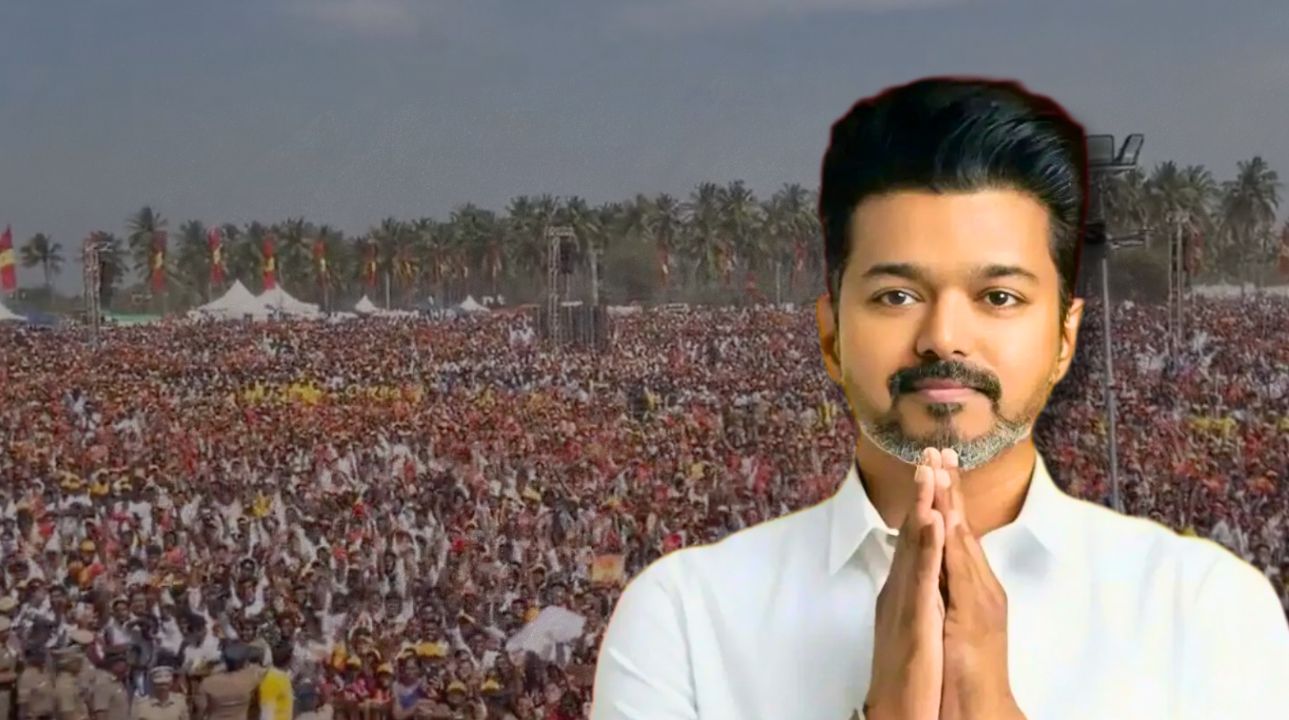
Vijay has been able to convince his support base that he represents a new era of politics, despite not articulating his ideology.

Synopsis: Vijay’s limited but focused campaign for the Assembly elections heavily targeted DMK, while largely avoiding direct criticism of BJP and AIADMK, revealing a carefully calibrated political approach. Whether this strategy of sharp DMK opposition and strategic restraint towards other parties will translate into electoral gains or backfire will only be clear once the results are announced.
With polling for the 2026 Tamil Nadu Assembly elections having concluded on 23 April, vote counting is set to begin in a few hours — on Monday, 4 May —one political figure who drew more attention than most during the campaign was actor-turned-politician Vijay, the leader of Tamilaga Vettri Kazhagam (TVK).
With his party contesting the Assembly election for the first time, a key question dominates political discourse: Will TVK secure enough support to form the government, or fall short of expectations?
At the same time, Vijay’s campaign stood out for being notably limited. Compared to other political leaders, he participated in far fewer campaign meetings over the past month. In fact, he addressed the public directly in fewer than 15 rallies.
This raises important questions: What did Vijay communicate in his speeches? Which political party did he criticise the most? Did he target both his proclaimed political rival, DMK, and ideological opponent, the BJP, equally? And will this electoral strategy yield results?
Also Read: What district-wise polling data says about Tamil Nadu’s ‘historic’ turnout
Vijay began his campaign for the 2026 Assembly elections on 30 March, immediately after filing his nomination in Perambur. Over the course of the campaign, he addressed the public directly in fewer than 15 meetings.
A closer look at his speeches shows a clear pattern. He focused primarily on allegations of corruption under the DMK government, especially relating to TASMAC (Tamil Nadu State Marketing Corporation) and the municipal administration. Across rallies, he repeatedly called for the DMK to be removed from power and urged voters to give TVK a chance to deliver “good governance”.
In terms of frequency, Vijay mentioned the DMK 44 times during his campaign speeches, and Chief Minister Stalin by name 23 times. In comparison, he used the term BJP 20 times.
Although Vijay positioned DMK as his political rival and BJP as his ideological opponent, his criticism was overwhelmingly directed at the DMK.
For instance, during his campaign in Puducherry on 4 April, despite the BJP–NR Congress being in power there, Vijay criticised the DMK–Congress alliance more than the ruling dispensation. Specifically, he mentioned the BJP only six times and referred to the DMK eight times.
Beyond this, he rarely spoke at length about the BJP. In contrast, in every campaign meeting, he mentioned DMK anywhere between four and fourteen times.
The only instance when he spoke comparatively more about the BJP was during his final campaign on 21 April.
Even then, rather than directly criticising the BJP, he alleged a “covert alliance” between the BJP and DMK, stating that a vote for DMK would effectively benefit the BJP. However, his criticism of the BJP did not match the intensity with which he attacked the DMK.
For example, during a campaign in Tiruchirappalli East on 2 April, he blamed the DMK government’s lack of preparedness for the LPG cylinder shortage arising from the Iran–US conflict. Even in that context, he did not strongly criticise the BJP.
Similarly, on the final day of campaigning, he mentioned Prime Minister Narendra Modi and Union Home Minister Amit Shah only once each, merely to suggest that DMK would align with them after losing the election. At no point did he engage with them at an ideological level.
If that is the case, AIADMK chief Edappadi Palaniswami appears to have been even more “fortunate”. Vijay did not mention him or the AIADMK even once directly during the entire campaign. At a few places, he referred vaguely to “other alliance partners,” but never explicitly named either Palaniswami or AIADMK.
This has raised questions in political circles: Did Vijay deliberately avoid these names, keeping post-poll alliance possibilities in mind?
Both journalist and writer Raja Sangeethan and Tamil enthusiast and political observer Tamil Kamarasan agreed that Vijay’s decision not to attack AIADMK or Edappadi Palaniswami directly could be linked to post-poll alliance calculations.
At the same time, they pointed to deeper strategic nuances.
Sangeethan explained that after former chief minister Jayalalithaa’s death, AIADMK entered a period of internal flux. Vijay, he said, has been attempting to draw its vote base towards himself. “That could be one reason for avoiding direct criticism. Additionally, if Vijay secures around 20 percent vote share and AIADMK wins a reasonable number of seats, both parties could attempt to form a coalition government. Maintaining cordial relations now would help in that scenario,” he added.
Kamarasan offered another perspective: Both Vijay and AIADMK are attempting to sideline each other. “By ignoring AIADMK, Vijay positions himself as the primary alternative to DMK, while AIADMK avoids engaging with Vijay in order to retain its position as the principal Opposition,” he said.
Echoing this, Sangeethan added that if AIADMK were in power, Vijay would likely have targeted them instead. According to him, Vijay’s approach is to project himself as an alternative force by opposing whichever party is in power or dominant. In that sense, DMK has become his primary target, not necessarily because of deep-rooted ideological opposition.
Although Vijay identified the BJP as his ideological adversary, he largely refrained from criticising the party during the campaign, even though the BJP was in alliance with AIADMK. He also avoided direct criticism of Prime Minister Modi and Home Minister Shah.
While Sangeethan and Kamarasan agreed that political caution plays a role here, they offered nuanced interpretations.
According to Sangeethan, strongly criticising the BJP in Tamil Nadu could indirectly benefit the DMK, as anti-BJP votes tend to consolidate behind DMK. “Vijay appears to have recognised that attacking the BJP would not yield electoral advantage, and instead chose to focus on DMK as the principal opposing force,” he said.
Kamarasan suggested another dimension: Neither Vijay nor his party may be prepared to face the consequences of directly confronting the BJP, which leads the Union government. “As a result, they have consciously chosen to sideline the party in their rhetoric,” he said.
“At times when they are compelled to address the BJP, they place both DMK and BJP on the same level, normalising the narrative that both parties are alike. This becomes their strategy to show that they are opposing the BJP without escalating the confrontation,” he explained.
Also Read: When a Tamil Nadu Congress leader voted for TVK in Assembly polls
Taken together, Vijay’s campaign suggests a carefully calibrated political approach. On one hand, TVK appears keen to attract AIADMK’s vote base. On the other hand, Vijay seems to be preparing for post-election scenarios.
At the same time, by focusing heavily on anti-DMK sentiment, he is attempting to consolidate opposition votes in the state, while avoiding a confrontation with the BJP at the national level and the potential complications that may follow.
The effectiveness of this dual strategy will ultimately be tested only when the 2026 Assembly election results are declared.
(Edited by Muhammed Fazil.)



