

Published Feb 18, 2026 | 2:23 PM ⚊ Updated Feb 18, 2026 | 2:23 PM

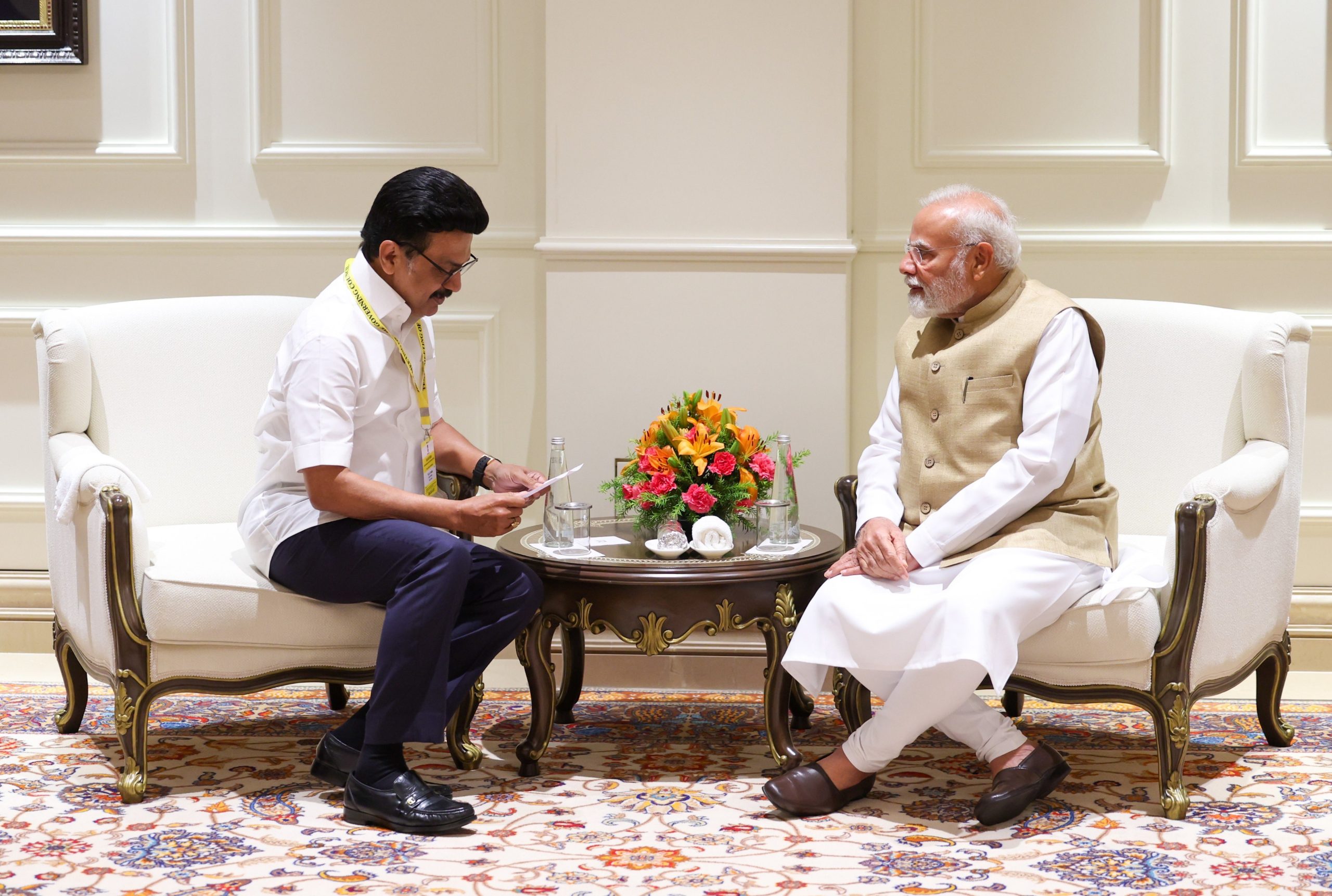
Tamil Nadu CM MK Stalin with PM Modi. Credit: x.com/mkstalin
Synopsis: The Tamil Nadu High-Level Committee report, tabled by CM MK Stalin, proposes sweeping constitutional reforms to strengthen federalism: restructuring Article 368 for robust State ratification in amendments, limiting Parliament’s power over State boundaries, entrenching English and regional languages, redefining the Governor’s role, freezing delimitation until 2126, opposing One Nation One Election, decentralising education/health, and overhauling GST for greater State fiscal autonomy.
In one of the most expansive assertions of state autonomy in recent years, Tamil Nadu Chief Minister MK Stalin on Wednesday, 18 February, tabled the Part 1 report of the State’s High-Level Committee on Union-State Relations in the Legislative Assembly, calling for a far-reaching constitutional restructuring to restore what he described as the “federal balance” envisioned by the framers of the Constitution.
Presenting the report, Stalin said that if a state does not have the authority to realise the aspirations of its people, it is evidence that the Centre has failed to grant adequate state rights. While asserting that Tamil Nadu has progressed socially, economically, educationally and infrastructurally by effectively utilising the powers currently available to it, he stressed that the state must continue to fight strongly for its financial rights and greater autonomy.
“The day we begin the process of amending the Constitution to make state governments fully empowered will be a historic one,” he said.
He argued that the prevailing equation — where the Union decides and the state merely receive — must give way to a partnership model. True federalism, he maintained, means a Union governed collectively by its states, not a central authority exercising overriding command. Similar concerns, he said, have been expressed by several other states across India.
Citing the landmark 1994 Supreme Court ruling in SR Bommai vs Union of India, Stalin noted that federalism has been recognised as part of the Constitution’s basic structure. That principle, he argued, must now be strengthened in practice through explicit constitutional amendments and institutional reforms.
Pointing out that the Constitution has been amended 106 times in 76 years, he said that further amendments are entirely possible if there is sufficient political will.
“We must begin the effort to transform India into a truly federal nation,” he declared, adding that the committee’s report provides the legal foundation for such a transformation.
He also announced that the report would be sent to all political parties across India to build broader support for strengthening federalism and state rights.
Although the full report is yet to be officially released, details of its recommendations, accessed by the South First, reveals an extraordinarily wide-ranging blueprint covering constitutional amendments, territorial integrity, language policy, the office of the Governor, delimitation, elections, education, health, and GST regime.
In its opening chapter, the committee lays down eleven foundational arguments for decentralisation and state autonomy. Seven of these advance the affirmative constitutional case: The Liberty Argument (divided power safeguards freedom), the Strategic Focus Argument (over-centralisation weakens governance), the Democracy Argument (subsidiarity strengthens accountability), the Resilience Argument (centralised systems fail under stress), the Innovation Argument (decentralisation fosters experimentation), the Social Justice Argument (social reform often emerges from States), and the Probity Argument (dispersed authority promotes integrity).
The remaining four dismantle what the committee terms entrenched fallacies sustaining over-centralisation: the Incapacity Fallacy (central distrust weakens states), the Control Fallacy (coordination outperforms command), the Equalisation Fallacy (centralisation breeds dependency), and the Uniformity Fallacy (diversity sustains federal unity).
Taken together, the committee argues, these principles should guide constitutional amendment, legislation and policy to create a federal order in which authority is matched by responsibility and democratic accountability is strengthened.
The committee proposes a complete restructuring of Article 368 by inserting a series of new sub-clauses (2A to 2F) to hard-wire federal safeguards into the amendment process.
First, it seeks to drastically reduce the number of constitutional provisions amendable by simple parliamentary majority, requiring nearly all amendments to follow the stricter Article 368 route with a two-thirds majority of the total membership of each House of Parliament.
It then proposes a strengthened federal ratification model: Under a recast Article 368(2), most amendments would require approval by at least two-thirds of State Legislatures representing not less than two-thirds of India’s population.
To empower states proactively, a new clause (2A) would mandate that if two-thirds of State Legislatures representing two-thirds of the population adopt a constitutional amendment proposal, Parliament must formally take it up under the enhanced procedure.
Clause (2B) would require amendments affecting specific states to be ratified only by those affected states, but by a two-thirds majority of their Legislatures. Clause (2C) would explicitly codify the Constitution’s “basic features,” prohibiting any amendment that abridges or destroys them.
Clause (2D) would introduce a cooling-off rule, no Constitution Amendment Bill can be finally voted upon in the same session in which it is introduced, and presidential assent cannot be granted until one year after introduction unless ratifications conclude earlier.
Clause (2E) would make three months of prior public consultation mandatory before introducing any amendment bill.
Finally, clause (2F) would institutionalise periodic constitutional review by inserting sunset-style provisions requiring certain clauses to be reconsidered every 10 or 15 years, failing which they would lapse unless reenacted.
Together, these changes would transform constitutional amendment from a Parliament-dominant process into a deeply federal, consultative, and structurally restrained mechanism.
The report seeks to sharply curtail Parliament’s unilateral power to reorganise states under Articles 2 and 3.
It recommends first narrowing Article 2 so that it applies only to the admission of new external territory and the creation of new states from such territory, preventing its use for internal reorganisation.
All internal territorial changes currently enabled by Article 3 would instead be treated as state-specific constitutional amendments requiring the concurrence of the affected states, with Article 4 amended to remove its present facilitative link to Article 3.
For the creation of a new state under Article 3(a), the President would be required to obtain the consent of the affected State Legislature(s) before recommending introduction of a Bill; if consent is withheld, a referendum may be ordered in the affected area, which would succeed only if at least three-fourths of eligible voters participate and two-thirds vote in favour.
Even then, the Bill must secure a two-thirds majority of the total membership of each House of Parliament. Similarly, any proposal under Article 3(b)–(d) to alter state boundaries or areas would require prior consent of the affected State Legislatures and passage by a two-thirds majority of the total membership of Parliament.
In the case of changing a state’s name under Article 3(e), the proposal could originate only in the concerned State Legislature through a resolution passed by a two-thirds majority of its total membership and would take effect only through a Constitution Amendment Bill passed by a two-thirds parliamentary majority; moreover, no such renaming would be permitted if the state’s name had been altered within the preceding 25 years.
The committee further proposes barring the introduction of any territorial reorganisation Bill while an affected State is under President’s Rule, preventing the Union from redrawing boundaries during suspended democratic governance.
Finally, it recommends inserting a new Article 3A to prohibit the creation of new Union Territories and to require decennial referendums for existing Union Territories (excluding the National Capital Territory of Delhi), offering them the option either to merge with a neighbouring state or to become full-fledged states; if the referendum fails, the Union Territory would continue in its existing status.
Collectively, these changes would convert territorial reorganisation from a Parliament-driven process into one anchored firmly in state consent and democratic validation.
Language has always been an emotionally and politically sensitive issue in Tamil Nadu, shaping its identity and Centre–State relations for decades. It is, therefore, one of the most serious and consequential parts of the committee’s report, which proposes a sweeping reset of India’s language policy and constitutional framework.
The committee first calls on the Centre to correct what it terms census distortions by ending the classification of 53 independent languages, including Bhojpuri, Rajasthani, Chhattisgarhi and Magadhi, as “dialects of Hindi,” and to present the actual proportion of Hindi speakers, which it estimates at about 25 percent rather than 43.6 percent.
It recommends expanding the Eighth Schedule to include all languages with over one million native speakers, with a lower threshold for vulnerable tribal languages, and adding Pali, Prakrit and English. It also stresses strict implementation of Article 350A to ensure primary education in a child’s mother tongue.
Arguing that nearly 250 Indian languages are extinct or endangered, the report proposes replacing the Special Officer for Linguistic Minorities with a National Language Commission dedicated to preservation and revival.
It rejects the “One Nation, One Language” idea and calls the Three-Language Formula a policy failure, instead advocating high-proficiency bilingualism, English for global mobility and the regional or mother tongue for governance and cultural continuity, with any additional language being voluntary.
Constitutionally, it proposes amending Article 343 to entrench English permanently as an official language of the Union and declaring all Eighth Schedule languages as Union official languages with a phased transition.
It seeks to amend Articles 345 and 346 to clarify state language autonomy and guarantee English as the permanent link language. Articles 344 and 347 should be omitted as redundant, while Article 351 should be reframed to promote all Indian languages rather than exclusively Hindi.
It also recommends allowing states to use their official languages in High Courts without prior Presidential approval, mandating Union offices to reply in the citizen’s language where feasible, and abolishing the “permission-to-speak” rule in legislatures by amending Articles 120 and 210 to guarantee members the right to speak in any Indian language with real-time translation support.
The committee’s recommendations on the Governor propose a structured constitutional overhaul of Articles 155, 156, 157, 176, 200 and 201 to reduce discretion and reinforce federal balance.
It recommends amending Article 155 to bind the President to appoint as Governor one of three names approved by a majority of the total membership of the State Legislative Assembly. Article 156 should be amended to provide a single, fixed, non-renewable five-year term, delete the proviso allowing continuation beyond tenure, and permit removal only through a resolution passed by a majority of the State Legislature’s total membership, with the President required to act within 14 days.
Upon expiry of term, the Chief Justice of the High Court would officiate until a successor assumes office. Article 157 should be tightened to require that a Governor be an outsider to the state, an eminent public figure, and politically neutral, having held no party or constitutional office in the preceding five years.
A new Thirteenth Schedule, an “Instrument of Instructions”, should codify binding limits on discretion, particularly in government formation and Assembly procedures. In post-election or no-confidence situations, the Governor must invite parties in a fixed order of preference and mandate a floor test within seven days, with no scope for subjective assessment.
Under this framework, summoning and proroguing of the Assembly must occur strictly on the aid and advice of the Council of Ministers, and dissolution cannot be used to pre-empt a floor test. Article 176, which mandates the Governor’s special address, should be omitted to prevent political friction.
Crucially, amendments to Articles 200 and 201 would impose strict timelines for assent to State Bills, drawing from the Supreme Court’s ruling in State of Tamil Nadu vs Governor of Tamil Nadu (April 2025). Governors must act within 15 days on State List Bills and cannot reserve them for Presidential consideration except in narrowly defined circumstances; if a Bill is re-passed, assent must follow within a further 15 days.
Concurrent List Bills may be reserved only in cases of repugnancy under Article 254. Before reserving any Bill, the Governor must obtain a written legal opinion and communicate reasons within 60 days.
The report emphasises that neither the Governor nor the President should exercise an executive veto over duly enacted state legislation; where constitutional doubt exists, the matter should be referred to Parliament for resolution, binding the President.
The committee’s recommendations on delimitation and parliamentary representation propose a significant restructuring of Articles 81, 82, 170, 329(a), 327, 330, 332 and 80 to safeguard federal balance. It calls for extending the existing freeze on inter-state seat allocation, currently anchored to the 1971 Census, until 2126, or until the Total Fertility Rates of all States converge within a narrow band of the national average, whichever occurs earlier.
This would require amendments to Articles 81, 82 and 170. The Lok Sabha’s maximum strength would remain capped at 550, and State Assemblies would retain their present strengths, though periodic intra-State delimitation would continue. The rationale mirrors the 1976 freeze: states that achieved population stabilisation should not be penalised with reduced representation.
To strengthen procedural safeguards, Articles 82, 170 and 329(a) should be amended so that delimitation orders take effect only after prior, time-bound scrutiny by Parliament and the concerned State Legislatures. Limited judicial review should be permitted on constitutional and jurisdictional grounds before election notification, while maintaining the existing bar on court interference once the electoral process begins.
The committee further proposes constitutionally separating Union and State Delimitation Commissions by amending Articles 82, 170, 327, Entry 72 of the Union List and Entry 37 of the State List. Lok Sabha delimitation would vest exclusively in a Union Commission, while State Assembly delimitation would be handled by independent State Commissions with multi-party representation and panel-based appointments.
Amendments to Articles 330 and 332 are recommended to introduce decadal rotation of Scheduled Caste–reserved constituencies within States for both Lok Sabha and Legislative Assemblies.
Significantly, the report calls for restructuring the Rajya Sabha under Article 80 to ensure equal representation of states. It proposes amending Articles 80(1)(b), 80(2) and the Fourth Schedule to allocate six seats to every state, existing and future, and six seats collectively to Union Territories with legislatures.
Articles 80(1)(a) and 80(3), which provide for nominated members, should be deleted to make the Rajya Sabha a wholly elected House of States. Clauses (4) and (5) of Article 80 should also be amended to require that members be domiciled in the state or Union Territory they represent.
The committee’s chapter on elections proposes a structural redesign of India’s electoral architecture, anti-defection regime and voter rights framework through amendments to Articles 324, 327, 243K, 243ZA, the Tenth Schedule, Part III, Part IV-A, Articles 84 and 173, and the Representation of the People Act, 1951.
At the institutional level, it recommends separating Union and State election administration in line with federal best practices. The Election Commission of India, under Article 324, should be confined to conducting elections to the Lok Sabha, Rajya Sabha, President, Vice-President and Union Territories.
Independent State Election Commissions should exclusively conduct elections to State Legislatures and local bodies, and exercise full control over preparation and maintenance of electoral rolls. While the ECI may use these rolls for Union elections, it should have no supervisory authority over State rolls. This restructuring would require amendments to Articles 324, 327, 243K, 243ZA, the Seventh Schedule, and insertion of a new Article 324A to clearly demarcate powers.
The report strongly opposes the proposed “One Nation, One Election” framework contained in the Constitution (One Hundred and Twenty-ninth Amendment) Bill, 2024, arguing that truncated tenures, unexpired-term elections and discretionary postponement of Assembly polls undermine federalism, weaken accountability and risk constitutional deadlock. It contends that the proposal violates the Constitution’s Basic Structure and should be withdrawn.
A major overhaul of the Tenth Schedule is also proposed. Paragraph 2 should be amended to impose a six-year electoral disqualification on defectors, not merely barring them from ministerial office but preventing them from contesting elections to Parliament, State Legislatures or local bodies, aligning defection with the seriousness of electoral corruption.
The binding force of party whips should be restricted only to confidence motions, no-confidence motions and Money Bills, thereby strengthening intra-party democracy. Paragraph 4, which allows the “merger exception,” should be deleted to prevent wholesale defections.
To curb strategic mass resignations engineered to topple governments, Paragraph 2(1)(a) should be amended with an Explanation overriding Articles 101(3)(b) and 190(3)(b), treating coordinated resignations intended to evade disqualification as defections attracting the six-year ban.
The Speaker should be divested of adjudicatory authority in defection cases by amending Paragraph 6 of the Tenth Schedule; jurisdiction should vest in the High Court, with day-to-day hearings and decisions within 60 days. Pending adjudication, alleged defectors should face interim suspension from voting or holding office. Appeals to the Supreme Court should also be concluded within 60 days.
The report further recommends explicitly criminalising political horse-trading by treating inducements for defection, including cash, contracts or ministerial positions as corruption offences. It calls for inserting the Right to Vote into Part III as a Fundamental Right and adding a Fundamental Duty to Vote under Part IV-A.
Articles 84(b) and 173(b) should be amended to standardise the minimum age for legislative membership at 25 years. Finally, Section 62(5) of the Representation of the People Act, 1951 should be amended to extend voting rights to undertrials, detainees and convicts whose appeals are pending and whose convictions have not attained finality.
On education, the committee argues that the sector requires a decisive structural break from excessive central regulation, likening the need for reform to the 1991 economic reset.
It proposes freeing the top 100 universities from UGC and related oversight for a decade, with scope to expand autonomy further. Crucially, it recommends moving “education, including technical and medical education and universities” from the Concurrent List (Entry 25) back to the State List (Entry 11), reversing the 1976 shift.
The Union’s power under Entry 66 of the Union List should be constitutionally confined to setting broad academic standards, not controlling admissions, curricula or governance. Admissions to State institutions must rest solely with states.
The National Testing Agency should be disbanded, and entrance exams decentralised. The report also calls for a Constitution Bench ruling to resolve conflicts between UGC Regulations and State University Acts, and for Governors to be removed as Chancellors of State universities, allowing States to appoint independent, non-partisan heads.
In health, the committee recommends that the Union bear at least 80 percent of Centrally Sponsored Scheme costs, with other assistance provided as untied block grants or optional schemes.
It urges the Union to avoid administrative intrusion into state health systems, while retaining national roles in research, surveillance and advanced institutions. Medical education and workforce planning should align with state public health needs, reinforcing the shift of education back to the State List and limiting Union authority under Entry 66.
Amendments to the National Medical Commission Act, 2019 are proposed to ensure permanent state representation, strengthen the Medical Advisory Council, and decentralise regulation. The report calls for abolishing NEET and NExT by repealing Sections 14 and 15 of the Act, discontinuing national entrance tests for state institutions, and replacing the All-India Quota with a voluntary, state-determined model.
The committee proposes a sweeping overhaul of the GST framework under Article 279A to curb what it sees as Union dominance and restore cooperative federalism.
On voting, it offers four models:
To stabilise rates, the Council should adopt a strict “One Product, One Rate” rule and introduce a single Annual Rate Calendar effective 1 April. Procedural reforms would be published in a December White Paper, while tariff changes would be vetted confidentially and finalised on 31 March.
Citing Mohit Minerals (2022), the report says Article 279A(4) must clarify that GST Council recommendations are advisory under Article 246A. GST laws should be amended accordingly, and GSTN redesigned to allow state-specific rate variation.
States should be permitted to vary SGST within a ±2 percent band. It also proposes rotating the GST Council chairpersonship annually between the Union and states.
The report further calls for an independent GST Council Secretariat, formalised technical committees with majority State representation, and a federated UPI-style GSTN architecture. Compliance should shift to a “design-based” system by phasing out GSTR-3B and restoring the GSTR-1/2/3 chain.
Finally, it proposes a new Article 279A(12) creating a Joint Standing Committee of MPs and state legislators, and amending Article 279A(11) to establish an independent GST Dispute Settlement Authority. States are advised to defer bringing petroleum under GST until these structural reforms are implemented.
(Edited by Amit Vasudev)


