

Published Oct 25, 2026 | 7:00 AM ⚊ Updated Oct 25, 2026 | 7:00 AM

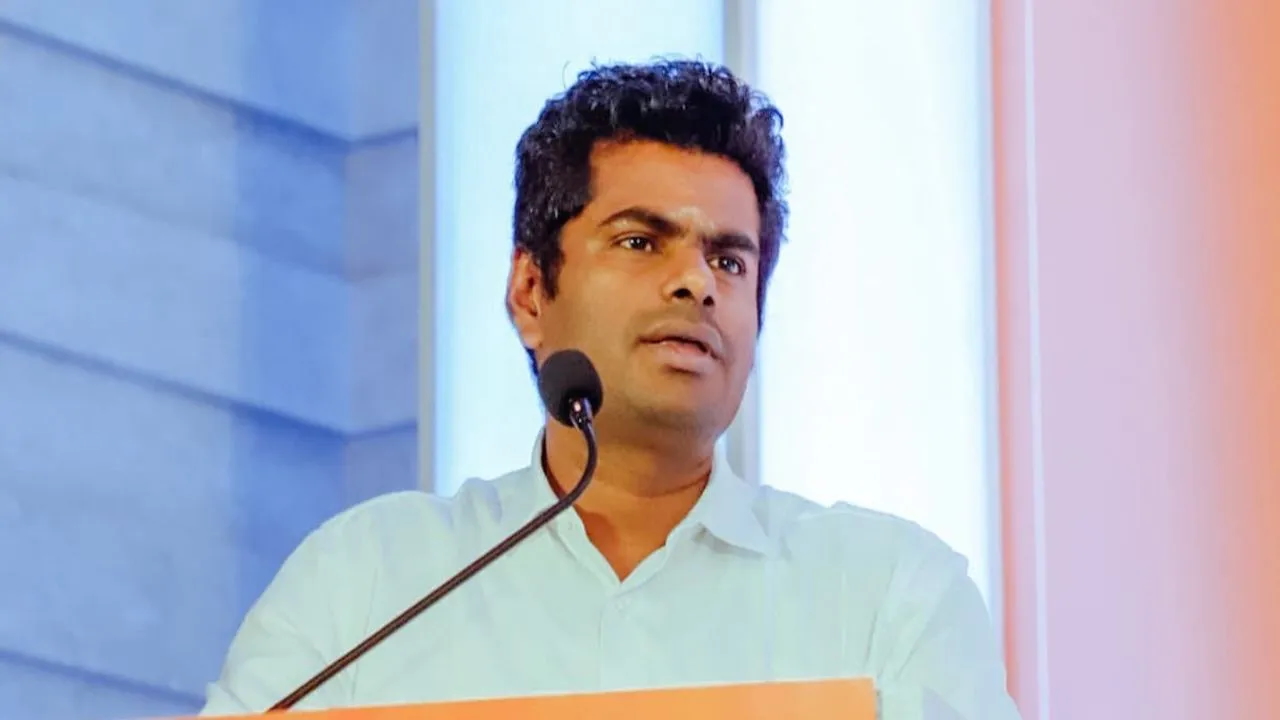
K Annamalai.

Synopsis: K Annamalai, the BJP’s former state president in Tamil Nadu, has sparked serious debate with recent remarks criticising the central government’s handling of dissent. Some believe he is laying the groundwork to launch We the Leaders Foundation as a political outfit, while others suspect he is still following the BJP’s script. They pointed to Karnataka’s BS Yeddiyurappa—who rejoined the BJP after leaving it—as an example.
Tamil Nadu BJP unit former president K Annamalai’s recent statements criticising the party have raised questions about his political future and the support base he hopes to build.
The IPS officer-turned-politician quit the BJP on 5 June 2026, and formed the We the Leaders organisation to continue his political journey.
Those close to Annamalai argued that he began expressing his political views freely once freed from the restrictions imposed on him as a BJP office-bearer.
Veteran journalist Priyan Srinivasan felt that Tamil Nadu is not yet ready for the political ambitions Annamalai hopes to realise, regardless of his efforts.
Also Read: Annamalai raises ‘uncomfortable’ questions to central government over handling of CJP protests
After leaving the BJP, Annamalai continued his political activities through We The Leaders Foundation. He has also begun working towards transforming the organisation into a political party.
His recent criticism of the BJP-led Union government has triggered a debate in Tamil Nadu’s political circles.
Speaking to reporters in Coimbatore on 20 October, Annamalai said the Centre must ensure transparency and fairness in the proposed delimitation exercise, stressing that southern states should not be penalised for having successfully controlled population growth.
He also criticised the Union government’s handling of the protests organised by the Cockroach Janata Party (CJP) in Delhi.
Members of the BJP’s Tamil Nadu unit criticised his remarks. On 21 October, Annamalai issued a detailed statement defending his position.
Referring to Prime Minister Narendra Modi’s remarks as Gujarat Chief Minister during the anti-corruption movement in 2011, Annamalai argued that Modi had been right to criticise the police crackdown on protesters at Delhi’s Ramlila Maidan.
Annamalai questioned the procedures the Delhi Police followed in detaining protesters, rejecting sureties, and using Special Executive Magistrates in preventive proceedings. He shot five questions at the Union government, arguing that the handling of the CJP protesters raised concerns about due process and democratic freedoms.
He also accused the BJP of giving the CJP publicity instead of countering the organisation politically. For example, he cited a Dasara event led by BJP MLA Ashok Goel, during which they burnt a cockroach effigy along with Ravana.
Annamalai criticised the tendency to portray protests against the Union government as anti-national or foreign-funded. He urged the government to address his questions instead of responding with counter-allegations.
Reiterating that he had left the BJP, he asked party supporters to stop identifying him as a BJP member. He also recalled his earlier criticism of the Centre’s response to protests against the National Eligibility-cum-Entrance Test (NEET), saying he had advocated dialogue with demonstrators.
Annamalai questioned the central government’s approach to dissent, alleging that opponents continued to be portrayed as enemies rather than having their concerns about police procedures and civil liberties addressed.
Also Read: Annamalai endorses CJP, says continued detention of Das and Ranka would only strengthen the movement
Following Annamalai’s 21 October statement, BJP leaders in Tamil Nadu targeted the former state party president.
Tamilisai Soundararajan, Narayanan Thirupathy and Vanathi Srinivasan criticised Annamalai for defending Modi’s 2011 remark about waging a war against the Centre and questioning the Delhi Police’s handling of the CJP protests.
Soundararajan took a swipe at her former party colleague, saying that a mountain does not change its shape with the wind. She said those who once claimed to be lions were now “scurrying like cockroaches” in Tamil Nadu.
BJP state chief spokesperson Thirupathy accused Annamalai of blurring the line between peaceful protest and deliberate law violations. He argued that CJP leaders had breached restrictions by climbing barricades at Jantar Mantar and violating peace bonds.
Defending the police action, Thirupathy questioned Annamalai’s comparison between the CJP protests and the 2011 anti-corruption movement.
Srinivasan, meanwhile, targeted those who had risen to political prominence through Modi and the BJP but were now criticising the Prime Minister and the party.
Defending the Modi government against comparisons with the Congress-led United Progressive Alliance (UPA) regime, she highlighted the corruption scandals that emerged between 2004 and 2014.
She also accused opposition parties of using the CJP protests to destabilise the government and alleged that foreign interests backed the demonstrations. In a sharp attack, Srinivasan said those supporting the “cockroach” protests were “certainly anti-national” and were acting in concert with foreign conspiracies aimed at destabilising India.
“The same Annamalai, when he was the president of the BJP’s Tamil Nadu unit and later a senior functionary, supported the Special Intensive Revision (SIR) of electoral rolls in various states. It is therefore disappointing to see what he has posted now,” Thirupathy told South First.
He added that the police had a duty to prevent people from staging protests in unauthorised locations and to take action against those whose activities threatened public order. He said the Delhi Police had merely discharged that responsibility.
“Annamalai did the same thing and said the same things when he was a police officer. What I want to point out is that his position was one thing six months ago and is now something entirely different,” Thirupathy said.
Arun Kumar, a political science faculty member at a private university, made a similar observation.
“When he was in the BJP, Annamalai said protests against the farm reform laws were wrong. Now he is speaking differently. Back then, he argued that the protests should stop and insisted the government would not move an inch. Now he is talking about the right to protest,” Kumar told South First.
He also suggested that Annamalai’s approach could be part of a BJP strategy.
“Even if a youth upsurge was visible across India in July, it had become clear by May that a similar political awakening among young people was emerging in Tamil Nadu. Annamalai understood that a section of young voters no longer wants to accept the established political leadership and is looking for something new. He has also realised that the narrative around this shift is missing,” he said.
Kumar added that Annamalai’s strategy is to attract politically unaffiliated young people and voters by positioning himself as anti-BJP.
Thirupathy, however, felt Annamalai is speaking about the CJP protests primarily to gain publicity in Tamil Nadu and strengthen his own political organisation.
Priyan Srinivasan offered a different assessment.
“Annamalai has not said anywhere that he opposes the BJP or that he supports the CJP. He has criticised the way the protests were handled. Beyond that, I do not see any significant decline in his admiration for Narendra Modi,” the journalist said.
“I believe he still has a soft corner for Modi. He has few other political options. He has differences with the AIADMK; joining hands with the DMK is not a realistic possibility, and he has said that he has nothing to do with the Tamilaga Vettri Kazhagam (TVK).
Given his current support base, around 90% of his supporters back the BJP. He is unlikely to want to give up those votes,” he added.
Also Read: Annamalai resigns from BJP membership
Kumar felt Annamalai’s independent political journey could also serve the BJP’s broader interests.
“The BJP follows this strategy in several states. Instead of operating as a single entity, it works through different organisations to expand its influence. In Tamil Nadu, for instance, the Hindu Munnani is a stronger on-the-ground organisation than the RSS, but the RSS laid the foundation for it.
Similarly, the idea may be to use Annamalai’s image as an honest former IPS officer to mobilise public support around him. The BJP could use that support in different ways over the long term,” he said.
He felt that Annamalai’s decision to leave the BJP and establish an independent organisation may have been influenced by the political changes that followed the election.
“After the election, Annamalai may have recognised that a large section of young people was emerging as a potential political constituency in Tamil Nadu. He may have decided to draw them to himself rather than let them move elsewhere. That could be one reason he left the BJP and created an independent platform,” Kumar said.
He pointed to former Karnataka chief minister BS Yediyurappa as an example of how such political trajectories can unfold.
“Yediyurappa launched a separate party in Karnataka and eventually returned to the BJP. Something similar could happen in Annamalai’s case as well,” Kumar said.
However, Priyan Srinivas said Annamalai is uncertain about which voter base he intends to target and how he hopes to achieve his political ambitions.
“Tamil Nadu politics has become bipolar. The AIADMK, which holds third place in the state’s political landscape, is also weak. But can Annamalai occupy that space? Does he have the voter base required to do so? Those are important questions.
“There could be many political changes by 2031. We do not know what position the TVK will take by then. The party could part ways with the Congress and align with the BJP, though that remains uncertain.
“The TVK currently has a large number of young supporters in Tamil Nadu. Only if its influence declines could people like Annamalai have an opportunity. But will such a change happen anytime soon? That is another question,” he said.
He also questioned whether Annamalai could sustain his political relevance without the BJP, the party that gave him his political identity.
Beyond a section of educated young people and urban voters, Annamalai does not appear to have established a substantial presence in rural areas, the journalist argued. Without a strong organisational structure, his support base could remain limited.
“Without the BJP, he may end up becoming a paper tiger,” he said, raising doubts about the strength of Annamalai’s independent political platform.
Also Read: Annamalai disagrees with own government on CBSE’s three-language policy
Those close to Annamalai said he is determined to establish himself as a bold political leader, undeterred by BJP criticism.
“His position is that any government should be appreciated when it functions well, irrespective of party affiliation, and criticised when it goes wrong. As for the CJP, he does not support the organisation as such. He supports some of its demands,” sources close to Annamalai said.
They also alleged that BJP leaders in Tamil Nadu viewed Annamalai as a threat to their political standing.
“Several senior leaders in the Tamil Nadu BJP have their own political directions. They lacked unity on the path the party should take. When Annamalai became state president in 2021, he tried to establish a clear political objective for the party. But others were not prepared to follow the direction he set. Many were also uncomfortable with his growing popularity.
“He eventually concluded that he could not bring about the changes he wanted from within the party. That is why he created his own platform,” the sources said.
Annamalai had been unable to speak openly on several issues while he was in the BJP because of internal restrictions. Now that those constraints no longer bind him, they said, he is expressing his views more freely.
They cited his remarks on the 148th birth anniversary of social reformer Periyar as an example. Annamalai praised Periyar for fighting against social inequalities and superstitions.
Asked about the apparent contrast with the BJP’s ideological position, sources close to Annamalai said his views on Periyar had not changed.
“This has always been his opinion about Periyar, even when he was in the Tamil Nadu BJP. But he did not express it openly because he was in the party and faced restrictions. Now he is speaking openly and boldly about everything,” they said.
The sources also said that the We The Leaders, which has reportedly enrolled 21 lakh members, is expected to become a political party soon. Preparatory work to build the necessary organisational structure is under way.
(Edited by Majnu Babu).



