

Published May 04, 2026 | 6:16 PM ⚊ Updated May 04, 2026 | 11:07 PM

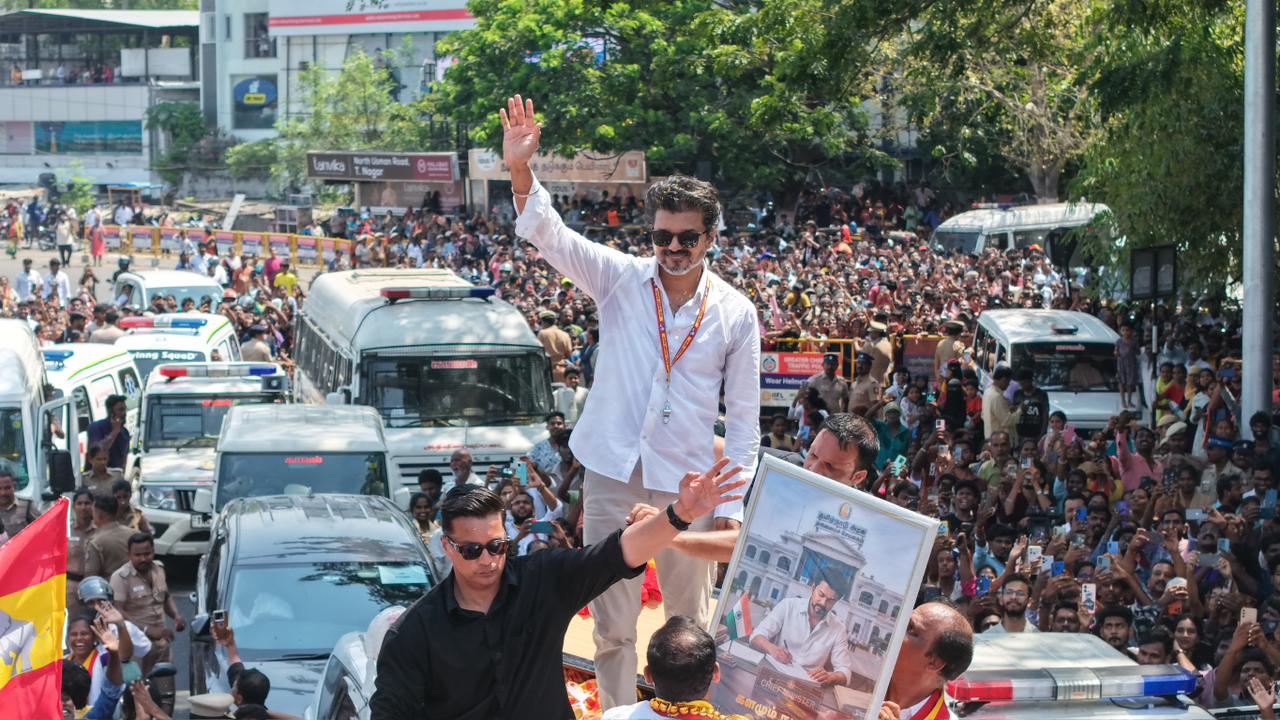
The narratives spreading on social media appear aimed at building a larger image of TVK itself as a party of ordinary, humble people.

Synopsis: Actor Vijay’s Tamilaga Vettri Kazhagam (TVK) has emerged as the single largest party in the 2026 Tamil Nadu Assembly elections with 107 seats and 34.92 percent of the vote, but remains short of a majority and needs support from at least 11 more MLAs to form a government.
For the first time since 1967, Tamil Nadu is headed towards the possibility of a government led by a party outside the two dominant Dravidian parties, the Dravida Munnetra Kazhagam (DMK) and the All India Anna Dravida Munnetra Kazhagam (AIADMK).
In the 2026 Assembly elections, actor-turned-politician Vijay’s Tamilaga Vettri Kazhagam (TVK) delivered a historic performance and emerged as the single largest party in its first electoral outing. Within just two years of launching the party, Vijay now stands on the cusp of capturing power in Tamil Nadu.
Across Tamil Nadu’s 234 constituencies, counting began at 8 am on 4 May. Postal ballots were counted first. Counting ran through 15 rounds in some seats and up to 23 to 25 in others.
In the final tally, TVK secured 107 seats. The DMK was reduced to just 60 seats. Its allies—the Congress (INC) won 5, the Indian Union Muslim League (IUML) 2, the Communist Party of India (CPI) 2, the Viduthalai Chiruthaigal Katchi (VCK) 2, the Communist Party of India (Marxist) [CPI(M)] 2, and the Desiya Murpokku Dravida Kazhagam (DMDK) 1—took the DMK-led Secular Progressive Alliance (SPA) to 74 seats.
The AIADMK alliance finished third. The AIADMK won 47 seats. Its allies—the Pattali Makkal Katchi (PMK) won 4, the Bharatiya Janata Party (BJP) 1, and the Amma Makkal Munnetra Kazhagam (AMMK) 1—took the alliance total to 53 seats.
Notably, Seeman’s Naam Tamilar Katchi (NTK), which projected itself as a third front, did not lead in a single constituency.
In vote share, TVK secured 34.92 percent or 17,191,040 votes. The DMK followed with 24.20 percent or 11,914,215 votes, and the AIADMK with 21.24 percent or 10,455,742 votes.
The NTK secured around 4 percent, the INC 3.36 percent, the BJP 2.97 percent, the DMDK 1.18 percent, and the VCK 1.10 percent. Other parties did not cross 1 percent.
Despite being the single largest party, TVK is short of the 118 seats required for a majority in the 234-member Assembly. It needs the support of at least 11 more MLAs to form a government.
Also Read: Vijay’s TVK breaks Dravidian parties’ duopoly
From the start of its campaign, TVK had sought to portray its campaign as a “return of history”. When MG Ramachandran founded the AIADMK, he won the 1977 election with over 30 percent of the vote and formed a majority government.
Vijay has not matched that seat count, but he has surpassed Ramachandran’s vote share, securing nearly 35 percent.
TVK candidates matched, and in many cases surpassed, the postal vote counts of the DMK and the AIADMK, which have dominated Tamil Nadu politics for nearly six decades.
Vijay contested from Perambur and Tiruchirappalli East and won both constituencies. In contrast, DMK chief and Chief Minister MK Stalin suffered a defeat against TVK’s VS Babu in Kolathur by 8,000 votes.
Several senior leaders, including KA Sengottaiyan, N Anand, Aadhav Arjuna, and CTR Nirmal Kumar, have also won. TVK has also made significant inroads in Chennai, long a DMK stronghold.
Across Chennai, Kancheepuram, Tiruvallur, and Chengalpattu, TVK won nearly three-fourths of the constituencies. The party has also defeated more than 10 sitting ministers in their own constituencies.
In the 2021 Assembly elections, the DMK-led SPA secured over 40 percent of the vote and won 159 seats. The AIADMK-led National Democratic Alliance (NDA) won 75 and moved into the opposition.
This time, the DMK alliance is down to 74 seats – a loss of nearly 85.
In 2021, the DMK contested 188 constituencies and won 133, securing a clear majority. This time, it contested 164 and won 60 – a drop of 73 seats.
The Congress, which contested 25 seats and won 18 in 2021, contested 28 this time but won only 5. It lost Velachery in Chennai to TVK.
The VCK, which won 4 of 6 seats in 2021, was allotted 8 this time but won only 2.
CPI and the CPI(M), which together contested 12 seats and won 4 in 2021, were allotted 10 this time and again won 4.
Also Read: TVK registers first electoral success, crosses one crore votes
In the previous election, the AIADMK contested 191 seats and won 66. This time, it contested 169 and won 47 – a drop of 19.
The PMK, which won 5 of 23 seats last time, contested 18 this time and won 4.
The BJP, which contested 20 seats and won 4 previously, contested 27 this time but won only 1. Its candidate Bojarajan won in Udhagamandalam by 976 votes.
This cuts the BJP’s tally from 4 to 1.
BJP state president Nainar Nagendran, the sitting MLA from Tirunelveli, lost in Sathur. Senior leader and former Governor Tamilisai Soundararajan, who contested from Mylapore, finished third.
The BJP had claimed the NDA would form the government in Tamil Nadu. It lost 26 of the 27 seats it contested, dealing a blow to the alliance and to the AIADMK.
The AMMK, which contested 11 seats in the alliance, won 1. Its candidate S Kamaraj defeated Minister TRB Rajaa in Mannargudi by 1,566 votes.
This is a gain from its previous tally of zero, but losses in the remaining 10 constituencies weaken the AIADMK alliance overall.
Also Read: From top electoral bond donor to family of MLAs: Santiago Martin’s wife, son, son-in-law win big
Following the unexpected result, leaders from these parties have struck a cautious tone about potential alliances with the TVK.
Communist Party of India (CPI) state secretary Mutharasan Veerapandian said they respect the verdict but will decide collectively whether to extend support. He added that TVK has not made a formal approach.
VCK MP D Ravikumar said it is too early to discuss alliances. Even with wins, he said, any decision to support another party would need careful consideration after the final results.
He also pointed to risks for Vijay. Aligning with the AIADMK could dilute TVK’s identity, but a tie-up with the BJP may not be viable. His options remain limited and complex.
The Congress, which came close to breaking from the DMK alliance to join hands with TVK but stayed, is considering “outside” support.
A formal post-poll coalition or joining the government does not appear to be its preferred option. The party has to weigh national equations, and the DMK remains a key ally in parliamentary polls despite friction between leaders and cadres in Tamil Nadu.
Leader of the Opposition in the Lok Sabha, Rahul Gandhi, said he spoke to Vijay and congratulated him on TVK’s “spectacular result”.
“This mandate reflects the rising voice of youth, which cannot and will not be ignored. My heartfelt thanks to the Congress workers of Tamil Nadu and Puducherry for their hard work and support. I reiterate that the Congress party will continue to protect and serve the people of Tamil Nadu and Puducherry,” Gandhi wrote on X.
For now, attention turns to post-result negotiations, as Tamil Nadu faces a potential shift after nearly six decades of Dravidian politics.
(Edited by Dese Gowda)



