

Published Mar 01, 2026 | 2:13 PM ⚊ Updated Mar 01, 2026 | 2:13 PM

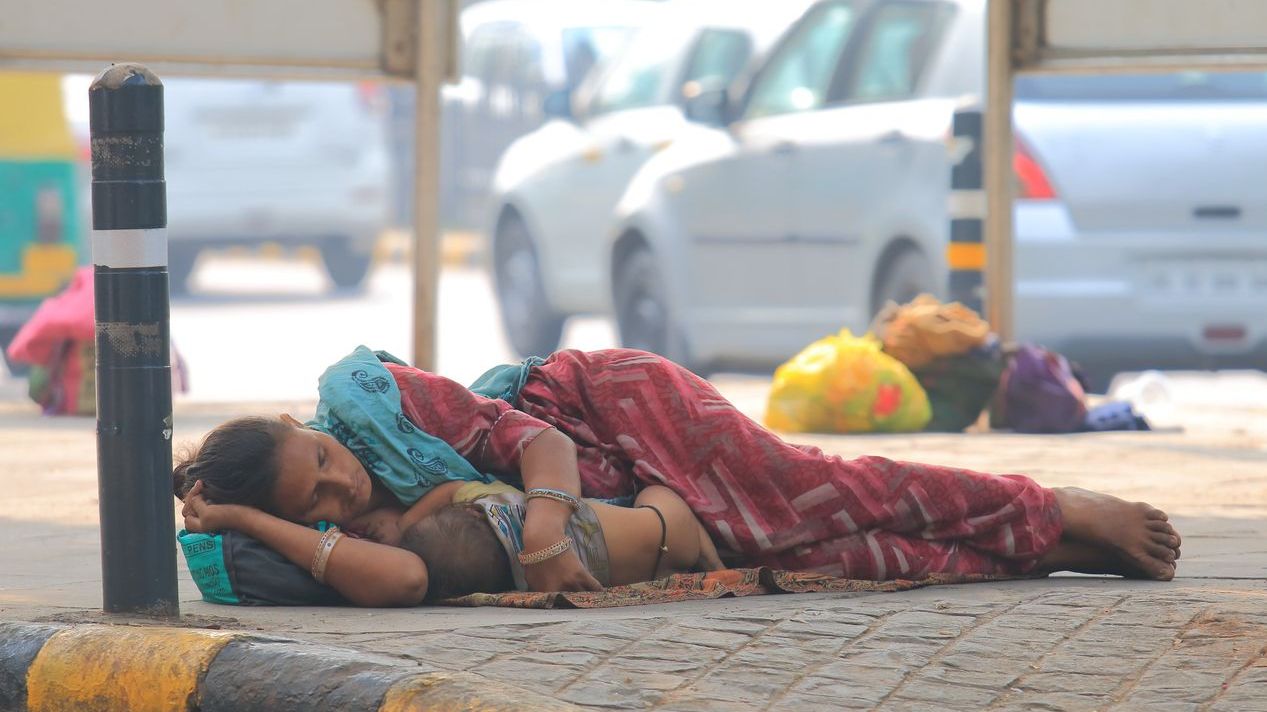
A woman and her baby sleeping on the street. (iStock)
Synopsis: A survey showed that 13,529 people are living in Chennai without a home across its 15 zones. Homelessness in Chennai does not have a single face. It includes families who migrated generations ago for work, elderly people left without support, individuals who walked away from violent homes, and persons living with untreated mental illness.
In just three months, Chennai counted 13,529 people without a home across its 15 zones. A number that lays bare the scale of a crisis that people pass by every day without seeing.
The survey, conducted between January and March 2025 by the Madras School of Social Work (MSSW) on behalf of the Greater Chennai Corporation, identified 2,837 GPS-mapped locations where people were living without secure housing.
“Nearly 65 percent of the homeless population we surveyed are living as families, not as isolated individuals,” said M Antony Stephen, Assistant Professor and chief coordinator of the study. “That changes how we must think about homelessness in Chennai,” he told South First.
The findings were presented at Maatram 2026, convened by The Banyan, where discussions moved beyond numbers to examine the health, mental health and policy gaps shaping life on the streets.
Stephen cited Supreme Court guidelines to highlight the scale of the gap.
“According to Supreme Court guidelines, there should be one shelter home for every one lakh population.”
Chennai, with a population of roughly 85 lakh within the Greater Chennai Corporation limits, should ideally have around 85 shelters.
“However, we currently have only around 50, and most are designed to accommodate individuals rather than families,” he pointed out. Even before examining the number of people living on the streets, the infrastructure shortfall is clear.
The MSSW survey identified a total of 2,482 homeless families on the streets. This finding challenges the common perception that homelessness in Chennai is largely individual and transient.
The demographic details reveal the depth of vulnerability. Of the 13,529 people counted, 4,922 were men and 2,829 were women, along with 2,322 children. The elderly population also seems to be rising — 2,053 elderly men and 1,219 elderly women were recorded. The rest are differently-abled people.
“We are clearly seeing an increase in elderly homelessness, which is a serious social concern,” Stephen noted.
Nearly 30 to 35 percent of those identified are above 60 years old. Compared to earlier surveys, this represents a visible increase. Some elderly people have been abandoned; others have slipped into homelessness after losing income or pension access.
Nearly 80 percent belonged to the Scheduled Caste and the Scheduled Tribe communities, underscoring the overlap between caste marginalisation and housing insecurity.
Further, homelessness is not evenly spread across the city. More than 60 percent of Chennai’s homeless population is located in Royapuram Zone 5.
Homelessness in Chennai does not have a single face. It includes families who migrated generations ago for work, elderly people left without support, individuals who walked away from violent homes, and persons living with untreated mental illness.
“Most of the reasons for homelessness begin with migration in search of livelihood,” Stephen said.
Several families moved from rural areas to Chennai, hoping for steady work. They found daily wage jobs, but incomes remained too low to secure rental housing. Over time, even informal settlements became unaffordable, pushing them onto pavements and under flyovers.
“Some people leave home because of family conflicts — disputes, violence, or breakdown of relationships,” Stephen said. “Without savings or social backing, they begin sleeping in public spaces.”
Others are elderly persons who have been abandoned or whose pensions have stopped, leaving them with no stable income or consistent care.
Mental illness is another pathway. Dr Preetha Krishnadas, Deputy Director of The Banyan, said people with untreated mental health conditions are especially vulnerable to losing family and community support.
Without consistent care, many drift into street situations and struggle to access services, she explained to South First.
She also pointed to a smaller but visible pattern involving interstate migrants. Some individuals from northern states arrive in Chennai by train without clear plans or support systems.
In certain cases, families place a relative on a long-distance train that terminates at Chennai Central. “They reach the last station, Chennai Central, and they do not have anywhere to go,” she explained. With no local contacts, some remain in the city and eventually slip into homelessness.
Stephen clarified that such interstate migrants form a small fraction of the total homeless population. However, their presence reflects another layer of vulnerability — displacement without preparation or protection.
“There are also workers, mainly three-wheeler drivers, who sleep in their vehicles or in public spaces because their daily wages cannot cover rent,” Stephen said. “For some communities, homelessness has become intergenerational, shaped by long-standing marginalisation and unstable livelihoods,” he added.
Together, these pathways show that homelessness in Chennai is not accidental. It emerges from fragile incomes, broken support systems, untreated illness, ageing, and structural exclusion. Each story is different, but the outcome — life without a secure shelter — is shared.
Homelessness in Chennai is not only about the absence of shelter. It is closely tied to declining physical and mental health.
“By the very fact of being homeless, their physical and mental health are severely affected,” Dr Krishnadas said. She explained that exposure to heat, rain, poor sanitation and unsafe sleeping conditions weakens the body over time.
Access to healthcare remains limited even when public hospitals are available. “They can walk into an outpatient department,” she noted, “but for admission, most facilities require a caregiver. Many of them do not have anyone.”
Without someone to manage paperwork and stay beside them, hospitalisation is often impossible.
Basic services are equally uncertain. Safe drinking water is not consistently available. Toilets are scarce. For women, managing menstruation without privacy or clean supplies becomes a daily struggle. These conditions directly harm physical health.
Mental illness is both a cause and consequence of homelessness. Some lose housing due to untreated conditions; others develop anxiety, depression or trauma after prolonged insecurity.
“When food is distributed, people with mental health issues may not even reach the queue,” Dr Krishnadas explained. Isolation and confusion prevent access to support.
“They may not understand what is happening or how to seek help,” she added, increasing vulnerability to abuse. Without stable housing, treatment breaks down, medicines are lost, and recovery remains fragile.
Shelters are part of the response, but they are not the entire solution. Dr Krishnadas said the first question should be whether shelters are safe and respectful spaces. “It cannot be a mandate that we simply move people off the streets and put them into a shelter,” she said. “We have to ask if they feel secure and if their needs are met.”
In 2012, The Banyan initiated the “Kind People, Happy City” campaign to encourage citizen engagement with homelessness. The idea was to build a culture of informed kindness rather than occasional charity.
“There is already kindness in the city,” Dr Krishnadas observed. “Auto drivers may drop someone off at a safer place. Tea shop owners may offer a cup of tea. But awareness about where to refer to them is equally important,” she added.
To deepen public understanding, the organisation launched another initiative called “Under the Stars.” Volunteers spent a night on the streets to experience the conditions firsthand.
“It is not a special profession to live on the pavement,” she said. “You search for drinking water. You look for toilets. You worry about safety.” The exercise aimed to shift perceptions that equate homelessness with criminality.
Dialogue has also moved to policy spaces. The Maatram platform brings together shelter coordinators, NGOs, civic officials and civil society groups to discuss gaps and improvements.
“We want to brainstorm together and localise solutions,” Preetha said. Health, housing, legal identity and social entitlements are often handled separately. The goal is to connect them into coherent interventions.
Interventions, the speakers stressed, must be backed by training and systems. Stephen said the survey team recommended in-situ housing within two to three kilometres of existing locations so that families do not lose access to livelihoods.
Relocation to distant sites, he warned, often disrupts daily wages and pushes people back into homelessness. Housing, he stressed, cannot be separated from income security.
He added that the government responded positively, especially to the call for convergence between departments. When housing, health, social welfare and civic administration function in silos, vulnerable families fall through the cracks.
Basic services were also framed as rights issues. Limited access to safe drinking water, toilets and proper waste management affects both health and dignity.
Dr Krishnadas emphasised that denying sanitation and healthcare to people on the streets amounts to a violation of fundamental human rights.
Another layer of concern is awareness. Stephen noted that many homeless persons are unaware of their entitlements. Generational poverty and long-standing exclusion mean “people do not even know what rights they can claim,” making access to welfare schemes difficult.
Dr Krishnadas also referred to “Kaval Karaghal”, a Greater Chennai Police initiative dedicated to rescuing people from the streets.
The unit works with 10 to 25 non-governmental organisations to support outreach and referral. She stressed that such efforts must remain rights-sensitive, ensuring assistance is voluntary and dignity is preserved.
Training programmes for shelter staff, volunteers and police personnel now focus on early identification of mental health needs and respectful engagement. “Intent may be good,” she said, “but the approach must protect the individual’s rights.”
Earlier this year, the GCC had approved a revised operational framework to strengthen services for the urban homeless under the Shelter for Urban Homeless (SUH) scheme.
As part of the restructuring, administrative control of the programme was shifted from the health department to the buildings department to improve monitoring and implementation.
The civic body also outlined plans to expand infrastructure through new family shelters and additional categories such as transit shelters and facilities for migrant workers.
The framework includes round-the-clock rescue operations supported by dedicated ambulances and rescue vehicles, along with coordination with hospitals to assist homeless persons requiring medical or institutional care.
Category-specific food systems and the adoption of a community development model were proposed to improve social support delivery within shelters.
Officials had also emphasised rehabilitation alongside accommodation, with a decentralised governance structure to oversee implementation.
It also mandates minimum space and basic amenities in shelters, while focusing on access to identity documents, skill training, employment linkages and family reintegration, along with improved sanitation, isolation facilities and safety measures.
As the GCC’s survey expands across all 25 zones of the state and results are expected by the end of March 2026, the question is whether policy action can match the scale of the crisis — and ensure that an address becomes a gateway to care, protection and belonging.
(Edited by Muhammed Fazil.)


