
Published Jul 24, 2026 | 9:00 AM ⚊ Updated Jul 27, 2026 | 3:14 PM

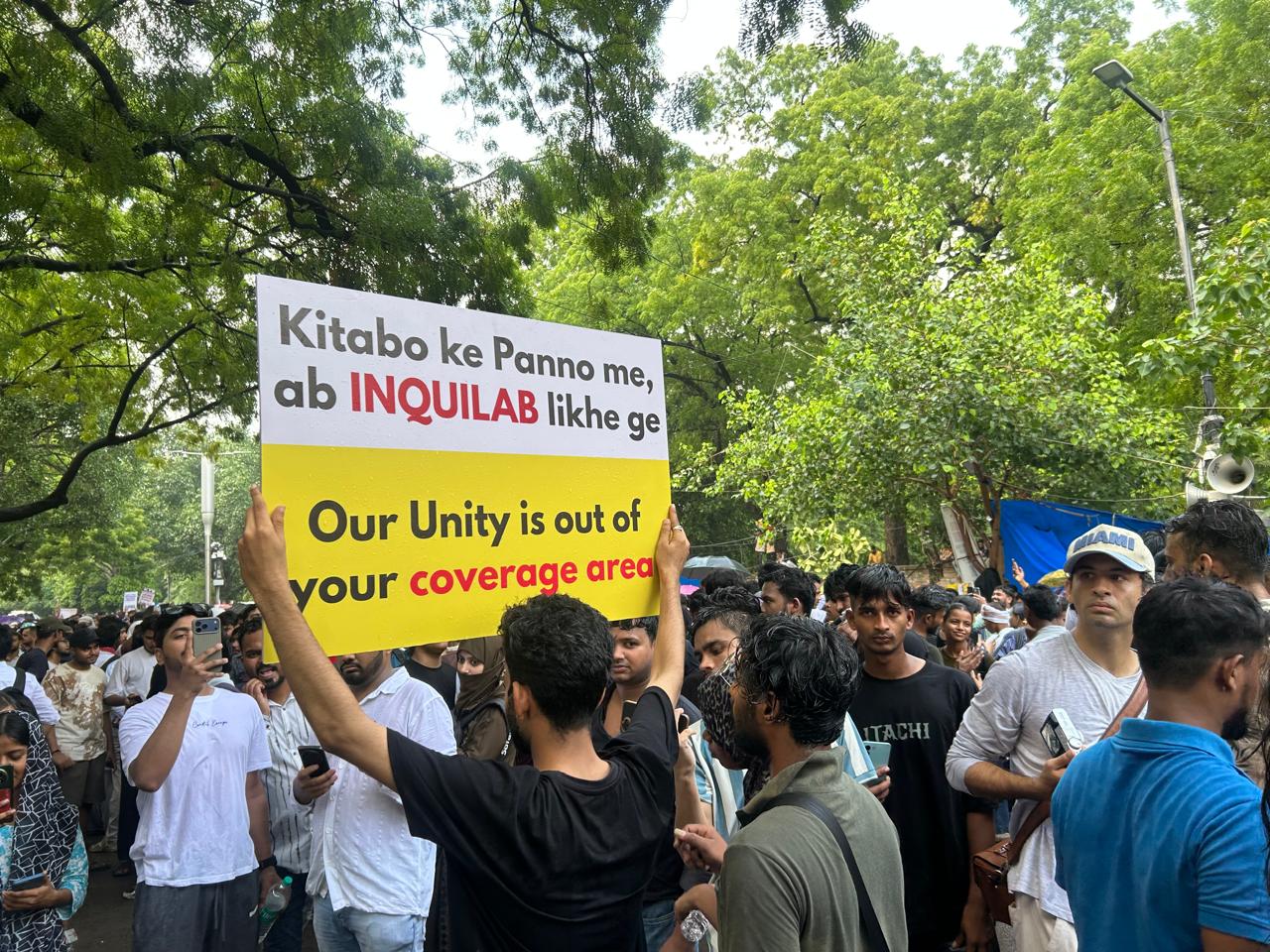
Students remain firm on their demand for accountability. (Sourced)

Synopsis: The youth at the Jantar Mantar protests have not been welcoming of legacy media. This mirrors a trend of global protests that target information ecosystems seen as sympathetic to the powers-that-be. If journalists wish to end it, they must pledge themselves anew to the values they have been expected to safeguard.
In July 2026, Delhi’s historic Jantar Mantar—a longstanding venue for public protests and democratic expression—transformed into a contentious arena.
While the primary focus remained on youth-led demonstrations against the NEET-UG paper leak, CBSE marking irregularities, and systemic failures in the education sector, the site also witnessed significant friction between protesters and mainstream media personnel. Activists, particularly from the Cockroach Janta Party (CJP) and allied student groups, confronted journalists, heckled reporters, and in several instances forced camera teams to withdraw, frequently labelling them as “Godi Media.” This development underscores deeper fault lines in public trust, journalistic practices, and the dynamics of contemporary Indian protest movements.
The term “Godi Media,” translating to “lap media” or idiomatically “lapdog media,” was coined and popularised by veteran journalist Ravish Kumar. It gained widespread currency in the years following 2014, amid criticisms that significant sections of television and print media had grown overly aligned with the ruling establishment.
“Godi” evokes the image of media comfortably nestled in the lap of power, functioning more as amplifiers of official narratives than as independent watchdogs. Kumar highlighted this through his programmes, sometimes using symbolic enactments to depict subservient journalism. The phrase crystallised broader concerns about media capture, ownership concentration, TRP-driven sensationalism, and a perceived decline in accountability journalism. Over time, it became a shorthand in activist circles for outlets accused of prioritising prostrating before power over rigorous scrutiny.
The ongoing Jantar Mantar dharna traces its roots to June 2026, when the CJP—a movement that originated as satirical social media commentary in response to the Chief Justice of India’s remarks comparing unemployed youth to “cockroaches”—shifted to street protests.
The agitation’s demands centre on the resignation of Union Education Minister Dharmendra Pradhan, comprehensive reforms to prevent exam leaks, and compensation for affected students. The agitation intensified with environmentalist Sonam Wangchuk’s hunger strike and culminated in a major “Chalo Sansad” march toward Parliament on July 20. Clashes with police resulted in injuries on multiple sides, detentions, and a renewed occupation of the protest site, drawing national and international attention to youth frustrations over education, employment, and governance accountability.
Within this charged atmosphere, mainstream media found itself at the receiving end.
Protesters initially accused outlets of under-coverage despite the movement’s scale and growing participation, arguing that limited visibility in traditional channels contrasted sharply with amplification through social media and international reporting. When cameras did arrive, reporters faced allegations of biased questioning—such as demanding trivial spellings like “NEET” or “cockroach,” or redirecting conversations toward communal or “anti-national” angles instead of engaging with core issues of policy failure and student distress.
Specific incidents, including disputed coverage of hunger strikes, fueled claims of misrepresentation and selective framing. Videos of confrontations, including with teams from prominent networks, circulated rapidly, portraying journalists as extensions of the establishment rather than neutral observers.
Also Read: India’s students’ revolt has exposed BJP’s biggest political blind spot
From the protesters’ perspective, this behaviour exemplifies “Godi Media”: outlets perceived as being on the side of those in power, echoing governmental lines, ignoring repeated examination scandals, and diverting attention from public grievances through polarisation or trivialisation. Youth participants, many digitally native and reliant on alternative platforms, view such journalism as having abandoned its democratic role, thereby justifying direct pushback. This reflects a generational shift where social media empowers ordinary citizens to challenge traditional gatekeepers in real time.
However, the media’s position involves genuine professional hazards.
Journalists on the ground have reported heckling, intimidation, and hostility, complicating efforts to report accurately amid chaos. Female reporters, in particular, have faced uncomfortable situations, prompting concerns over press freedom and safety.
Editorial teams argue that field staff often bear the brunt of broader resentments unrelated to individual reporting, emphasising the difficulty of maintaining neutrality when covering clashes involving police action, stone-pelting allegations, and competing claims of brutality versus legitimate crowd control. The polarised national discourse—where one side highlights student injuries and the other points to damage and disruption—further complicates verification and balanced storytelling.
Also Read: To resign or not? Inside story of how Dharmendra Pradhan is holding on
Several structural factors explain this backlash.
Decades of perceived media failures, economic dependencies, and ownership influences have eroded public confidence, especially among younger generations sceptical of legacy institutions. The CJP’s meme-savvy, decentralised style amplifies confrontations, turning isolated incidents into viral moments.
In a broader sense, the phenomenon mirrors global trends of institutional distrust, where protests target not just governments but the information ecosystems perceived to sustain them. Past agitations, from farmers’ movements to other sectoral protests, have shown similar patterns, but the scale of youth involvement and digital tools have intensified the dynamic at Jantar Mantar.
The implications for Indian democracy are significant.
A credible, independent press serves as a vital pillar, enabling informed discourse and accountability. When trust collapses, it fragments the public sphere, empowers unverified narratives, and risks justifying restrictions on journalism. Conversely, aggressive targeting of reporters undermines protest legitimacy and endangers the safety essential for on-ground coverage. Resolution demands introspection on all sides: media houses enhancing transparency, ethical standards, and diverse sourcing; protesters upholding non-violence and facilitating responsible reporting; and systemic efforts addressing ownership concentration and polarisation.
Ultimately, the hostility towards the media at Jantar Mantar stems from accumulated perceptions of bias intersecting with a potent youth movement demanding systemic change. It is less an aberration than a symptom of evolving information battles in a deeply divided polity. Bridging this divide requires renewed commitment to journalistic rigour, public engagement, and democratic norms—lest such confrontations erode the shared space for dissent and dialogue that Jantar Mantar itself symbolises.
Also Read:
Gen Z protest is not ‘unserious’, it is civil disobedience dismantling Modi’s crafted image
(Edited by R Rajesh Kumar.)



