

Published Oct 04, 2026 | 9:30 AM ⚊ Updated Oct 04, 2026 | 9:30 AM

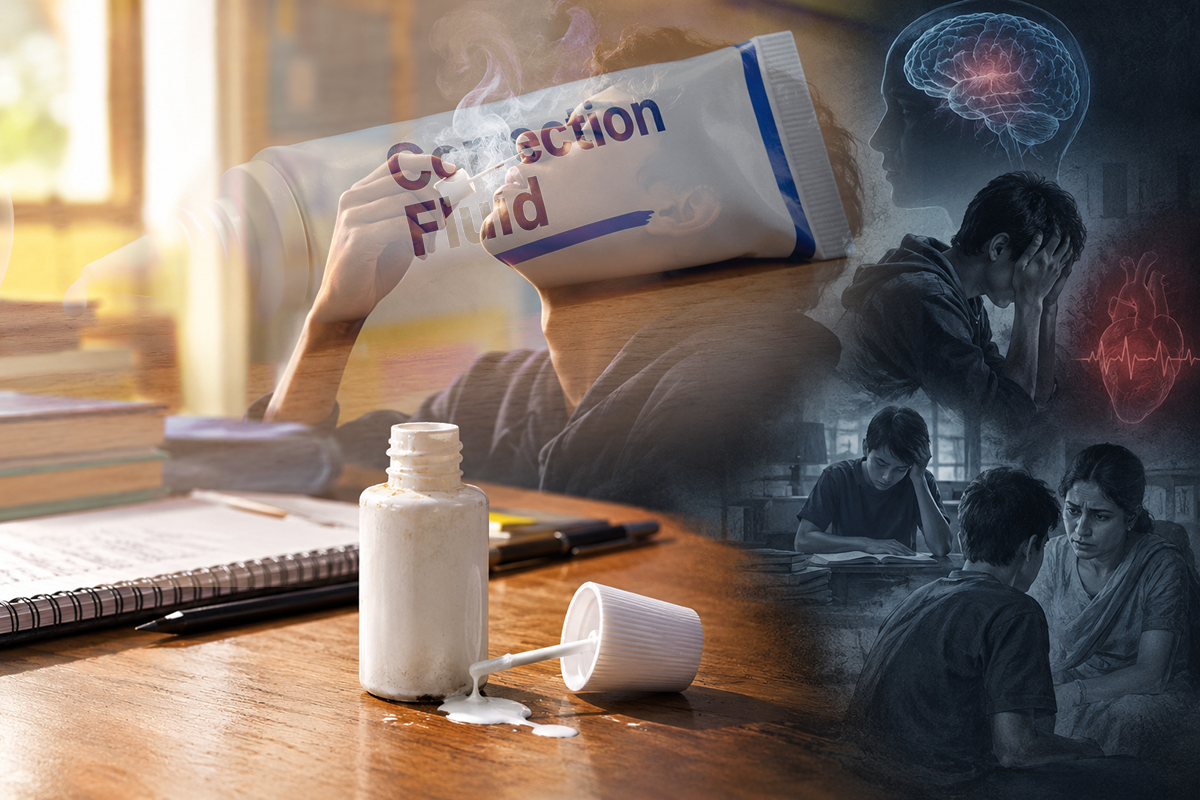
Image used for representational purposes only. (AI generated image)

Synopsis: Whitener, an ordinary stationery product found in schoolbags and on study tables, is emerging as an overlooked source of substance abuse among young people. India’s national survey on substance use found that 1.17 per cent of children and adolescents aged 10–17 were current inhalant users. This translates to 18 lakh children.
It was typist Bette Nesmith Graham who invented the first correction fluid (guess where?) in her kitchen in 1956. She called it ‘Mistake Out’.
Seventy years later, a few drops of the whitener can still erase a spelling mistake. But that same bottle is worryingly leading many to a life-changing mistake too.
The whitener, an ordinary stationery product found in schoolbags and on study tables, is emerging as an overlooked source of substance abuse among young people. Its easy availability, low cost and deceptive familiarity make it particularly dangerous.
For some adolescents, the attraction lies in the temporary sensation produced by inhaling its chemical fumes. Curiosity, peer pressure, emotional distress or a desire to experiment can lead to initial use. What may appear to be a harmless thrill can develop into repeated use, exposing young users to chemicals that can seriously affect their health.
The scale of the wider problem is reflected in India’s national survey on substance use, conducted by the National Drug Dependence Treatment Centre at AIIMS. It found that 1.17 per cent of children and adolescents aged 10–17 were current inhalant users, compared with 0.58 per cent among adults. This translates to roughly 18 lakh children across India being in need of help.
Inhalants were the only substance category in which prevalence was higher among children and adolescents than among adults. The survey also estimated that 0.21 per cent of children in this age group had harmful or dependent inhalant use.
A more recent school-based study involving 5,920 students across 10 Indian cities found that 1.9 per cent had used inhalants during the preceding year. The study reported higher use among boys and increasing prevalence in higher grades. Although these figures cover inhalants broadly rather than whitener alone, they underline the vulnerability of young people to substances that often escape public scrutiny.
Clinical studies offer a closer look at correction fluid misuse. In one study of 50 treatment-seeking inhalant users, the average age was just over 17, and 72.2 per cent were children or adolescents.
Correction fluid was the most commonly used product, while 88 per cent of the participants were classified as dependent. Another study found that 73.6 per cent of 87 treatment-seeking inhalant users had used typewriter correction fluid. These findings cannot represent the general population, but they reveal the seriousness of the problem among those who seek treatment.
The danger lies in the speed with which these chemicals can affect the body. When inhaled, volatile solvents pass through the lungs into the bloodstream and rapidly reach the brain. The immediate effects may include dizziness, confusion, euphoria, nausea, drowsiness and impaired coordination. Repeated exposure can damage the nervous system, affecting memory, concentration, learning and judgement. Depending on the chemicals involved, the liver, kidneys and other organs may also suffer lasting harm.
More alarming is the possibility of sudden death. Certain inhalants can interfere with the heart’s electrical activity, triggering dangerous irregular rhythms even after a single episode of use. Loss of consciousness, seizures and respiratory complications are other potentially life-threatening consequences. There is no reliably safe level of deliberate inhalation.
The familiarity of whitener is itself part of the problem. Unlike illegal narcotics, correction fluids are sold openly and are often treated as harmless household or educational products. The misconception that something legally available cannot be dangerous leaves parents and teachers unaware of the risks. Other everyday products, including adhesives, paint solvents and aerosol sprays, can pose similar dangers when misused.
Recognising the warning signs is therefore essential. Unexplained chemical odours, sudden behavioural changes, declining academic performance, unusual secrecy, repeated dizziness and irritation around the mouth or nose may warrant attention. None of these signs alone confirms substance abuse, but persistent or combined symptoms should prompt a careful response.
Punishment and humiliation are unlikely to solve the problem. Adolescents need an environment in which they can speak openly about curiosity, peer pressure and emotional difficulties. Parents, teachers and counsellors should focus on early identification, supportive intervention and professional treatment when necessary. Schools must expand substance-awareness programmes to include inhalants, explaining that ordinary products can become hazardous when deliberately misused.
The statistics are a warning that should not be ignored. Inhalant misuse is not simply a matter of indiscipline or youthful experimentation; it is a public health concern involving children at a crucial stage of physical and mental development. Greater awareness, responsible product handling and accessible counselling can help prevent experimentation from turning into dependence.
Whitener is designed to conceal mistakes on paper, not to provide an escape from the pressures of growing up. A momentary high can come at the cost of a young person’s health, education and future. The bottle may be small, but the consequences of misuse can be irreversible.
Also Read:
Divided by drugs, united by power! The story of Kochi’s ‘Goondas’ who backed Operation Toofan
Kerala’s ‘stoned’ generation: ‘Cooks’ make merry as drugs spur youth to crime
(Edited by R Rajesh Kumar.)



