

Published Oct 09, 2026 | 7:00 AM ⚊ Updated Oct 09, 2026 | 7:00 AM

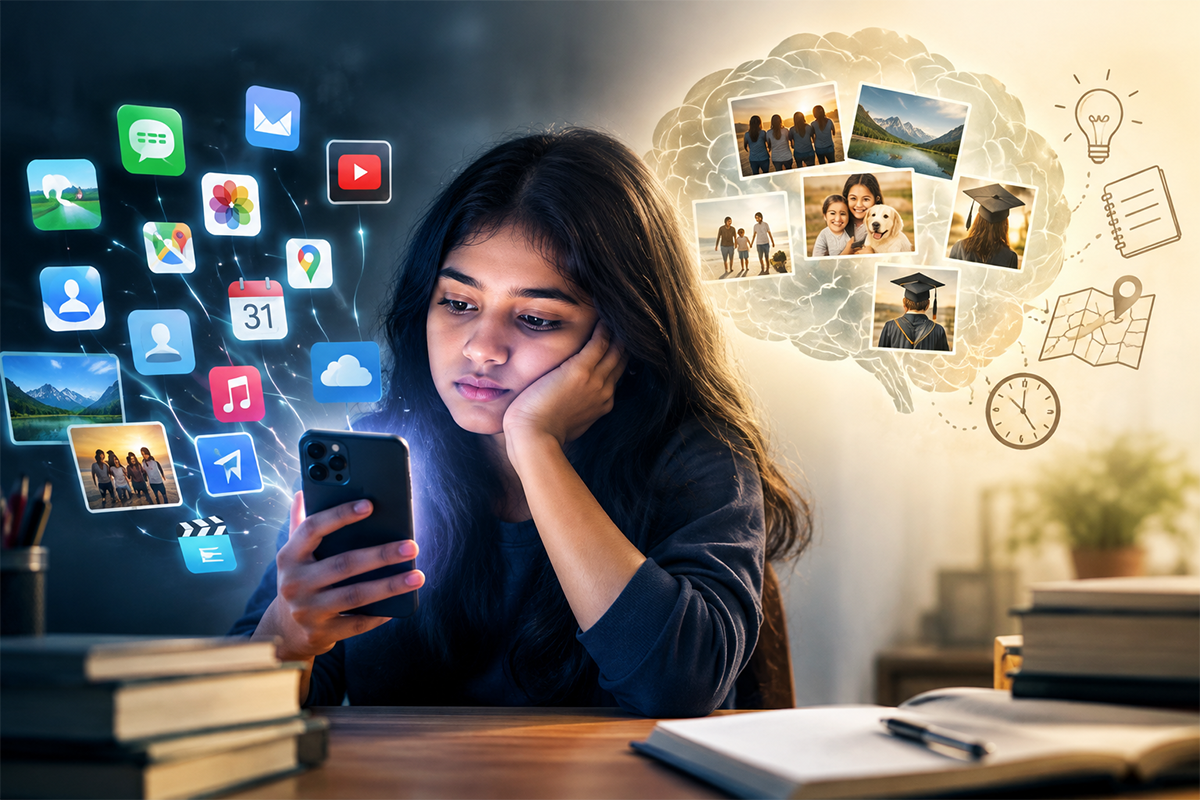
Image used for representational purpose only. (AI generated image)

Synopsis: Smartphones have become an external memory bank. Is our reliance on them chipping away at a healthy mind’s ability to concentrate, understand, retain and recall?
The concern is not that smartphones will make us forget everything, but that we may gradually forget how important remembering is.
What if the device designed to help us remember is quietly weakening the habit of remembering?
The question is no longer merely philosophical. The smartphone has become an external memory bank for billions, storing our contacts, appointments, directions, photographs and facts. But when remembering is repeatedly replaced by instant retrieval, something fundamental can change: the mind gets less opportunity to pay attention, encode information and recall it independently.
This does not mean smartphones are destroying human memory. There is no credible scientific basis for such a sweeping conclusion. The concern is more subtle—and more consequential. Excessive smartphone use can fragment attention, interfere with sleep and encourage dependence on external information, all of which can influence how memories are formed and retrieved.
A distracted mind cannot encode information efficiently. A notification checked during a conversation, a message opened while studying or a short video watched between two tasks may seem insignificant. Repeated throughout the day, however, such interruptions can make sustained concentration increasingly difficult.
A 2024 systematic review of functional MRI studies examining smartphone and internet addiction among adolescents and young adults identified recurring concerns involving cognitive control.
Another rapid systematic review covering 10 studies and 231,117 children across nine countries reported associations between excessive information and communication technology exposure and poorer executive functions, particularly working memory, inhibitory control, cognitive flexibility and attention. The researchers, however, emphasised that outcomes varied according to the nature and intensity of use, sleep and other environmental factors.
That qualification matters. Much of the existing research is observational, making it difficult to establish cause and effect. People who already experience stress, poor sleep or attention difficulties may also be more likely to use smartphones excessively. The evidence therefore supports caution, not technological alarmism.
Sleep may be the most important link between smartphones and memory. Learning does not end when a person closes a book. During sleep, the brain consolidates newly acquired information and strengthens memory. Yet smartphones encourage late-night scrolling, continuous messaging and the expectation of being permanently connected.
A recent umbrella review combining seven systematic reviews and meta-analyses, representing 127 primary studies and approximately 867,000 participants, found associations between digital-device use and shorter sleep, bedtime procrastination and poorer sleep quality among adolescents. Smartphone and problematic social-media use showed particularly strong associations.
Another meta-analysis involving children aged five to 10 found that every additional hour of smartphone or tablet use was associated with an average 11-minute reduction in sleep. These figures do not prove that smartphones alone cause sleep loss, but they highlight a pattern that cannot simply be dismissed.
There is another phenomenon worth examining: cognitive offloading. Human beings have always used external aids—diaries, calendars, maps and libraries—to reduce the burden on memory. Smartphones have taken this practice much further. We no longer need to remember a phone number, route, appointment or even a basic fact when everything can be retrieved instantly.
Convenience is not the enemy. Dependence can be.
When the brain knows that information is permanently available outside itself, there may be less incentive to encode and retain it. Similarly, constantly photographing an experience, checking messages during conversations or documenting every moment can reduce the attention given to the experience itself. The smartphone may preserve the photograph while the mind preserves less of the moment.
Children and adolescents deserve particular attention. Their capacity for sustained attention, self-regulation and learning is still developing. A digital environment built around rapid stimulation can make slower cognitive activities—reading, writing, listening, problem-solving and reflection—feel unnecessarily difficult.
The solution is not to demonise technology. Smartphones are indispensable educational, professional and social tools. The answer is disciplined use: fewer non-essential notifications, phone-free periods during study and meals, reduced screen exposure before sleep and regular stretches of uninterrupted reading and conversation.
Schools and families should teach digital self-control as seriously as they teach conventional study habits. The objective should not be to produce children who fear technology, but adults who control it rather than being controlled by it.
A smartphone can store millions of pieces of information. But a healthy mind needs more than access to information; it needs the ability to concentrate, understand, retain and recall.
The real danger, therefore, is not that smartphones will make us forget everything. It is that we may gradually forget how important remembering is.
Also Read:
Smartphone camera: The first audience of childhood
Between access and addiction, Kerala searches for balance on children’s screen time
Phones in pocket causes male infertility? Why evidence remains unsettled
(Edited by R Rajesh Kumar.)



