
Published Jun 19, 2026 | 8:00 AM ⚊ Updated Jun 19, 2026 | 12:42 PM

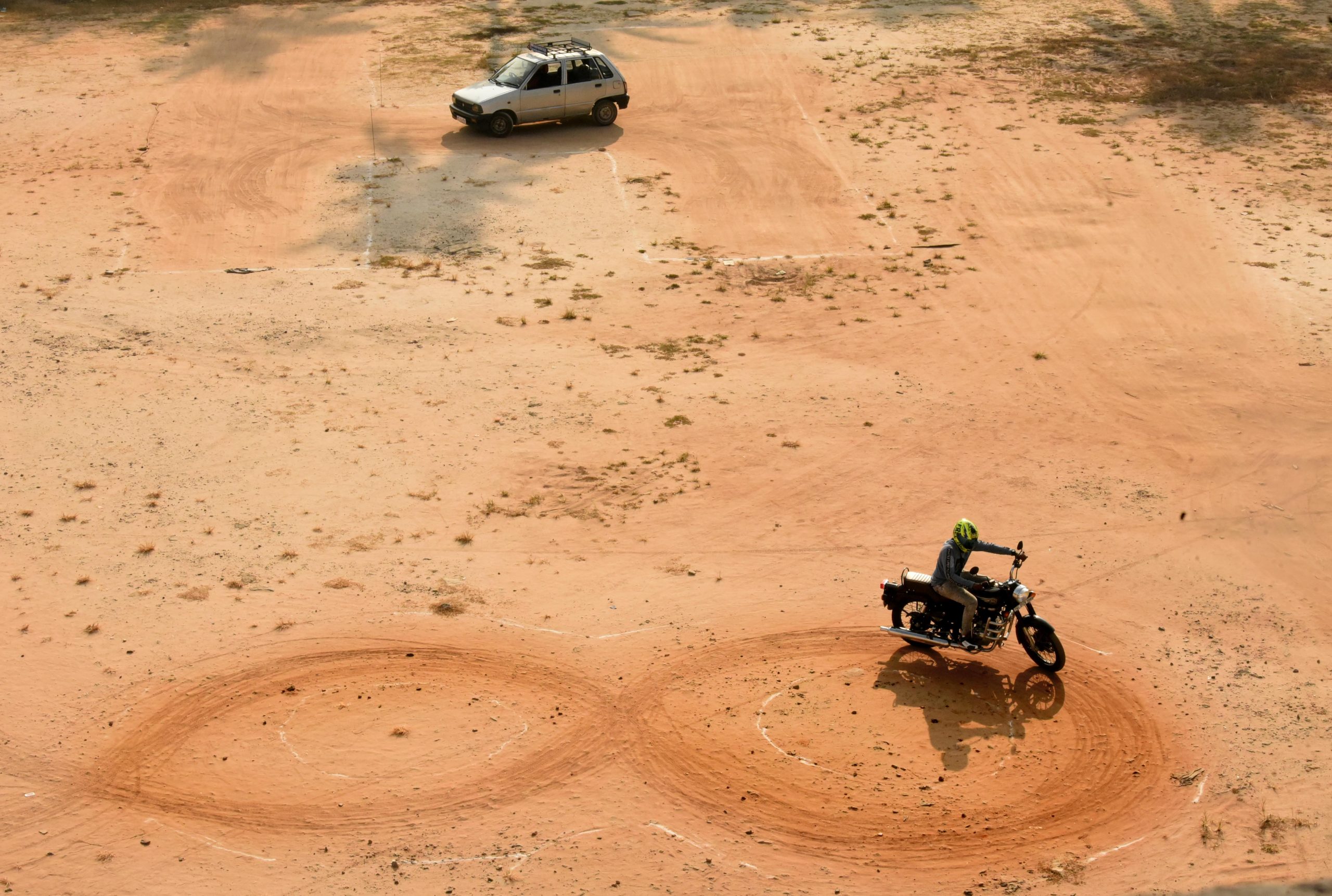
For decades, the driving test pass rate in Kerala was an absurd 95–100%. (Photo: Special Arrangement)

Synopsis: The basic question no official report dares to ask is this: how did Kerala’s dangerous drivers get their licences in the first place? Therein lies the real story.
Let me begin with a tale of two driving tests.
In 1974, I presented myself for my driving test at the Kerala Motor Vehicles Department office in Thiruvananthapuram. The inspector asked me to drive the car I arrived in—a Fiat Cinquecento— onto the city road. Partway up a steep incline, he asked me to stop, then to resume without letting the car roll backwards. It was a genuine test: brake, clutch, and accelerator in perfect unison. I did it.
Then came a question. “Suppose you suddenly see a ball darting out onto the road in front of you, what will you do?” I answered: apply the brakes cautiously, wait, then accelerate. The inspector looked at me with a smug grin. “You must remember,” he said, “that behind that ball could also be a child. Expect the unexpected.”
That inspector was testing not just mechanical competence, but a philosophy of driving—an understanding that the road is a shared, unpredictable space where judgment and anticipation can mean the difference between life and death. I got my licence—a little red booklet—by registered post. In those days, when there were hardly one lakh vehicles in Kerala, it was a sign of some merit.
Fifty-two years later, in 2026, my young nephew came home to proudly announce he had received his hologram-embossed driving licence. “Which of your cars did you drive?” I asked. His reply was scandalous: “The car of the driving school. It has brake, clutch and accelerator on both sides. The trainer sat beside me. I was just told to hold the steering and ‘pretend to drive’. He did the rest. I passed the test.”
My nephew did not lie. What he described is now the standard operating procedure of Kerala’s licensing system—a corrupt deal between driving schools and officialdom that has turned the driving test into a meaningless ritual. In the words of my time: a rubber stamp on a piece of paper that certifies nothing about a person’s ability to drive safely.
What I narrate below, with much trepidation, as I continue to drive in the city of Kozhikode at the age of 75, is the story of how Kerala—a state that accounts for just 1% of India’s population and 2% of its road network—came to account for a staggering 10% of the country’s road accidents. It is a story of systemic corruption, institutional failure, and a licensing system that has become a factory for producing dangerous drivers.
Over the two-year period ending in 2025, Kerala lost 7,613 lives in nearly one lakh road accidents—an average of 10 fatalities every day. In 2025 alone, the state recorded 49,889 accidents, resulting in 3,733 deaths and 56,922 injuries.
The State Crime Records Bureau’s Road Accident Analysis Report reveals that over-speeding caused 46% of fatalities. The most dangerous time on Kerala’s roads is between 6pm and 9pm. Crucially, 81,534 accidents and 5,609 deaths occurred in clear, sunny weather. Bad weather is not the culprit. Potholes caused just six accidents in Kerala in 2023, and one death. The roads themselves are not the primary problem.
At the national level, we are the undisputed global leader in absolute road accident fatalities, reporting nearly five lakh road accidents annually, claiming approximately 1.8 lakh lives and costing the economy 3% of its GDP in 2023. Over 60% of victims were aged between 18 and 34. Kerala, despite its small size, is the state with the third-largest contributor to this national tragedy.
The conventional discourse on road safety focuses on symptoms: over-speeding, drunk driving, mobile phone use. These are real problems, but they are symptoms of a deeper disease. The fundamental question—the one that no official report dares to ask—is this: how did these dangerous drivers get their licences in the first place?
The answer, laid bare by the Vigilance and Anti-Corruption Bureau (VACB) in July 2025, is devastating. In a coordinated operation code-named “Clean Wheels”, VACB officials swooped down on 81 MVD offices across the state. What they uncovered was widespread and entrenched corruption.
A network of dishonest MVD officials had devised methods to allow licence aspirants to pass through “perfunctory examinations”—a bureaucratic euphemism for no examination at all. Officials worked with agents who collected bribes, passing portions on via UPI transactions. Preliminary verification of those transactions revealed officials had illicitly received ₹7,84,598—”merely the iceberg’s tip,” as a senior official put it. Applications sponsored by agents were cleared quickly; independent applications gathered dust.
The VACB has since initiated criminal enquiries against 40 MVD officials and recommended disciplinary action against 112 others.
For decades, the driving test pass rate in Kerala was an absurd 95–100%. One motor vehicle inspector was issuing 60 licences a day, spending just six minutes on the entire ground test, road test, and candidate screening. Former Transport Minister KB Ganesh Kumar himself revealed that “there was a time when 122 candidates out of 124 who appeared for the driving test under a single inspector breezed through.”
In March 2025, the MVD introduced stricter norms: it capped tests per inspector to 40 per day and installed dashboard cameras and vehicle tracking for recording tests. The result was immediate and damning. The average pass percentage plummeted to just 52%. In some cases, it fell as low as 40%.
Think about what this means. For decades, the pass rate was near-universal not because Keralites were exceptionally skilled drivers, but because the test was a fraud. When the MVD briefly attempted genuine examination, half the applicants could not pass. A vast army of completely unqualified drivers had been unleashed onto Kerala’s roads, licensed by the state to operate vehicles they had no business driving. The driving schools, predictably, led a pitched protest, forcing the government to relax some of the reforms.
Kerala’s problem is not an isolated anomaly. Union Minister Nitin Gadkari has publicly acknowledged that an estimated 30% of all driving licences in India are fake. A landmark experiment in Delhi found that 69% of applicants who used corrupt channels to obtain their licences were rated as failures on an independent driving test.
The Ministry of Road Transport and Highways does not even maintain centralised data on fake or duplicate licences—a fact that speaks volumes about institutional indifference. The Motor Vehicles (Amendment) Act, 2019 was supposed to eliminate duplicate licences and reform driving tests. Six years later, the problem persists. An analysis by the Ministry found that an overwhelming majority of India’s road tragedies are attributable to human error. The system is not failing despite the numbers; it is producing them.
To understand why the licensing system remains broken, one must understand the powerful economic forces that depend on it remaining broken. The 1991 economic reforms triggered an extraordinary production surge in the automobile sector. Total vehicle production grew from 2 million units in 1991–92 to 28 million units in 2023–24. The sector now contributes 7.1% to India’s GDP, 49% to manufacturing GDP, and supports over 37 million jobs.
In Kerala, vehicle numbers have surged from under 1 lakh in 1970 to approximately 1.9 crore in 2025—an almost 150-fold increase. Meanwhile, road length grew only fivefold. The result: the average number of vehicles per kilometre of road has skyrocketed from one in 1970 to 57 in 2025. Every day, Kerala issues an estimated 1,000 new driving licences. You cannot test and certify that many drivers honestly without a colossal, well-funded, and incorruptible infrastructure. Kerala does not have that.
The system defaults to the path of least resistance. Industry demands new drivers to absorb its production. The economy needs the industry for GDP and jobs. The RTO needs to process applications. The solution is found in the perfunctory examination, the fake test, the purchased licence. The machine of economic growth continues to roar, and the human cost is counted in thousands of lives lost each year.
Kerala’s unique geography makes the problem even more acute. Nearly 90% of its road network is single-lane, a direct consequence of high population density, scarce land, and a rural-urban continuum where villages merge seamlessly into towns.
While the rest of India builds six-lane highways, Kerala has actively downsized its NH 66 corridor from 60 to 45 meters. Packing 819 people per square kilometre into a continuous, linear strip of land squeezed between the Western Ghats and the Arabian Sea—just 120 kms at its widest and a coastline of 600 kms—forces all pedestrians, motorcycles, cars, and buses onto a highly restricted road system.
Every single-occupancy car on Kerala’s narrow roads is a spatial disaster: a bus passenger uses just 0.48 m² of road space, while a car passenger uses 2.23 m². Yet, as car density has soared per motorable road kilometre from 0.5 in 1990 to 2 in 2000 and 14 in 2025, Kerala’s public bus system has been systematically dismantled.
Between 2013 and 2023, 11,700 private buses and 1,300 KSRTC buses disappeared. Daily bus ridership has collapsed from 1.32 crore to just 66 lakhs. This exodus from public transport is a primary driver of the car boom, trapping the state in a vicious cycle.
There is a bitter irony in all of this.
In June 2026, the Indian government removed licensing requirements for the radio spectrum used by self-driving systems and crash-avoidance technologies. Advanced Driver Assistance Systems already have an 8.3% market share in new cars. Yet the same minister who acknowledged that 30% of licences are fake has vowed: “We won’t allow driverless cars in India. I am very clear on this,” citing concerns over job losses for drivers.
The state is caught between an ideology that protects driving jobs and a reality where licenced drivers are demonstrably unqualified, causing over 1.7 lakh deaths annually. Technology that could save lives is being held back to preserve a system that is killing people.
Also Read: Kerala IAS officer to stand trial nearly 7 years after journalist’s death in car crash
The evidence is overwhelming. Kerala’s road safety crisis is not a mystery. It is the predictable, tragic outcome of a system that has prioritised economic growth, convenience, and corruption over skill, safety, and the public good. Reform requires several urgent measures.
Radical transparency. All driving test data—pass rates by RTO, inspector, and driving school—must be publicly available. Name and shame the offices where 95% of people magically pass. Driving schools must face stringent licensing and regulation. Training must include, among other things, knowledge of traffic rules and road signs; strict parking assessment; lane and signalling discipline; city, highway and hill road vehicular handling and etiquette; and computer-based theory tests with high passing scores for all who complete the learner’s training. There must be a special certification for heavy vehicle drivers with mandatory driving reviews once in five years.
Automated, tamper-proof testing. The national plan to introduce automated driving test tracks with HD cameras, motion sensors, and AI-driven scoring must be fully implemented without exception. The recent controversy over exempting KSRTC trainees from this system shows how deeply the resistance to honest testing runs.
A Passport Seva-style overhaul. The Motor Vehicles Department needs complete transformation from a physical, agent-driven bureaucracy to a fully online, transparent, corruption-proof system. This was successfully done for passports; it can be done for licences.
Breaking the nexus. The corrupt relationship between driving schools and RTO officials must be dismantled. Driving schools should be training institutions, not licence factories.
A genuine public transport revival. The collapse of Kerala’s bus system is not just a convenience issue; it is a safety issue. Every person who abandons a bus for a car because the bus system has collapsed is usually one more unqualified driver on the road. To fix bottlenecks, the new government in Kerala should deploy Demand-Responsive Transit (DRT) to run on-demand minibuses along dynamic routes, ensuring flexible first-and-last-mile connectivity. Integrating this via a Mobility as a Service (MaaS) platform would unite KSRTC buses, ferries, and local auto-rickshaws into a single, seamless digital booking and ticketing network.
In 1974, an inspector in Thiruvananthapuram taught me that behind every ball on the road, there could be a child. He was testing for skill, judgment, and the anticipation that defines a safe driver.
In 2026, a young man in Kerala was told to hold the steering wheel and pretend to drive while his trainer did the rest. He passed. Thousands like him are now on the road, licensed by the state, a danger to themselves and everyone around them.
The 7,613 lives lost on Kerala’s roads in two years are not an act of God. They are not primarily the result of bad roads or bad weather. They are the direct, bloody outcome of a system that sold licences to people who never learned what that inspector in 1974 taught: that driving is a responsibility, not a right; that a licence is a certification of competence, not a receipt for a bribe.
Kerala accounts for 1% of India’s population and 10% of its road accidents. This is not a coincidence. It is a verdict on a system that has failed its citizens. The time for perfunctory examinations is over. Genuine reform must begin now.
* John Kurien, a reflective development practitioner based in Kozhikode, penned this essay in response to the alarming rise in daily road accidents reported across Kerala’s media. Drawing on his observations of exemplary driving culture and etiquette in South East Asia, Europe, and the Gulf, and now navigating the chaotic traffic of Kozhikode, he felt compelled to write this piece.
Also Read: Why free bus travel for women is good for Kerala



