

Published Nov 18, 2026 | 9:19 PM ⚊ Updated Nov 18, 2026 | 9:20 PM

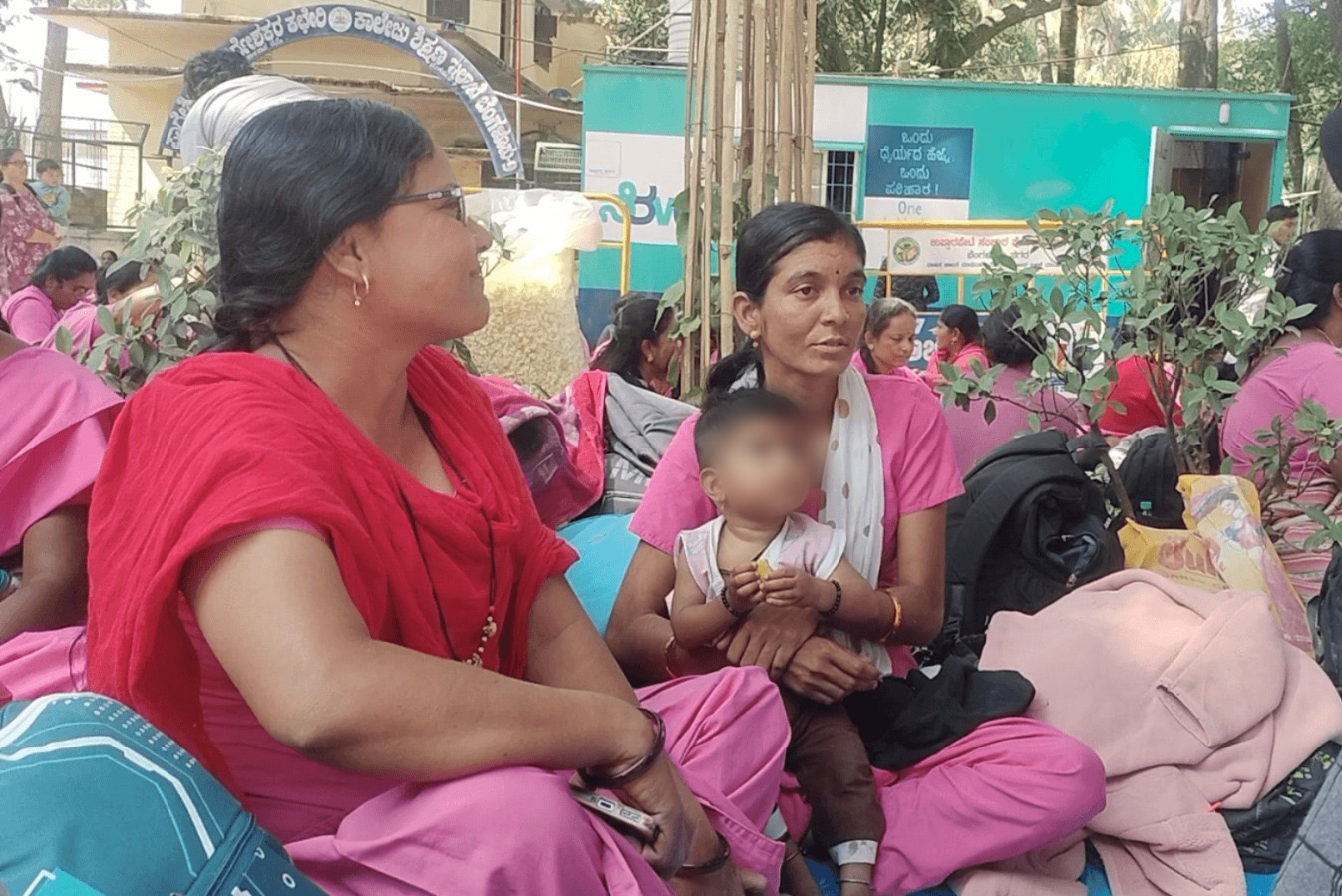
An Accredited Social Health Activist with her child at the protest site.

Synopsis: Thousands of ASHAs have gathered at Bengaluru’s Freedom Park for an indefinite protest, demanding a fixed monthly honorarium of ₹15,000, disbursement of pending incentives and better retirement benefits. They said inadequate pay, an expanding workload and glitches in digital reporting systems have left them struggling to make ends meet despite being the first point of contact for public healthcare across the state.
Kala* cradled her two-year-old child as she sat amid a sea of women in pink sarees and churidars. An Accredited Social Health Activist (ASHA) from Kalaburagi, she had travelled more than 500 km to Freedom Park in Bengaluru a day ago to demand a fair wage for her work.
She, like many other ASHAs from across Karnataka, reached Bengaluru on Tuesday, 17 November, to wage a battle for fair remuneration. Many more are expected to join the struggle in the coming days.
Sitting on the tarpaulin sheet spread on the ground, Kala explained the protest’s purpose. She had endured the previous cold night with hundreds of other workers on the blue tarpaulin sheet, which contrasted with their pink attire.
“How are we supposed to make a living with ₹5,000? The prices of everything—milk, rice, dal— have gone up.”
In Karnataka, ASHAs receive a fixed state honorarium of ₹5,000, plus performance-linked incentives. The frontline health workers are demanding a monthly honorarium of at least ₹15,000, arguing that their current remuneration falls far short of the state government-fixed minimum wages.
The Labour Department has fixed monthly minimum wages ranging from ₹19,319 to ₹23,376, depending on the work.
ASHAs, however, are activists — Accredited Social Health Activists — not workers. Their designation itself does not consider them as workers.
“If they are not convinced of our demand, let them show us how to live on ₹5,000. Chief Minister DK Shivakumar should consider this seriously. He said he believes in empowering women, but making an announcement is not enough. It has to be implemented,” Jayachithra, an ASHA from Bengaluru Rural district, said.
Also Read: ASHAs and the neoliberal crisis of accountability
The ASHAs’ demand is not new. In January 2025, ASHAs had staged a similar protest against low remuneration. They called off their strike after then Chief Minister Siddaramaiah assured them that their honorarium would be increased to ₹10,000.
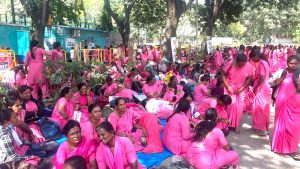
ASHAs are braving the weather to press the government to accept their demands.
However, workers said the assurance remains unfulfilled.
“Those were just words. Our honorarium increased by only ₹1,500,” Kanthamani, an ASHA from Mandya, said.
Health Minister UT Khader visited the protest site on Tuesday and received a memorandum from representatives of the ASHA Workers’ Union. He urged the activists to call off their agitation. The minister assured them that he would take up their demand for a fixed monthly honorarium of ₹15,000 with Chief Minister Shivakumar at the Cabinet meeting on 19 November.
“In one voice, the ASHAs rejected the health minister’s offer. We were fooled in the past; we will not be fooled again. This time, whatever assurance the government provides will have to be in writing,” Rama TC, vice president of the Karnataka Rajya Samyuktha ASHA Karyakarteyara Sangha, said.
“The demanded amount is not exorbitant,” she continued, pointing to other states where ASHAs received higher honorariums. In neighbouring Keralam, ASHAs reportedly receive ₹12,000 a month, while those in West Bengal get ₹11,250.
Also Read: ASHAs in Kerala deserve dignity
With every new health scheme and survey, the work an ASHA does increases, according to Manjula, an ASHA from Hunsur taluk.
“We visit every house; we are there for every delivery; we take care of the health of mothers and newborns, and conduct TB, dengue and malaria surveys. Yet, we are not paid what the pourakarmikas (municipal sanitary workers) receive. This ₹5,000 honorarium does not meet our needs, and we are not compensated for the hard work we do,” she said.
While regularising the jobs of pourakarmikas of the Bruhat Bengaluru Mahanagara Palike (BBMP) on 1 May 2025, then Chief Minister Siddaramaiah said their wages had been increased to ₹17,000 from ₹7,000.
“Earlier, the salary was ₹ 7,000. It was increased to ₹17,000, and a system was made to pay it directly to the bank account,” Siddaramaiah said in the presence of AICC president Mallikarjun Kharge.
Each ASHA is responsible for 250 to 300 households and 37 health-related activities under the National Health Mission. Karnataka has 41,785 ASHAs, making them an important link between communities and the public healthcare system.
Another demand ASHAs raised was to discontinue compulsory mobile-based work through applications such as Samasta.
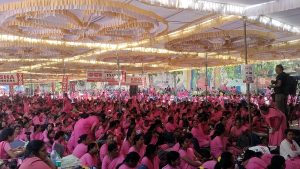
Protesters at Freedom Park on Wednesday.
Introduced in August 2026, the app requires ASHAs to upload household health, maternal and child health, and immunisation records, in addition to maintaining physical registers. The rollout was almost immediately met with complaints of server-related problems and technical glitches, with workers in Shivamogga reporting difficulties in October.
“Working on the app is very difficult. We have not been given any training to use it. Neither mobile phones nor money for internet expenses are provided. We are paying for these things out of our own pockets,” Kavitha, an ASHA from Kalaburagi, said.
The app has revived longstanding grievances over digital reporting. In 2021 and 2022, workers reported losing incentives because of failed uploads, poor internet connectivity and entries being rejected by the Reproductive and Child Health portal. Because several payments depend on successful data submission, workers said the risk of losing incentives for completed work was high.
The protesters’ demands extended beyond a monthly wage revision. They sought the immediate release of pending incentives under the Centre’s ASHA Nidhi Scheme, lump-sum payments due to workers who have retired over the past several years, and an increase in retirement benefits to ₹5 lakh.
They also demanded the reinstatement of ASHA Facilitators — whose services were terminated in February 2025 — along with payment of their arrears. Other demands included a special incentive of ₹5,000 for every NIOS training module completed and continued payment of the state honorarium and routine work incentives for at least three months to ASHAs undergoing treatment for serious ailments.
Also Read: They watch, they alert, they act
The protest has begun taking a toll on workers, who have already endured a cold night. On Wednesday, an ASHA from Chitradurga district, Deepa, fainted after suffering severe chills and a high fever. She was rushed to KC General Hospital in Malleshwaram in a police van.
“Many are sick here. Many have come with serious illnesses. There are cancer patients, people who have recently undergone surgeries. Even then their spirit to change their circumstances is strong,” Rama said.
For Kala, the immediate concern is protesting and looking after her child. She said she has been running a cold and fever, with little choice but to keep her child beside her.
“We have been out here in the cold, with fever, with my child. We will not move until our honorarium is increased to ₹15,000,” she asserted.
(*Name changed on request. Edited by Majnu Babu).



