


Published Jun 26, 2026 | 2:00 PM ⚊ Updated Jun 26, 2026 | 2:01 PM

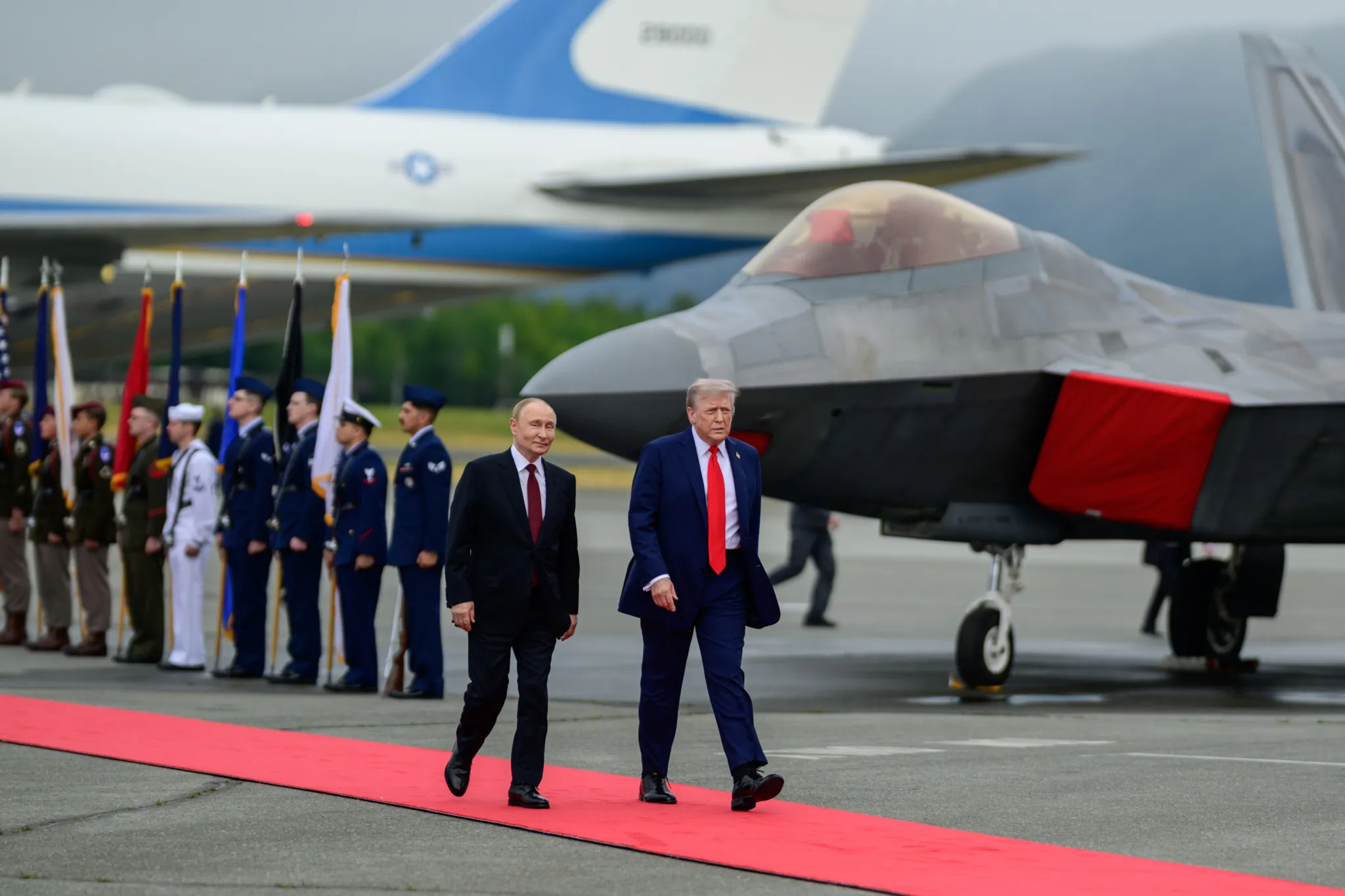
Vladmir Putin and Donald Trump are seen together in this file photo. (White House)

Synopsis: When Russian leader Nikita Khruschev crossed a line, the world did not sit idly by. But these days Trump, Putin and other leaders are bending it to their will and almost everyone is busy obliging…
“We are in the midst of a rupture, not a transition,” Canadian Prime Minister Mark Carney said while describing the current state of global affairs as a prolonged era of geopolitical fragmentation and disorder.
It’s a fact that the liberal international order, which was built on the edifices of international laws and overseeing multilateral institutions and free markets, is in total flux. Although the scholars interpret this differently, liberals emphasise on the rules and institutions of the post-World War II era as a stabilising factor, while realists highlight how the order has now turned coercive.
The crucial point, however, is that international laws without an enforcement mechanism raise questions of legitimacy, as weaker states are expected to follow rules that are often bent or ignored by the powerful. But everyone believes it is preferable to have a pre-existing order that provides structural balance and predictability rather than return to the jungle of anarchy.
Today, major powers such as the US and Russia, by exercising their extra-territorial ambitions, are further ripping apart and fragmenting the multilateral global order. The trend of more states desiring a multipolar world has resulted in amplified rivalry and further evaporated cooperation.
This transition phase has seen frequent violations of legal norms and infringements of sovereignty, but the worst development is the ‘passive acceptance or active normalisation’ of such acts by the international community. Realists will frame this new normal by quoting that “Morality is luxury; norms are tools; power is the only reality out there.”
This explains how the powerful actors continuously violate laws, human rights and ethical standards without facing consequences and thus turn violations into patterned outcomes rather than anomalies. It extends to interventions, weaponisation of resources, disrupting global markets through tariffs and protectionism etc.
During the Cold War era, the Soviet Union, asserting that it had the right to intervene in any socialist state where power was threatened, suppressed the Budapest Uprising in Hungary, crushed the Prague Spring in Czechoslovakia and dispatched Red armies to Afghanistan as part of the Brezhnev Doctrine.
Likewise, the West orchestrated coups in Iran, Guatemala, Chile and airdropped massive bombs on Korea, Vietnam and Latin America. From Korea, Angola to Nicaragua and dozens of other countries, governments were toppled and popular leaders assassinated by insurgents or even their own armed forces.
The majority of these interventions were externally funded and supported with sophisticated weaponry. Military professionals and intelligence agencies trained the perpetrators and they were politically shielded at the apex global governing bodies, such as the United Nations Security Council (UNSC) and the Office of Counter Terrorism under the guise of humanitarian intervention.
All these marked a blatant violation of the UN Charter, the principle of sovereign equality and contravention of territorial integrity. Veto power was flagrantly abused by the Permanent Five, causing systemic paralysis at the United Nations.
After the disintegration of the Soviet Union, George Bush termed the post-Cold War era, as the “New World Order”. However, things did not change as much as expected.
The emancipated sole hegemon, the US, with its transatlantic alliance—NATO—continued to intervene in other territories. They updated their vocabulary a little, employing terms such as failed-state management, restoring democracies and humanitarian interventions on moral grounds, etc.
Later, the interventions in Iraq and Afghanistan were justified on the grounds of a perceived security threat and a global war on terror. Despite non-satisfactory evidence, the US, along with the Coalition of the Willing, invaded the country—ruled then by Saddam Hussein— without the explicit authorisation of the UNSC.
Another innovation was during the 2005 UN World Summit, where R2P (responsibility to protect) altered the notion of sovereignty from ‘absolute control’ to ‘conditionally qualified’.
Later, Putin used this linguistic coercive revisionism during the de facto annexation of South Ossetia and Abkhazia, the annexation of Crimea in 2014 and special military action in Ukraine by explicitly stating, “You created the rules we are now following.”
Also Read: How Ayatollahs of Iran betrayed their revolution’s mentor
What we are witnessing now is a consequential shift where the revisionist acts and the aggressive language of superpowers are accepted and normalised by the international community. Russian claims of “denazification of a neo-Nazi regime”, the US openly threatening sovereignty of foreign territories— calling for the annexation of Greenland and entering Cuba—China’s maritime claims about the South China Sea and unrelenting threats against Taiwan; Israel’s warning of laying a complete siege on Gaza and turning it into rubble have all not been met with outrage but with tame acquiescence.
The abduction of a sitting president, as was seen in Venezuela, failed to provoke widespread opprobrium. The decapitation of the adversarial head of state on a sovereign foreign territory, as was seen in Iran, was largely overlooked; condolences were delayed and were conspicuously diplomatic.
The reasons could vary, but the passive normalisation of such acts by ‘predatory hegemons’ striking anyone they consider “belligerent” tells us about how the world obliges hard power.
Trump’s warning that “Civilisation will die tonight” did not receive the proportionate response that Soviet leader Khrushchev’s remark “we shall bury you” during the peak of the Cold War did. Though both leaders possessed unchallenged powers, today the audience and other actors passively absorb these phenomena and adjust their baseline rather than principles.
As Stephen Walt mentions, “US under the Trump administration is gradually changing the nature of hegemony”—from building a consensual multilateral system to a more transactional and unilateral approach. The new predatory hegemon leverages its superior position, where it influences others with their dependence on dollar access, technology, intelligence and diplomatic protection. Everyone is expected to obey without questioning US power and accept unequal terms.
The shift in the new normal has more consequences than one can imagine. Acceptance of sovereignty violation sets a precedent for future crises. The unresolved border issues, active kinetic conflicts and resource confrontations will become the epicentre of geopolitical instability.
The rupture not only undoes the past progress of international institutional order, but sets in motion unpredictable, unprecedented and uncontrolled chaos that may cause severe harm to humanity. As Michael Glennon in his seminal work, On How Norms Die, warned that “when a norm is excessively violated by a sufficient number of states, violation is no longer an issue; instead, it principally applies another rule that permits unrestricted and unrestrained freedom of actions for everyone.”
This cannot and must not be condoned.
Also Read: The significance of President Trump’s AI security order for India and the rest of the world
(Edited by R Rajesh Kumar.)



