

Published Dec 27, 2025 | 8:00 AM ⚊ Updated Dec 27, 2025 | 8:00 AM

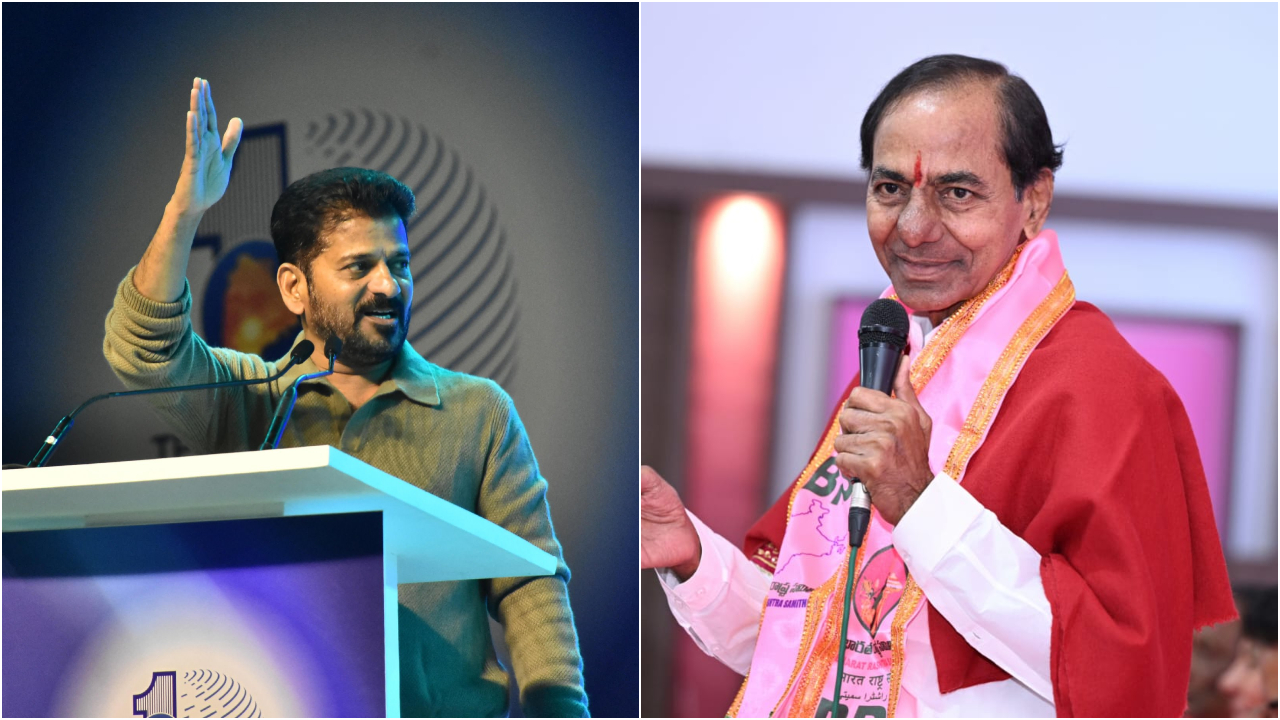
BRS has already gone on the offensive, accusing Congress of plotting to dismantle districts that have become symbols of its governance model.. Credit: x.com/revanth_anumula, x.com/BRSparty
Synopsis: In a state aspiring to lead in progress, with ambitious goals in information technology, irrigation development, farmer welfare and overall economic growth, leaders cannot afford these self-inflicted distractions that detract from governance and development. The restoration of dignified discourse demands concerted action from all stakeholders. Political leaders across parties must recommit to issue-based dialogue, focusing on facts, policies and solutions rather than personal vendettas.
In the final days of December 2025, Telangana’s political arena witnessed a sharp escalation in verbal aggression, underscoring a deepening crisis in public discourse.
The spark ignited around 21 December when Bharat Rashtra Samithi president and former Chief Minister K Chandrashekhar Rao (KCR), emerging from months of relative silence, launched a fierce critique of the Congress government over Krishna river water sharing and irrigation projects.
At a party meeting, KCR accused the ruling dispensation of betraying Telangana’s interests and used the provocative Telugu phrase “toolu teesta”—meaning “we will flay/skin alive”—to signal an aggressive campaign against the government, declaring there would be “no more niceties”.
Chief Minister A Revanth Reddy responded with equal ferocity on 24 December during a public meeting in Kosgi in Kodangal constituency, while felicitating newly elected sarpanches. Dedicating nearly half his speech to personal attacks, Reddy vowed that the “Kalvakuntla family” (KCR’s lineage) would never return to power as long as he remained in politics.
He countered KCR’s “skinning” threat with veiled dark humour, suggesting that if he reciprocated with similar language, KCR might “hang himself” at project sites such as Mallannasagar or Ranganayakasagar. Reddy labelled KCR a “broker”, accused the previous regime of massive debt and corruption, and issued thinly veiled warnings of imprisonment for KCR and his son KT Rama Rao (KTR).
The BRS fired back immediately. Between 24 and 26 December, KTR condemned Reddy’s “vulgar rhetoric”, “abusive theatrics”, “uncivilised and irresponsible language”, and “arrogance-driven politics”, arguing that it diverted attention from governance failures, particularly on the Palamuru-Rangareddy Lift Irrigation Scheme.
Former minister T Harish Rao decried the remarks as unfit for the Chief Minister’s office, claiming they frightened children and embarrassed the state. Other BRS leaders accused Reddy of lowering constitutional dignity.
Congress leaders defended Reddy, asserting that KCR had “patented abusive language” during the Telangana movement and the BRS rule, introducing personal vilification into politics. They maintained that Reddy was responding proportionately to provocation and urged KCR to debate issues in the Assembly rather than resorting to threats.
This vicious cycle of provocation and counter-attack exemplifies a troubling degeneration: leaders substituting policy scrutiny with personal sledging, amplifying divisions in a state still building its identity post-formation. Telangana’s episode is no anomaly but part of a nationwide trend in which political rhetoric has increasingly devolved into abuse and intimidation.
What began as robust criticism has morphed into “gutter politics”, with leaders deploying inflammatory language to evade accountability on deliverables such as welfare, infrastructure and economic growth.
Social media has dramatically exacerbated this phenomenon. Followers echo and amplify insults in partisan silos, turning platforms into battlegrounds of hostility rather than spaces for informed debate. YouTubers and influencers, chasing views and subscriptions, sensationalise these feuds with exaggerated commentary, often indulging in outright character assassination and speculative slander.
Paparazzi-style journalism prioritises personal scandals and dramatic confrontations over substantive policy analysis, normalising crudeness as clickbait entertainment that drives traffic and revenue.
The ramifications of this erosion are far-reaching and profound. Public trust in democratic institutions diminishes when elected representatives model incivility instead of statesmanship. Young people, constantly exposed to this barrage through digital media, risk internalising aggression as the norm for conflict resolution.
Societal polarisation deepens, making consensus on critical issues harder to achieve, while the shift from ideas to insults stifles the constructive dialogue essential for progress. In extreme cases, such rhetoric has been linked to real-world unrest, as inflammatory words can incite violence or deepen communal divides.
Multiple elements drive this decline in civility. Populist mobilisation tactics encourage leaders to frame opponents as existential threats, rallying bases through emotional outrage rather than reasoned arguments.
Digital platforms reward virality through controversy, with algorithms favouring short-form content that prioritises slogans, slurs and sensationalism over nuance and depth. An entrenched culture of impunity plays a role too—rare enforcement of decorum standards by parties, advisories from bodies such as the Election Commission, or legal provisions against hate speech embolden further escalation.
Historical legacies also contribute. In Telangana specifically, Congress supporters point to KCR’s intemperate style during the statehood agitation as setting a precedent that normalised strong-arm verbal tactics.
Nationally, various reports and surveys have documented surges in communal and personal vilification during polarised campaigns, highlighting how such discourse alienates moderate voices and undermines democratic foundations.
Telangana’s latest flare-up, triggered by KCR’s aggressive resurgence and met with Chief Minister A Revanth Reddy’s unyielding rebuttal, serves as a stark reminder of the high costs of unchecked rhetoric.
In a state aspiring to lead in progress, with ambitious goals in information technology, irrigation development, farmer welfare and overall economic growth, leaders cannot afford these self-inflicted distractions that detract from governance and development.
The restoration of dignified discourse demands concerted action from all stakeholders. Political leaders across parties must recommit to issue-based dialogue, focusing on facts, policies and solutions rather than personal vendettas.
Parties should implement and enforce internal codes of conduct that penalise abusive language. Media outlets and digital influencers bear an ethical responsibility to elevate public conversation through fact-checking, balanced reporting and contextual analysis, rather than amplifying outrage for engagement.
Ultimately, voters hold the greatest leverage. By demanding accountability not just for policy promises but also for the tone and quality of political speech, citizens can compel meaningful change.
As India confronts complex challenges ranging from inter-state water disputes to economic inequities and social cohesion, dignified and respectful discourse remains essential for forging inclusive and effective solutions.
It is time for Telangana’s leaders, and indeed those across the nation, to rise above the temptations of sledging and personal attacks, reclaiming the dignity that truly befits public office and the aspirations of a vibrant democracy.


