

Published Jul 18, 2026 | 11:38 AM ⚊ Updated Jul 18, 2026 | 11:38 AM

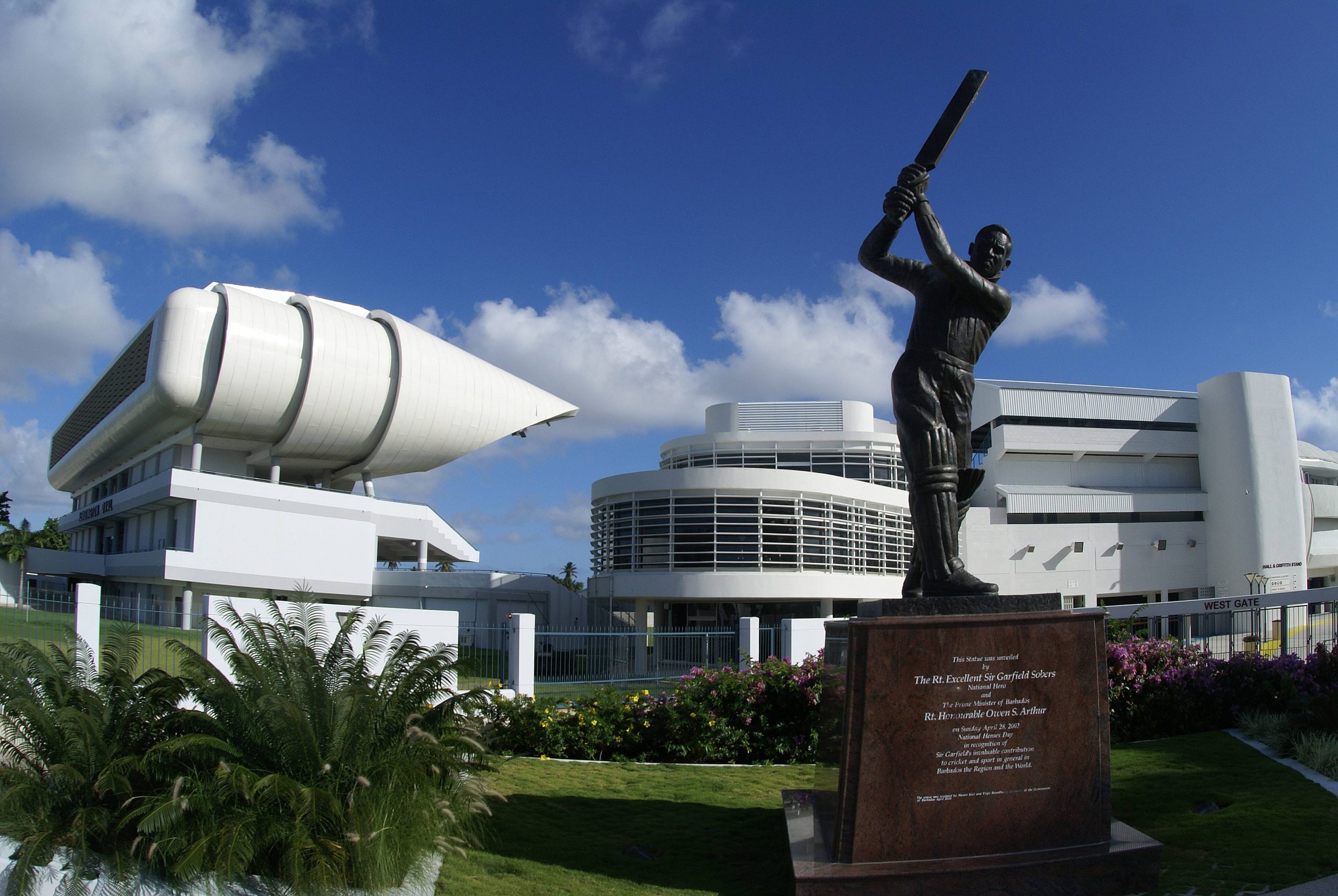
The statue of Sir Garry Sobers outside his beloved Kensington Oval in Bridgetown, Barbados. (Photo Courtesy: Winston Edghill, Wikimedia Commons)

Synopsis: Sir Garry Sobers illuminated the game as a batsman, bowler and fielder in a manner no one before him and after had. The story of how the great man rose to the heights he conquered after battling adversity as a boy in Bay Land will remain one of the greatest sporting tales of all time.
For those who came of age in the third quarter of the twentieth century, the death of Sir Garfield St Aubrun Sobers at the age of eighty-nine feels less like the passing of a legendary cricketer than the closing of an extraordinary historical chapter. With him disappears perhaps the last towering figure from cricket’s great age of decolonisation, when the game became a language through which newly independent nations announced themselves to the world. Garry Sobers was not simply the finest all-rounder cricket has known. He embodied the confidence, imagination and freedom of a West Indies discovering its own voice.
My own fascination with Sobers began far from the turquoise waters of the Caribbean, in the dusty courtyards of Madhubani in north Bihar. I belonged to a generation that never watched him in his prime, yet his presence felt strangely intimate.
My late uncle, Bashishth Narayan Thakur, was an ardent lover of cricket and spent countless evenings recounting stories of Sobers, Frank Worrell and the magnificent West Indies. Through his storytelling, our home in the village of Uren in Mithila briefly became Kensington Oval and Sabina Park. Long before I learnt to appreciate batting averages or bowling figures, I understood that cricket could also be history, politics and imagination.
Years later, watching Stevan Riley’s acclaimed documentary Fire in Babylon, I realised that my uncle had not merely described a cricket team. He had introduced me to one of the twentieth century’s greatest stories of dignity, emancipation and collective pride.
In his landmark book, Beyond a Boundary, CLR James famously posed the question: ‘What do they know of cricket who only cricket know?’ James argued that the game could not be separated from the shifting currents of social and political history. If Frank Worrell was the Moses who led West Indian cricket out of the wilderness of racial hierarchy, Garry Sobers was the Joshua who conquered the world, establishing the Caribbean style as the most joyous, dominant force in the post-war era.
Born on July 28, 1936, in the modest neighbourhood of Bay Land, St Michael, Barbados, Sobers’ early life was marked by both physical anomaly and personal tragedy. He was born with two extra fingers, one on each hand, which he remarkably severed himself as a boy using catgut and a sharp knife, a piece of folklore that only enhances his mythical status.
The loss of his father at sea when Garry was only five years old could have easily derailed a lesser spirit. Instead, the young Sobers found solace, identity, and eventually immortality on the playing fields of Barbados.
What struck early observers of Sobers was his terrifying, almost preternatural versatility. He entered the West Indies Test team in 1954 against Pakistan, not as the premier batsman he would become, but as a seventeen-year-old slow left-arm orthodox bowler batting at number nine. Yet, within four years, the callow youth had matured into a colossus.
It was at Sabina Park in 1958 that Sobers truly announced himself to the world. Playing against Pakistan, he scored a monumental 365 not out, breaking Sir Len Hutton’s long-standing world record for the highest individual Test score. What made the innings unforgettable was its sheer audacity; it was a maiden Test century converted into a triple-century by a twenty-one-year-old.
That record stood for thirty-six years until it was broken by another left-handed Caribbean genius, Brian Lara, in 1994. It was entirely fitting that Lara broke the record in Antigua with Sobers himself watching from the pavilion, ready to embrace his successor.
Over the course of his illustrious twenty-year Test career spanning from 1954 to 1974, Sobers played 93 Tests and amassed 8,032 runs at an extraordinary batting average of 57.78, scoring 26 centuries and 30 half-centuries. As a bowler, he claimed 235 wickets, and his sharp reflexes allowed him to take 109 catches in the field.
The statistics, as impressive as they are, do a grave injustice to the genius of Sobers. Sir Donald Bradman, a man not prone to hyperbole, once described Sobers as a “five-in-one cricketer.” If one were to construct the perfect cricketer in a laboratory, the result would be Garfield Sobers.
As a batsman, he possessed a back-lift that seemed to reach the heavens, a majestic cover drive executed with a full follow-through, and a murderous hook shot that punished the fastest bowlers of his day.
As a bowler, Sobers was a unique cricketing chameleon who could open the bowling with a lively, hostile left-arm fast-medium pace, swinging the new ball prodigiously. Once the shine wore off, he could switch seamlessly to orthodox left-arm spin, or, most remarkably, to slow left-arm wrist spin, delivering chinamen and googlies.
As a fielder, he was a magnificent, predatory presence in the slips and at short-leg, possessing reflexes that seemed to border on the clairvoyant.
To watch Sobers play was to witness a display of supreme natural athleticism that made the arduous craft of cricket look like a leisurely Sunday morning stroll.
My own generation remembers him not just for his Test exploits, but for his profound impact on the English county circuit. When Nottinghamshire signed him as their overseas captain in 1968, he transformed a side that had long languished at the bottom of the County Championship. It was at Swansea in August 1968, while playing for Nottinghamshire against Glamorgan, that Sobers became the first man in the history of first-class cricket to hit six sixes in an over off the unfortunate Malcolm Nash.
While the public never tired of discussing that solitary over, Sobers himself grew weary of it, gently complaining that it made people forget the decades of hard work he had put into enriching the broader tapestry of the game. He once reflected that the focus on the six sixes made him feel as though that was the only thing he had ever achieved in the history of cricket.
Following the tragic passing of Frank Worrell, Sobers assumed the captaincy of the West Indies in 1965. His tenure was a period of transition, marked by brilliant individual triumphs but also by the inevitable friction that comes with managing a multinational team representing distinct island nations. Sobers was an instinctive cricketer who expected others to possess the same genius that came so naturally to him, a trait that occasionally complicated his tactical decisions.
Like many great public figures, Sobers was not immune to error. His decision to play in Rhodesia—the South African state that went on to become Zimbabwe—in 1970, at the height of international opposition to white minority rule, provoked widespread criticism across the Caribbean. It momentarily threatened the moral authority he had acquired on the cricket field.
Yet he listened, acknowledged the hurt the decision had caused, rejected subsequent offers from apartheid South Africa and gradually restored the affection of a public that recognised both his greatness and his capacity for reflection.
After he retired from the game in 1974, Sobers was justly showered with honours. He was knighted by Queen Elizabeth II in 1975 on the beach in Barbados, a striking visual symbol of the old empire honouring the new majesty. In 1998, the Parliament of Barbados officially designated him as one of the country’s eleven National Heroes, a distinction that granted him the title of “The Right Excellent.” For nearly three decades, he stood as the only living national hero of his beloved island.
In his final years, ailing in health but never diminished in spirit, Sobers remained a regular and revered fixture at the Kensington Oval. To see him sitting in the pavilion, his eyes still sharp, watching the modern generation of cricketers, was to see a living bridge to an era when cricket was played with a heavy bat, a lighter heart, and an absolute absence of fear. His son Daniel shared that at the very end, in his home in Highgate Gardens, the old warrior put up a powerful, characteristically stubborn fight before passing peacefully into the ages.
With the passing of Sir Garfield Sobers, an extraordinary innings comes to its natural end. The contemporary game, shaped by franchise leagues, data analytics and increasing specialisation, has little room for a cricketer who could bat like the world’s finest batsman, bowl in three different styles and field as though instinct itself had taken human form.
Sobers belonged to an age when cricket still carried the aspirations of newly independent peoples and victories resonated far beyond the boundary rope. He leaves behind statistics that may one day be surpassed, but an imagination that almost certainly will not.
Somewhere between Bridgetown and Kingston, between Lord’s and Sabina Park, the Caribbean has lost one of its last living legends. Cricket has lost its greatest all-rounder. History has lost one of its most luminous sporting figures.
Also Read | ‘Messi’anic: How Argentina turned fear into belief against England
(Ashutosh Kumar Thakur is a writer and cultural commentator based in Bengaluru. He writes on literature, society, sports, politics and South Asian cultural histories for leading publications.)
(Edited by R Rajesh Kumar.)



